Latest Entries »

Mendoza first impressions

Like Denver, Mendoza is nested tightly against the east side of a spectacular mountain range whose foothills spill over to within a few miles.  As in Denver, I notice for the first time mixed among the bus terminal throngs faces that are clearly indigeno – native American.  On the way from the bus terminal to the hotel, my taxista tells me that 1.6 million people live here and I believe him, but the open skies of this sprawling low-rise city belie it.

My hotel is situated along a broad main street and on this Saturday mid-afternoon I venture out between a nap and a city tour scheduled to follow before evening begins.  Traffic on the avenida is light, and the next block down is occupied by hostels and restaurants and lined by late-model parked cars. Early Bird dinner specials may just be beginning back in the States, but here the Latin lunch is barely ended.
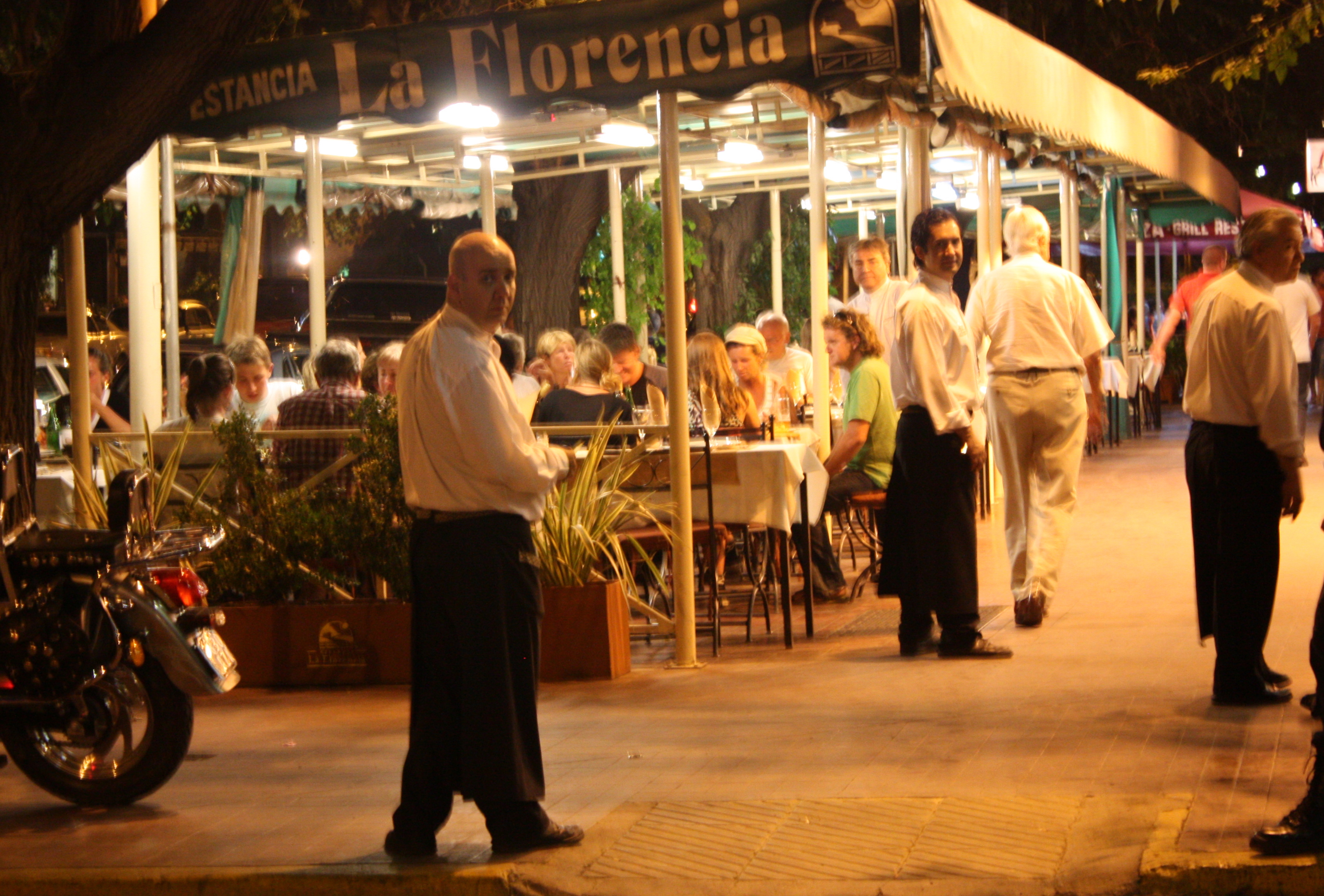
Streetside dining, Avenida Sarmiento, Mendoza

In contrast to B.A., where restauranteurs drag a few extra tables onto the sidewalk when the weather’s good, it’s clear that sidewalk dining is a fixture here.  Sidewalks separate restaurants from outdoor tables stacked three and four deep and covered by permanent-looking awnings with foul weather flaps neatly rolled up underneath. The main dining rooms are decorated in a casual brand of Old World elegance.  I lazily pick the one nearest to the hotel, where the menu runs a dozen pages and includes not only traditional Argentine dishes, but Continental specialties.  And then there’s the wine list, which runs even longer.  It’s ordered not by variety, but by local chateau, and I now know that I am in serious wine country.

Parched from the long bus ride,  I commit the ultimate blasphemy by first ordering a beer to quench my thirst.  The waiter arrives with a bottle of the local Quilmes that I swear is 750 ml large and served in an iced bucket as if it was champagne… along with a pair of empanadas that has also somehow sneaked onto my order.  I tell myself that I’m saving my appetite for dinner.  The crowd here is both young and old and clearly far more casual and laid-back than even in mellow B.A.  This place feels so much like Northern California that I wonder if some secret society of vintners stamps its cultural imprint on every place in which the grape is grown.  Think Big Sur or Mendocino with a gaucho twist:  Two tables down a striking,olive-skinned Latina in European designer glasses sits opposite a bearded guy in a plaid short-sleeved shirt , his baseball cap planted firmly over a bandana headdress.  Los viejos – the older ones – wear polo shirts beneath their sports coats.  If B.A. has wrung the pretension out of its European roots, then Mendoza has wrung from B.A. its essence, erasing the lines and leaving only the light and color as if in some Impressionist painting.

The empanadas hit the spot.  I apologize to my waiter for my poor Spanish, a tack which invariably earns both sympathy and magnanimity, before forging ahead.  I’m tempted to order una copa de vino – a glass of wine – but I can’t seem to find on the menu any selections by the glass and the price of a full bottle here is less than that of a tasteless Stateside flight.  I ask the waiter to pick me out a Malbec and for good measure to tack onto my order  two yet-untried flavors of empanadas.  He brings me a half-split that’s on par with the best bottle I’ve yet tasted Stateside. I spoon some killer salsa chimichurra over the empanadas, uncaring that it’s probably intended just for steak.  A joke spreads from the diners a couple of tables away to their waiter and from him to the next table and their waiter and to the table beyond.  This is decidedly looser than even mellow B.A. and I am enjoying the tableau as much as if I was a participant. I’m prepared to die at this moment a very happy man.

The empanadas have fallen short of absorbing the Quilmes + Malbec, but I’ve committed to the City Tour at 4 and I’m a man of my word.  I exchange names and shake hands with my waiter Mario, tip him generously, and haul myself and my fresh buzz back to the hotel.  All of this, incidentally, has cost me little more than US$15… with tip.

Parque San Martin, Mendoza

The City Tour turns out to be much more about listening to the guide lecture than about photo opps, which does not bode well for a gringo with bad Spanish and a camera, but it gives me the lay of the land for forays to follow.  It also includes a magnificent view of the city from a mountainside monument and one of the most spectacular metropolitan parks I’ve seen anywhere. Satisfying as my sleep on the bus may have felt, I’m apparently still running a sleep deficit because I’m catapulted into an impromptu nap as soon as I reach my hotel room; I emphatically deny that the Malbec had any part in this.

My “short” nap ends when I awaken abruptly nearly 4 hours later at 10:45PM.  In the States my dining options would now be limited to IHOP or Denny’s, but I am thankfully in Argentina.  I pop out onto the sidewalk where lights are blazing up and down the block and patio dining is raging at full tilt.  I’m torn between my newfound loyalty to the Estancia La Florentine and the equally tempting Giovanni’s across the street.  I rationalize that my La Florentine waiter Mario is now off-duty and that it’s not really cheating on him if I sample Giovanni’s, where the lighting is not quite as bright nor the tables quite as packed with large parties.

It’s late, so I pass over entrees like the quarter chicken – I’m certain that buried somewhere among the entrees is also a quarter steer – and take the easy way out. I graze my way tapas-style through a fistful of empanadas and some pumpkin soup.  Once again I do the I-only-want-a-glass-of-wine routine and once again I end up with a tasty Malbec split.  The empanadas – the spiced meat criolla is fast becoming a new favorite – are outstanding, but the pumpkin soup is exquisite.  As he clears the table my waiter asks how I like it.  I tell him more truthfully than he knows Spanish words fail me, and – arm outstretched – pantomime myself mainlining it directly into my veins.  He laughs at the crazy gringo, but I think he’s warming up to me.

Now the moment of truth has arrived:  To dessert or not to dessert.  It quickly become obvious that my waiter Diego’s practice of reciting the choices in Spanish isn’t going to fly, and we retreat to the menu where I pick out the flan de casera.  It is, however, not that simple:  I can have it con crema or con dulce de leche.  It’s already a foregone conclusion that before the trip is done I’ll have to return to the jogging trail at that magnificent urban park and do penance for the sins I’ve already committed, so I take the plunge and go for the dulce de leche.  I decline an accompanying coffee; these guys are purists who refuse to serve decaf and the gargantuan dollop of  dulce de leche containsenough sugar to keep me bouncing off the hotel room walls for the rest of the night.  And anyway it’s now past midnight and I leave at (OUCH!) 7AM for the High Mountain tour.  I ask reluctantly for the check and find that I’ve yet again failed to break the US$20 barrier, with tip.

My hotel is mercifully within eyesight of Giovanni’s, which is a good thing because the dulce de leche has just hooked up with the Malbec somewhere just south of my aorta and my brain isn’t quite certain if I’m coming or going.  I stand waiting in front of the elevator for the longest time until I remember that it’s one of those quant antiques which requires you to open a hinged door, pull back an accordion gate, and navigate yourself to your floor of choice. I have to remind myself to close the door and the gate behind me upon entering.

On the way up I replay the phone call received from the tour operator earlier in the day recommending that I substitute the High Mountain tour for the Canyon Tour.  It turns out, she tells me, that the photogenic clouds I saw on the bus ride here were the remnants of a storm that washed out some roads normally used by the Canyon Tour.  Then she blows completely past the TMI (too-much-information) threshold to tell me that as a result of the storm it took two days for them to retrieve the guests from last Thursday’s 1-day Canyon Tour.  Then she breaks her own freshly-minted TMI record to share with me that 4 casualties ( as in “mortalities”) resulted from a storm-induced the landslide.

I’m thinking that tomorrow morning I may forego my ritual cappuccino and instead get myself down to the local cathedral to light a few candles for them… and perhaps for myself.
I’ve previously travelled by bus into Mexico and there was pleasantly surprised both by the spacious seats and video entertainment of its premier class service, and by bus terminals that rivaled many U.S. airports in size.  This still left me unprepared for the scope and quality of bus service in Argentina.  (For the record, this overnight trip of around 600 miles with two meals costs approximately US$80.)

The B.A. Omnibus Terminal sits downtown very near the railroad’s Retiro Station and is a city unto itself.  When I arrive around 6:30PM for my 7:45 departure the crowds in the pre-boarding areas are heavy but orderly.  Dozens of shops, snack bars, and restaurants are doing a brisk business, and waiting passengers watch pay-per-view video at chairside kiosks. Outbound schedules for each departure lounge flicker across giant reader-boards, and arrivals and departures for the entire terminal appear on video screens everywhere.  The volume is awesome.  Just to display all current departures the screens must refresh three times. Upcoming departures are added and old ones retired every three or four minutes and only about 20 minutes pass between each new posting, so this is not a travel choice for the inattentive!

Through the lounge windows I see big tourist-sized busses parked side-by-side in angled rows as far as the eye can see in either direction.  If the crowd inside is heavy, the crowd in the boarding area outside can only be described as a quiet riot.  Out there is not a single unoccupied foot of pavement and processions of people making their way to each departing bus move like currents through the vast human ocean.  It is only possible to advance by pressing against those around you, and yet even here is the same Argentine civility I have experienced throughout my visit; voices are rarely raised and there is no shoving.

I check my larger bag with the curbside porter, tip him, and board.  There are two levels and my assigned seat is on the upper.  At the top of the stairs I do a double-take:  A broad aisle separates leather seats so wide that there are only three per row.  Every other row has been extracted to allow the seats to fully recline and leg rests to rise fully horizontal.  Large video monitors are scattered about and music videos are already playing as we await departure.

The bus pulls out of the station precisely on schedule, joining a throng of 20 or 30 others also outbound and passing a similar number inbound as it makes its way through downtown traffic toward the autopista.  A uniformed steward rises to make announcements, and then to pass the time spent in city traffic he distributes cards for what turns out to be a game of bingo.  He calls out the numbers in his best TV game show host tradition and the winning passenger is awarded a bottle of wine.  He passes through the cabin to take hot beverage orders for breakfast:  coffee, café con leche, hot chocolate, or cappuccino.

Once we’re on the autopista he serves dinner, first a cold plate and then a hot entrée and wine with refills.  Afterwards he cues up an English language movie with Spanish subtitles and sometime around 11 it’s lights out as we make our way through the very last of the suburbs.  Past my window roll the neon signs of motor hotels and Argentina’s ubiquitous parrilladas; I can almost smell the aroma of grilling beef through the glass.  Passengers around me have already pulled their curtains and from somewhere ahead I hear a gentle snore. I kick my seat into a prone position, tuck a fat pillow under my head, pull up a blanket, and nod off to the hum of the engine and spinning wheels.

I awaken from a satisfying sleep in darkness broken only by the line of streetlights stretching endlessly down the autopista median and small patches of light spaced in farmhouse-and-outbuilding clusters against the silhouette of a dead-level horizon.  As we move they are unblinking as they can be only on a treeless plain and I know that we are now crossing the Pampas.  From time to time we pass an ornamented gate and arch bearing the name of an estancia or a billboard picturing heavy farm machinery.  On rare occasion we pass through a toll booth. Near most exits are villages and many boast a light manufacturing facility; even in the darkness it is clear that there is economic substance here.  I doze off.

When I awaken the sunrise has already come and gone, but the sun is obscured by magnificently ominous, low-hanging clouds that run from horizon to horizon.  They’re not formed in bursts and billows, but in layered shades of gray and white that swoop and swirl like sand-painted snowdrifts.

The passengers are beginning to stir and soft American pop-rock drips through the speakers above.  The steward serves juice and pastries and hot beverages.  Outside the ceiling is lifting and the clouds brightening.  The grasslands have burst into sage broken by occasional stands of trees and truck farm patches.  The farmhouses have become more modest, the toll booths have vanished, and the highway has narrowed from four lanes to two.  Trucks and busses.  Trucks and busses.

The first, small vineyard appears.  An hour or so ahead lies Mendoza, and beyond it the Andes.

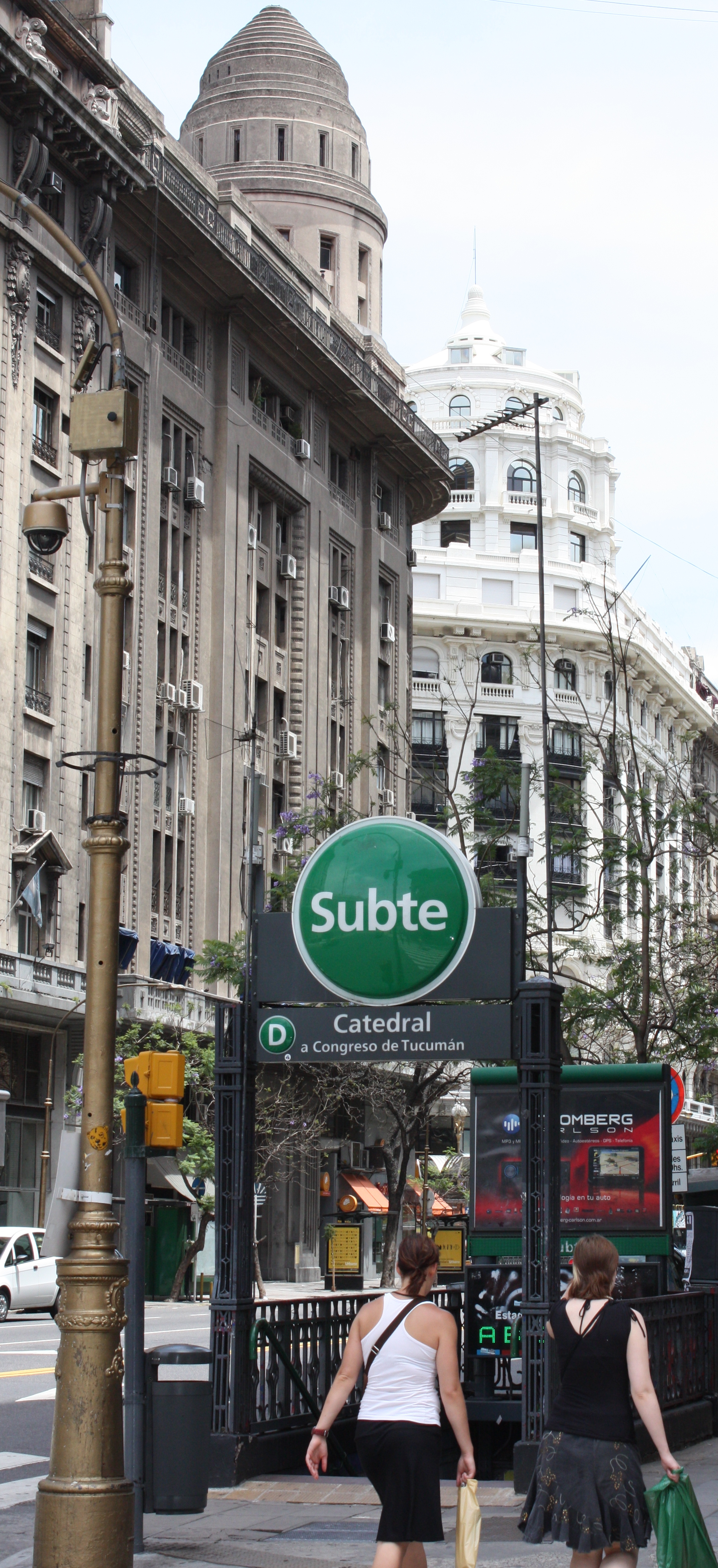
Catedral Subte Station, Buenos Aires

Yesterday I head for the first time in the opposite direction from downtown to Palermo, the only part of my B.A. Lonely Planet itinerary (find a “link to” at the bottom of today’s post) yet unexplored.  It’s not a moment too soon since I depart the city for Argentine parts west this evening.

As I’ve been doing for the past couple of days I take the Subte (B.A.’s subway) one way and walk the return.  This lets me pack more sightseeing into each day… it’s yet another way to experience more slices of B.A. daily life… and you can arrive by Subte within easy walking distance of every place visited in this blog except the international airport.  (There are instructions for riding the Subte at the end of this post).

The part of Palermo closer to the invisible coastline is dominated by large parks that include the zoo and botanical gardens and are bordered my multi-use high-rises (think Lincoln Park).   I arrive there via the Subte at the Plaza Italia station.  Palermo is such a large and varied neighborhood that it’s become widely known by subdivisions tagged with suffixes like Palermo Alta, Palermo Viejo, and neighborhoods now being recast as Palermo Hollywood and Palermo Soho.  Find the last pair of these about 10 blocks away from the coast.  I avoid Palermo Hollywood, where two new high-rise apartments are under construction.  In Palermo Soho the scale shrinks to a two-story neighborhoods undergoing the same kind of renaissance that’s already well under way in the urban U.S.  Here 20-somethings rent small, inexpensive flats, patronize hip shops and work out in hardbody gyms, and camp in outdoor cafés talking on cellphones and texting every bit like their Stateside counterparts.

Cheesy as it may sound I opt out of the zoo and botanical garden for the Museo Evita, a short walk from the Plaza Italia Subte station, and it turns out to be a good idea.

Museo Evita, Buenos Aires

It’s chock full of personal memorabilia ranging from clothing to the Peróns’ black Cadillac, and archival film footage is projected in several different rooms.  It’s all housed in an old Spanish colonial style mansion that’s worth the tour all by itself.  The intent of the curators to take a balanced political perspective is not lost even to my pidgin Spanish!

Museo Evita, Buenos Aires

Today is for taking a couple of photos thwarted by Wednesday’s clouds and overcast, to catch up on my writing, and to pack for the bus trip to Mendoza.  I regain an Internet connection only around midday tomorrow.


I recommend the LONELY PLANET BUENOS AIRES TOUR BOOK


RIDING THE SUBTE

The Subte operates around 17 hours daily and a trip – including unlimited transfers – runs about US45¢.   The ambiance is about the same as you’ll find on the Chicago El and as on each one of my walking tours you’ll feel quite secure unless you feel compelled through your dress or behavior to broadcast your tourist status to  pickpockets.  If you’ve never experienced a subway but are game to try, the rules are simple:

  1. Buy a magnetic fare card at the ticket booth in any station (this is not a good place to break your 100-peso note!)
  2. Know not only your intended station destination, but also the either-end terminals of your chosen train; it’ll keep you from traveling the wrong way, which is easier to do than you might think.  (There are system maps throughout every station and within every train car. )
  3. Note whether or not your platform is between opposing trains (white line through the station icon) or on either side of the tracks; it’ll keep you from standing on the wrong platform and missing your next train… or going the wrong way (see #2, above).
  4. Watch the TV monitors; they’ll tell you how soon your next train will arrive (I never waited more than 4 minutes)
  5. Check your bearings against a map for the first couple blocks after you emerge at your station destination; it’s quite easy to get turned around.

La Recoleta Cemetery, Buenos Aires

Beneath my blog pen name is an Italian surname with the requisite number of double vowels including a pair of “L’s”.  In much of  Texas where I now live and anywhere else that Spanish is widely spoken it is rare that these “L’s” are not mispronounced as a “Y”… except during my visit to Buenos Aires.  The reason, I suspect, is that nowhere else in the New World except the U.S. has been the destination of more Italian immigrants than Argentina.  Cappuccino widely appears on B.A. menus as “Italian Cappuccino,” and in the famed La Recoleta cemetery there is an Italian “neighborhood” of consequence not only because of its sheer size, but because of the many ostentatious monuments that speak to the early prominence and prosperity of Italians in Argentina.

While Argentina’s Italian connection has its nominal roots in Columbus’s discovery of the New World in 1492 and Amerigo Vespucci’s landfall within the following decade, Italian immigration in any significant numbers did not begin until nearly 350 years after Pedro de Mendoza founded Buenos Aires in 1536.

Italian restaurant, La Recoleta, Argentina

In no other nation do Italian immigrants seem to have had such an immediate and lasting impact.   While this is in no small part due to the industry and enterprise that they also amply demonstrated in the U.S., Italians had in Argentina a boost from a unique twist of geo-history.  Unlike in Mexico  and elsewhere in Hispanic America,  Argentina was occupied by no native populations of any size and its pampas geography made ranches a far more important element of rural economy than labor-intensive plantations.  The consequence is a distinctive absence of either indigent or African populations as any significant part of Argentina’s ethnography, which accounts in large part for its distinctively European character.  This Euro-centricity set a hospitable stage for the arrival of Italians in Argentina beginning  with the massive global Italian immigration of the 1880’s that continued for another 40 years.

The prominence of Italians in the Argentine mix also likely contributes to the unique reverence in which Columbus is held here.  Elsewhere in Hispanic America where sizeable indigent populations were nearly exterminated by European disease and slave labor, debate now rages about whether  Columbus is the first in a long line of Spanish criminals who propagated what we would call today a campaign of ethnic cleansing.  As these indigent populations increasingly prevail in the tortoise-and-hare race of assimilation, Argentina may ultimately become one of the few places in Hispanic America that his reputation remains pristine.

Italians in Argentina probably haven’t hurt Argentina’s drive to dynasty as a world soccer powerhouse, either;  B.A.’s rabid soccer fans bear a striking resemblance to those in Milan and Naples and it turns out that I share my Italian surname with one of the nation’s winningest soccer coaches.

In combination with a sizeable immigration of Germans that occurred in roughly the same period and Spain’s World War II neutrality, the high mix of Italians in Argentina also likely contributed to pro-Axis sympathies widely held by Argentinians during World War II.  But I digress.

Garibaldi Monument, Palermo, Buenos Aires

As Buenos Aires grew, it spread north and west away from its roots along the river port.  In response to epidemics spawned in the low-lying land along the water, its moneyed criolla families left these original B.A. neighborhoods to poor immigrants just as they similarly fled Manhattan’s Lower East Side .  The La Boca neighborhood and its El Camionito district were central to the Italian immigrants, where they worked as manual laborers on its port docks and in its meat-packing plants.  It was here that tango began as a bawdy, working-class phenomenon that over the years has acquired in its maturity a respectability which has enabled it to become a national trademark known worldwide.

Also as they did in America, Italian immigrants moved to the suburbs as they prospered, and that legacy survives today in the naming of the Palermo district that abuts the La Recoleta/Barrio Norte neighborhoods.

History, it appears, is not as original as we sometimes think.

If you’re like me you may have found the 1982 Falklands War a bit of a head-scratcher.  Did the Argentines really think that the Brits were going to let them just simply take possession of the Falkland Islands and forget about it?  Did they really think they could hang onto the place if the Brits didn’t?  Any why – despite an otherwise long history of friendship, commerce, and cultural exchange between these two nations – did things suddenly turn so nasty over a dispute that existed as little more than diplomatic posturing for nearly 150 years?

In an echo of  an all-to-familiar theme, 1982 became the year for war because it was the last refuge of an oppressive military regime that had worked Argentina into an economic crisis and needed a popular diversion.  It would, however, be a mistake to assume that the war was afterward swept under the rug along with the deposed generals when democracy returned to Argentina.  For the record, Britain’s 1833 occupation of the islands had its roots in a fishing rights dispute, and – not unlike America’s War of 1812 – came at a time when a fragile new Argentine republic was especially vulnerable to the Empire’s military might.

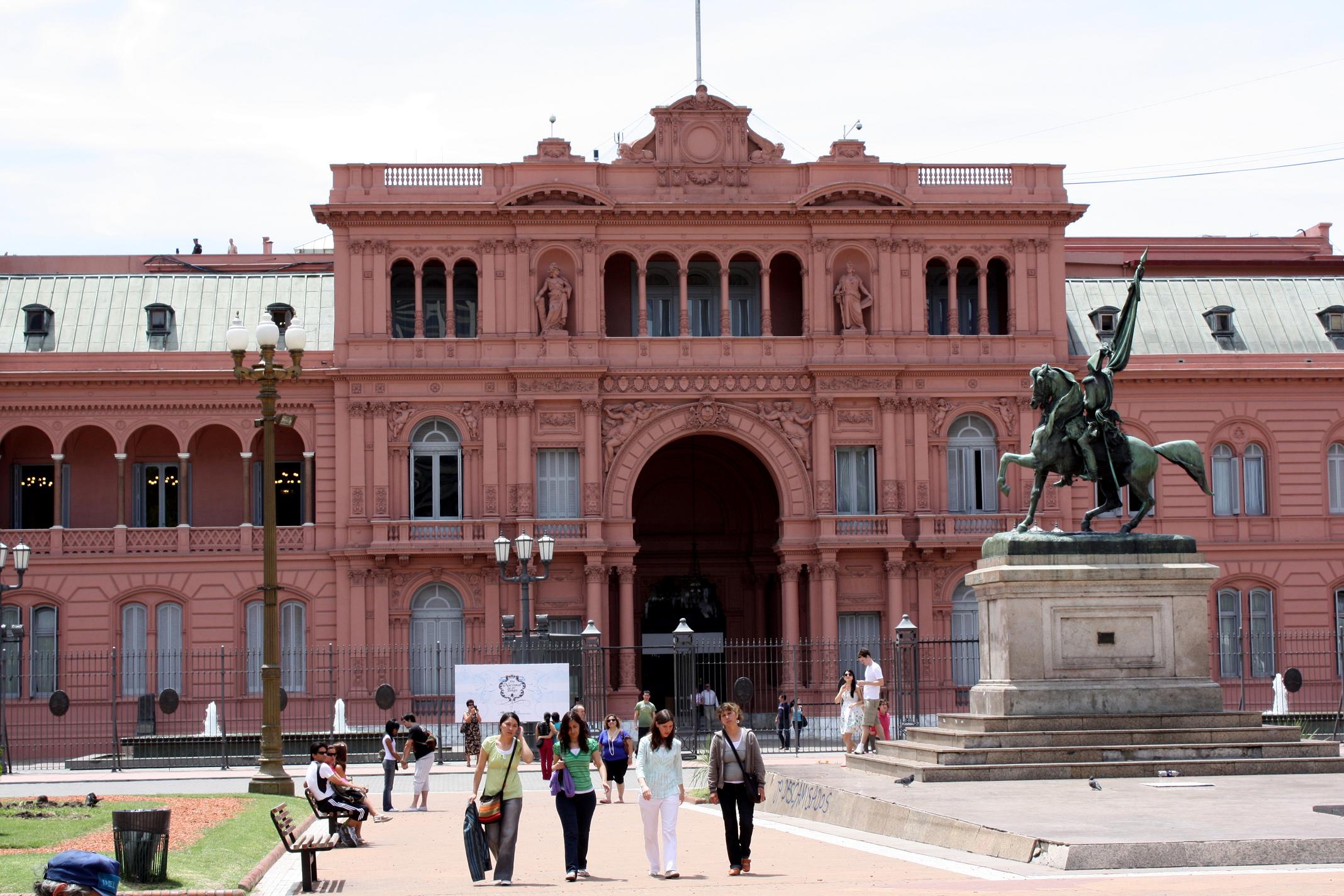
As I walked on Sunday around the Casa Rosada, Argentina’s White House, I noted among the many banners hanging on the surrounding fence one in support of the veterans of the Guerra de Malvinas.  I’ve since seen posters referring to associations of – and assistance to – Malvinas veterans, but I saw today the most graphic example of the national sentiment which lent itself so easily to the generals’ manipulation.

Remember that Argentina is a place where polo rivals soccer as a national sport… where a B.A. outpost of London’s famed Harrod’s department store was a longtime icon… and where English names crop up so frequently among Spanish in the pantheon of local notables that you’d think you were in Gibraltar instead of Latin America. Beginning in the 1880’s and continuing well into the 20th century, the British contributed by far the lion’s share of the foreign investment capital that fueled Argentina’s economic growth.

Torre des los Ingles, Plaza San Martin, Buenos Aires

Running through the heart of B.A.’s chi-chi Retiro District – separating neighborhoods that feel amazingly on one side like Manhattan’s East Side Midtown and on the other like its Upper East Side is a beautiful urban park that’s technically four grassy plazas laid end-to-end.  Here the Malvinas dispute is played out as if on some life-sized Monopoly board.  From the center of the Plaza Fuerza Aérea Argentina rises a 250-foot clock tower that looks like it belongs in colonial Williamsburg.  It was a gift of the city’s British residents to their adopted city that has stood since 1916 and was until 1982 known as the “Torre de los Ingleses.”  During the Falklands – er Malvinas – War the authorities actually thwarted plots to topple it with explosives and it has ever since been the popular target of desultory graffiti.

Just opposite it on the  Plaza San Martin stands the Monumento a los Caidos de Malvinas.  A monument to those fallen in the Malvinas War, it was dedicated only 8 years after the conflict in 1990 by a popularly elected, post-junta government.  Here an eternal flame is raised above a wall constructed in the fashion of the U.S. Vietnam Memorial and upon which are mounted side-by-side plaques bearing the names of more than 600 casualties.  The wall itself is painted a color that can only be described as blood red.

Malvinas War memorial, Plaza San Martin, Buenos Aires

As I stand between these two monuments, I cannot help but recall standing in the shadow of the Eiffel Tower on the Champs de Mars opposite the Ecole Militaire de Saint-Cyr, France’s equivalent of West Point, where sits just as paradoxically the Peace Monument erected in 2000.

America claims to have bars and eateries where “everybody knows your name,” but they are increasingly franchised chain clones with faux historical decor, uninspired menus, and rotating casts of alternately self-absorbed or mechanically detached managers and waitstaff.  America, in fact, has already passed the tipping point beyond which there are more chain restaurants than “mom and pops”.  Everywhere else in the western world foodservice means locally owned cafés  and bistros which often serve three meals daily, where food is freshly prepared and reasonably priced, where the staff and ownership have remained unchanged for years, and that have truly acquired the status of neighborhood institutions.

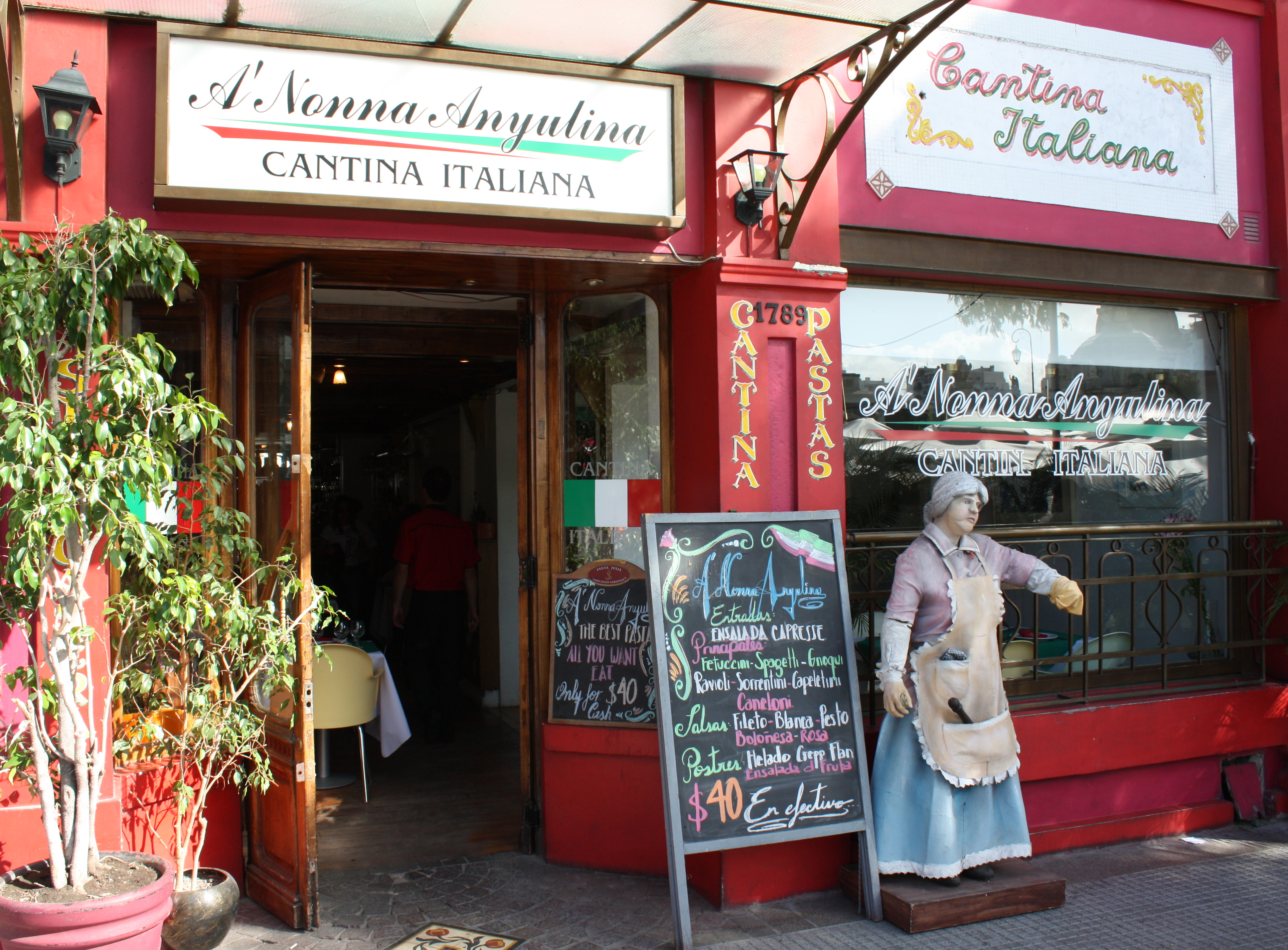
Plaza Dorrego Cafe & Bar, San Telmo, Buenos Aires

In Buenos Aires these are called “confiteria,” and you’ll find one at or near virtually every street corner.  As my B.A. immersion deepens, I find myself more often starting the day there with an espresso or cappuccino, grabbing a light midday snack, or occasionally taking an evening meal.  It’s another great way to experience a daily slice of Argentine life and to observe and better understand the B.A. psyche.

These places seem to cut across social classes in a way that establishments in nominally classless American society increasingly do not.  During morning rush hour a suited businessman can often be found seated at a table next to a store clerk wearing her workplace smock.  This leads me to reflect further upon how common it is in B.A. to see people wearing workplace uniforms to and from work in a way that Americans haven’t since the 1940’s. For one thing, trade unions remain a powerful force in Argentina as in other social democracies, and the right to a lifelong job is still widely and successfully sought after as a political right.  In contrast, American workers seem increasingly to see their jobs as a transient part of their lives, and at best peripheral to their identities.

But there may be even more to it than workplace identity.  I am struck as I walk among literally thousands of pedestrians every day by the singular absence of affinity-branded clothing among porteños.  Rarely if ever to be seen are shirts with pro sports or college alma mater logos, political slogans, political incorrectness masquerading as humor, or variations on the “I’m-a-bad-boy-and-that’s-a-good thing” theme.  It’s as if Argentines have an inner compass that lets them feel secure in their personal identities without the need to label themselves and broadcast it on their chests.  While the chic shops carry the latest from European designers, porteños’ choice of clothing most often has an understated sense of style that seems to place a higher value on timeless fashion than on here-today-gone-tomorrow trendiness.

This sense of self and balance seems also connected to a different sense of time.  I am struck as I move around the city by the singular absence of clocks on public buildings and in shops and restaurants. This place hustles and bustles from 9 to 5 in a way totally unlike the sleepy, banana republic version of Latin America, but it is not a nation of clock-watchers.

What a contrast this is with the Japanese, who  often seem determined to out-do Americans in their embrace of rock ‘n’ roll music, golf, Western fashion, and the longest white-collar work week in the world.

The New World seems so often  to have freed transplanted European culture of its most onerous confinements to make it more open and easy-going.   One can’t help wonder, however, at the different turn that metamorphosis has taken 40 degrees north of the equator than it has here, 40 degrees south of it.

Working class heroes

Vibrant, blue-collar La Boca and bohemian San Telmo are among the neighborhoods most often touted as B.A. must-sees.  I set out this morning on foot to add them to my mental scrapbook, retracing much of yesterday’s route to the Micocentro and past the Puerto Madero warehouse/marina district.  I’d otherwise bypass the crowded, cheesy pedestrian mall along Lavalle and Florida, but it seems like the place for a guaranteed score  of the  sunblock and cheap hat that are today’s first order of business; yesterday’s light breeze and balmy 70’s temperatures lulled me into a suspension of disbelief that December in B.A. = June in Dallas and I awake this morning just one stop short of a full-blown sunburn.

Bu the time I pass the Casa Rosada temperatures are pushing into the 80’s and at mid-day there is no longer a shady side of the street.  I apply my sunblock and dodge beween  porticoed sidewalks and shaded parks still in search of a full-brimmed hat.  As I pass Independencia headed southbound on Defensa the mid-rise buildings shrink to a more human scale and the architectural clock turns back a good 50 years.  Block by block, hip little shops begin to outnumber graffiti-covered vacancies, and in one of them I find a straw-colored fedora in tightly woven cotton with a breathable mesh crown, impeccably stitched.  The price of this little item in the States would start at US$50 and could easily run double that, but here it costs US$20 and change.  This place is turning me into a sale-a-holic and it frightens me, since I normally refuse to shop for clothing until something in my closet has disintegrated beyond repair.  In fact, were it  not for the internet, my fear of retail clothing stores would have turned me into a nudist years ago.  But I digress.

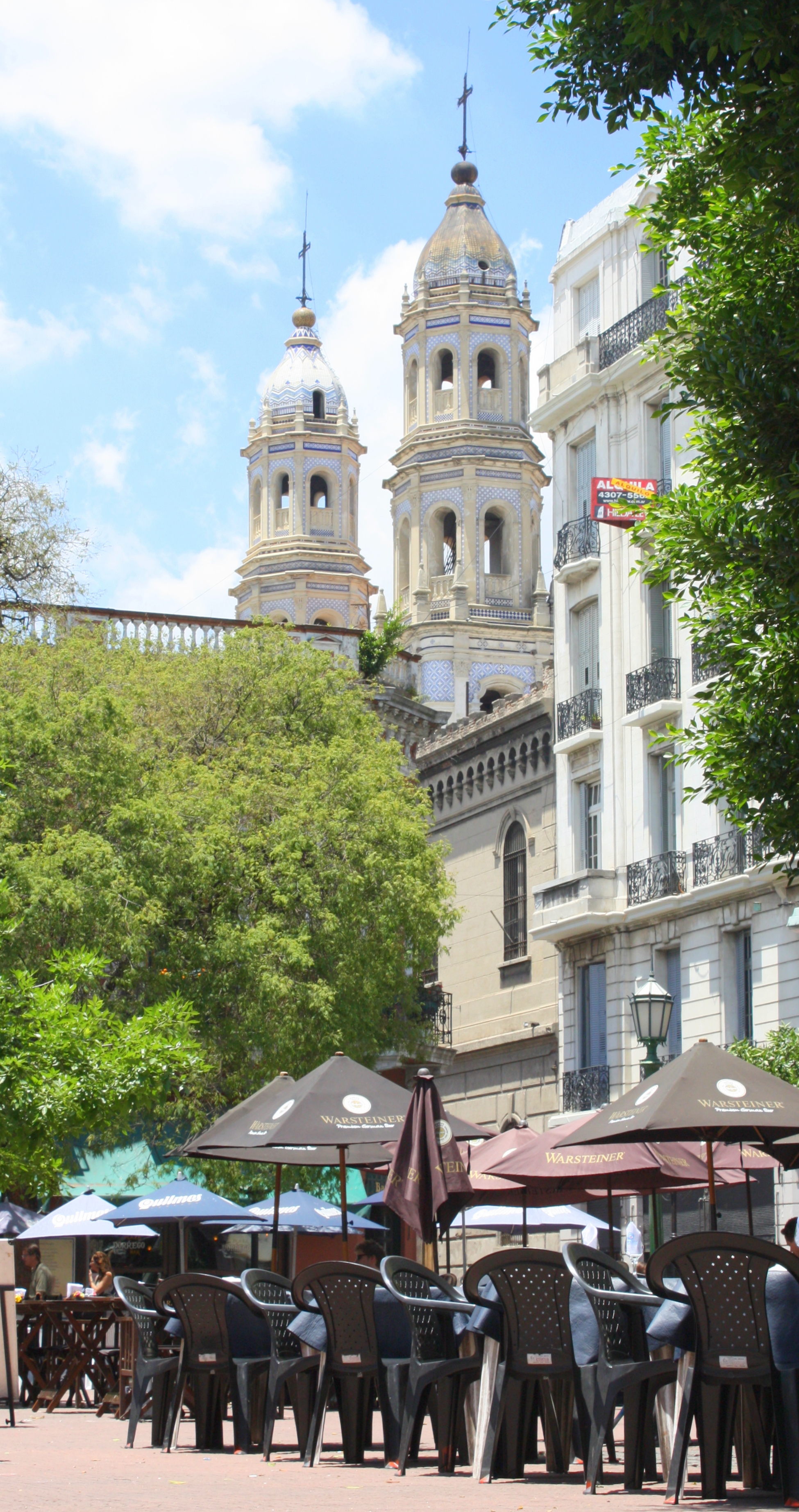
Plaza Dorrego, San Telmo, Buenos Aires

Only a couple of blocks past the hat store I find it:  A little gem of a square called Plaza Dorrego.  Restaurants on each side have carved out their fiefdoms of umbrella-covered tables, and chalkboard easels present their bills of fare.  I’m guided reluctantly to a table that seems too far from the photographic action, but the waiter – only the third black man I’ve seen in the entire city in three days – is forgiving of my paltry Spanish and graciously steers me through the menu.  Just when I fear that I may have become terminally beefed-out in this land of the gaucho, it leaps off the menu at me in a forehead-slapping moment:  CARPACCIO!  This one comes under a mountain of fresh spinach and a grated local queso blanco.  I round out the order and pull out a map to check my bearings while I wait.

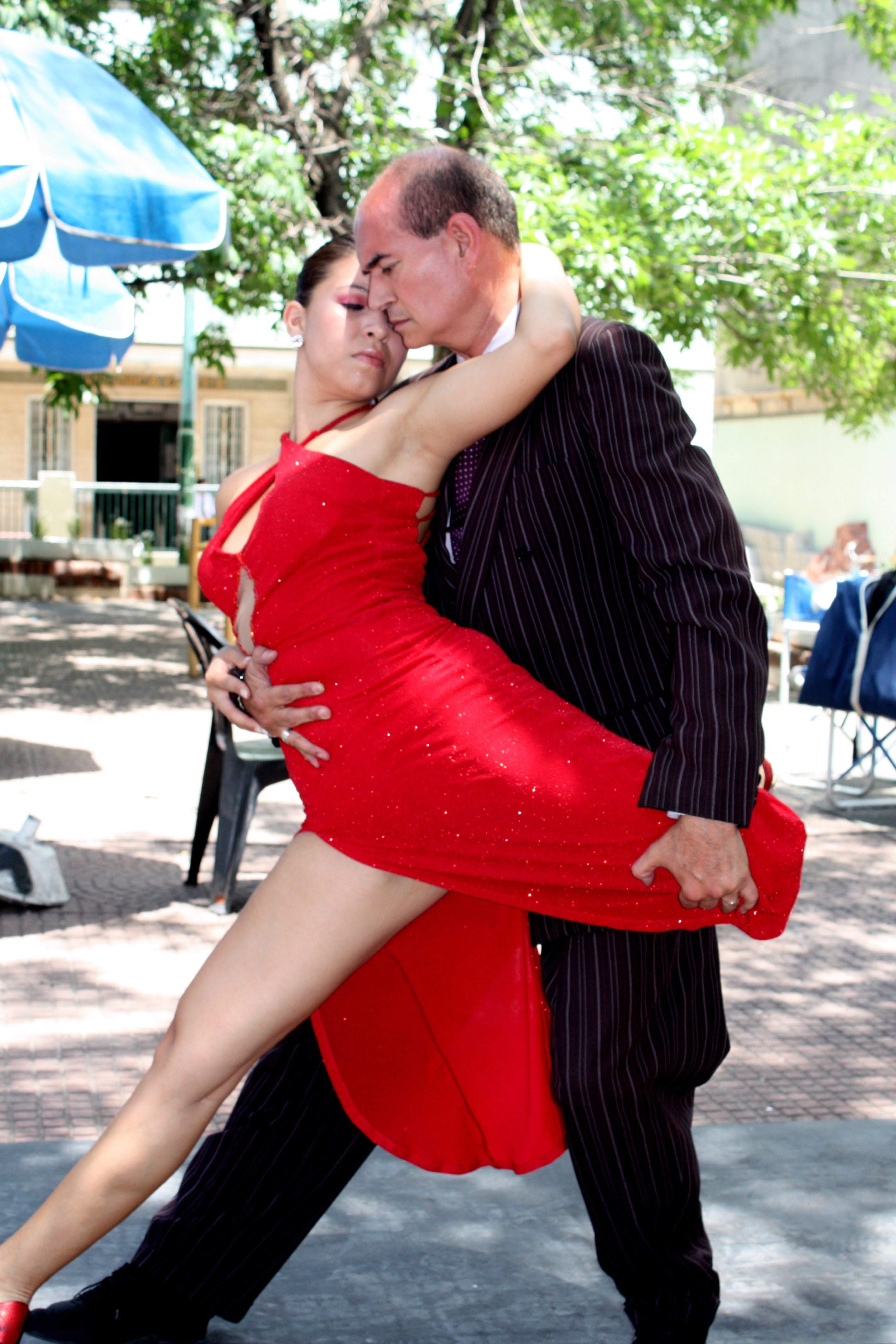
I should have seen it coming, but I am too engrossed in the passing sight of a shapely, dark-haired, dark-eyed young woman in a tight-fitting, bright red, calf-length skirt slit almost to the bikini line in several places.   As she passes into no my-longer-looking-but-ogling range, I shift my gaze to an interesting character who has stepped to the center of a clearing among the tables, carefully picking and preening a double-breasted, pinstriped burgundy suit that looks like it came straight out of the wardrobe of a production of Guys & Dolls.

Tango dancers, Plaza Dorrego, San Telmo, Buenos Aires

Suddenly tango music begins and the pair walks slowly and deliberately toward each other from opposite ends of the clearing until they are locked in an inseparable embrace.  Their expressions are frozen and their backs ramrod stiff.  He seems to pivot right and left from the  backbone, legs rotating like axles from somewhere below the hip.  She wraps herself around him again and again like a banner flapping in the wind, long legs hooking around him hip-high before sliding down him like he was a greased pole.  The footwork is delicate and yet rapid-fire, leaving no more than millimeters between them and a nasty fall… or a painful knee to his crotch.  The entertainment ends to a round of roaring applause and the young lady walks her partner’s hat among the tables for tips.

My cool peach liquado arrives and not a moment too soon.  Then comes the carpaccio salad along with a side of empanadas that somehow crept into my order.  In other countries, these come stuffed with your choice of just about anything imaginable, but here in B.A. the menu says simply “empanadas” because – you guessed it – they come only in beef except otherwise (and probably at peril of your life) specified.  In other countries they’re also known to arrive deep-fried, but this baked crust is such a work of art that for a moment I’m actually embarrassed to wolf it down.  It looks like it was crimped by French pastry chef and it’s golden brown without a burn mark anywhere.  I bite into it and it’s flaky throughout, which is amazing since the steaming juices from the minced beef are sealed inside.

Argentina is clearly seeping much more quickly into my consciousness than I had ever thought possible:  I’ve now managed to find a way to eat beef for two courses of the same meal.  Dare I next attempt a trifecta?

Plaza Dorrego Cafe, San Telmo, Buenos Aires

La Recoleta cemetery


Call it ghoulish if you like, but cemeteries have become a must-see item on my foreign travel itineraries.  It began a few years ago with a visit to the incomparable Père-Lachaise Cemetery in Paris, and I won’t lie to you:  I didn’t go there to see the graves of  Molière, Modigliani or Proust, but rather the grave of Doors front man Jim Morrison.  An important lesson learned there, though, stayed with me.  The world’s great cemeteries are time capsules, and through their architecture and inscriptions we see not just those buried there, but their cultural and family context.


La Recoleta Cemetery in Buenos Aires is more than the burial place of Argentina’s beloved Evita.  It is a snapshot of the city’s coming of age in the late 19th and early 20th centuries.  Like Père-Lachaise, La Recoleta is an urban cemetery chock full of notables.  Unlike Père-Lachaise it is compact in every sense of the word.  Most of the burials occurred in 50 years or so beginning around 1880 and there are no expansive spaces here; only mausoleum crypts packed cheek-to-jowl in a style very reminiscent of New Orleans. With few exceptions the architectural styles are similarly confined to themes and symbols prominent around the turn of their century.  As with Jim Morrison’s grave, the Duarte family crypt containing Eva Perón’s remains is quite modest.


Evita's family crypt


Also as with Jim Morrison, Evita’s celebrity overshadows those of others as highly revered and in their own ways at least as accomplished, including boxer Luis Firpo, the “Wild Bull of the Pampas” best known for his celebrated bout with world heavyweight Jack Dempsey.  Evita has a plaque; Firpo has a life-sized statue.


Only a stone’s throw away at the edge of a sprawling municipal park along Libertad I stumble upon a magnificent city fair at which artisans in wood, leather, and glass displayed their wares.  The quality and range of craftsmanship was stunning, and the mood of the place is equally uplifting.  Young people gather in small clusters on surrounding grassy knolls, talking and playing guitars, and the overall feeling is a sort of flashback to 1967 San Francisco.  Followed by my obligatory steak – tonight twin, butter-knife-soft beef loins – and Malbec, it is a great way to end the my first full day.


I take advantage of Sunday morning’s traffic lull to visit the obligatory Microcentro tourist sites. At the risk of sounding jaded, I find from city to city a certain repetitiveness to the church-government-monument school of tourism and if you hanker for the details of these in Buenos Aires there are plenty of tour books that will ably meet your need.  The national cathedral, the inevitable cabildo seat of Spanish colonial government, and the Casa Rosada contemporary home of the chief executive all conveniently face each other across the Plaza de Mayo.


Casa Rosada


(I catch myself wondering about the paradox of a Latino machismo culture that houses its chief executive in an edifice named, literally, “The Pink House”.)


At least as interesting to me are the sights, sounds, and aromas encountered in the course of getting there and back from my apartment.  I stick – as whenever possible – with a pedestrian point of view, which makes for a round trip of about 5 hours.


Avenida 9 de Julio


First there is the magnificent Avenida de 9 Julio, a broad boulevard for which opposing traffic is separated by a wide and beautifully landscaped median that was flowering wildly in this Argentine summer month of December.  My impression of it as reminiscent of the Champs-Élysées is punctuated by the obelisk monument at its intersection with the Avenida Corrientes.  Americans think instantly of its twin the Washington Monument, but it recalled for me also the Luxor Obelisk in the Paris’s Place de la Concorde.


Next I encounter mid-street on the Avenida de Mayo – blocked off on this Sunday for foot traffic – an impromptu demonstration of the tango.


Street tango


Tango always recalls for me flamenco in its stylization, but while flamenco dancers of opposite sexes meticulously avoid contact even when within a hairs-breath of each other, tango dancers are sensuously bonded at every step.


Behind the Casa Rosada I’m attracted by towering skyscrapers in the midst of which are the first construction cranes seen since my arrival.  At their feet on the riverfront I find a renaissance neighborhood of loft apartments, restaurants, and marina not unlike those also making their appearance in the States.


The district is called Puerto Madero. After half an hour or so, the mood is shattered when I come across a Hooter’s franchised restaurant and I beat a hasty retreat.


Puerto Madero


Only a block from the urban Galleria Pacifico, a recent-model mall mercifully integrated into the structure of older adjacent buildings, I see a sight all too familiar in the States:   a shuttered downtown department store.  Upon closer examination, this one reveals itself to be the once-revered Harrods, and I paused in a moment of silence for this vanquished legacy.


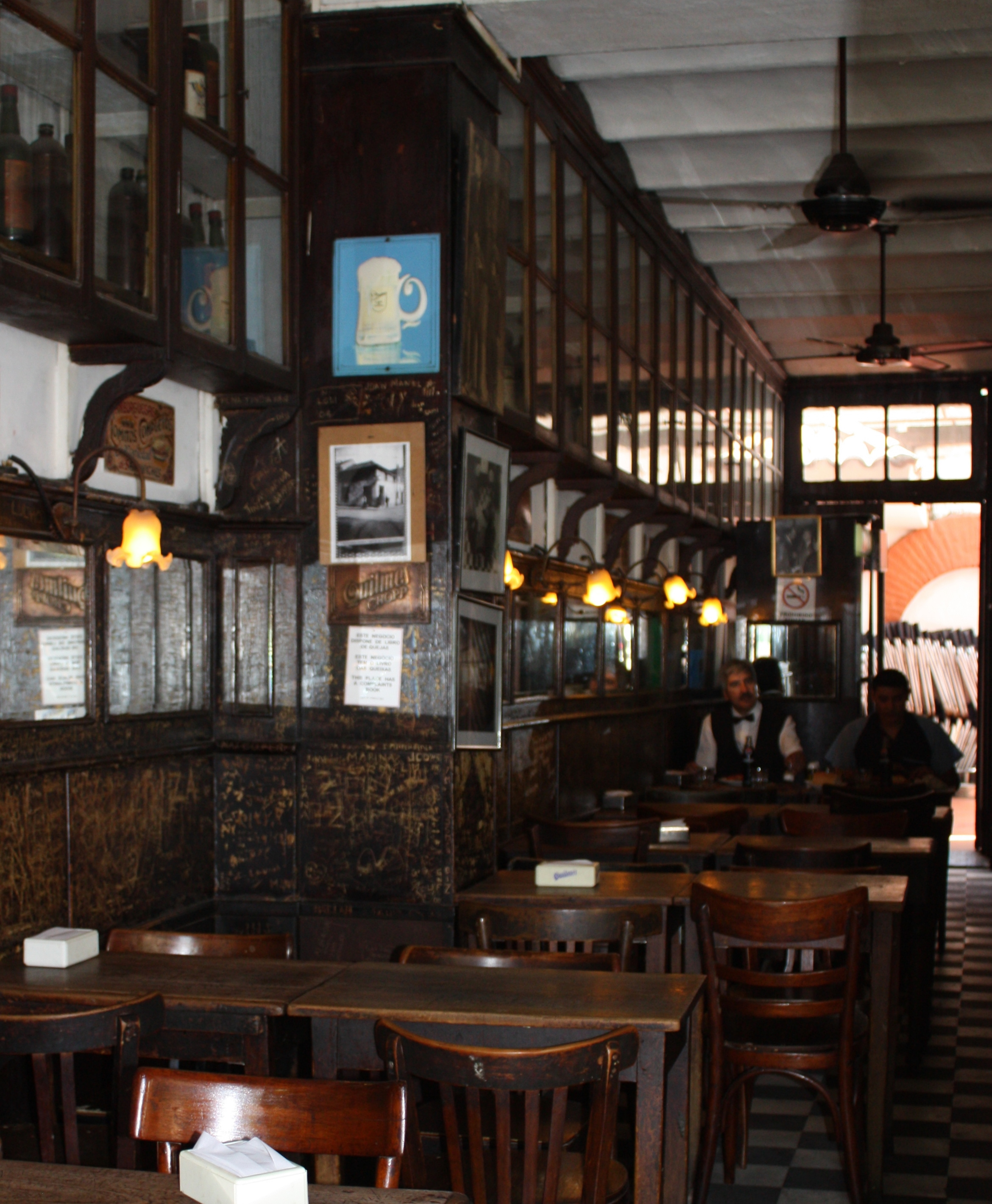
Last, but certainly not least, is the Café Tortoni, a Buenos Aires tradition dating back to 1858.  Starbucks’ owners would blush with embarrassment at daring to call their places coffee houses if ever they set  foot in this place.  Café Tortoni harkens back to an era when artists and activists gathered in coffee houses to share and debate news and literature and politics.


Cafe Tortoni, Buenos Aires


The decor evokes a Victorian drawing-room.  Fluted columns rise to a high ceiling where light breaks through art nouveau stained glass panels.  Tiffany-style lamps are scattered about like confetti.  Dark paneling infused with a century and a half of cigar smoke lines the walls and encases the massive centerpiece bar.  Most of the wall space above the paneling is covered with paintings and photos of celebrity patrons.  The most notable of them appear at eye level as bronze and plaster bas-reliefs. Granite-top tables are encircled by heavy oaken chairs upholstered in red leather long ago worn to dark burgundy by the press of countless bodies whose shoes have worn rutted footpaths into the stone floor.  Black-jacketed waiters in white shirts and black bow ties look to a man as if they have worked here for their entire lives.  My waiter wags a scolding finger at my Canon and its obtrusive lens even as flashes from tourist pocket cameras are going off behind him.  I order a Cappuccino Italiano and churros, and pull out my notebook to write this picture.

The economic roller coaster that Argentina’s been riding in recent years has a silver lining:  It may at this moment be the only civilized place on the planet where the American tourist dollar still has big clout.

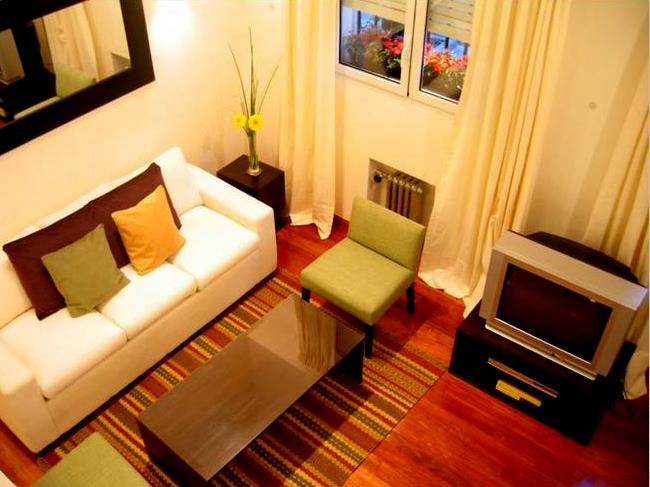
La Recoleta rental apartment

La Recoleta rental apartment

It’s almost an embarrassment of riches.  A taxi ride from the airport that would cost just well over US$50 anywhere else weighs in at well under US$35.  My first evening’s dinner – which includes a boneless steak the size of a New York strip on steroids and two glasses of the priciest Malbec on the menu, comes in at just about the same price.

La Recoleta apartment rental

La Recoleta rental apartment

My pied-a-terre – a neat little apartment in the chic Recoleta neighborhood with full kitchen, loft, wi-fi, cable, local phone, and night doorman – runs barelymore than US$100/day.  None of this would raise an eyebrow for any third-world tourist destination, but I am quickly finding that Argentina delivers a remarkably European experience at banana republic prices.

The embarrassment part comes from noting on the ride into town that – notwithstanding the absence of street people or other obvious signs of hunger or unemployment – there appears to have been almost no new construction here in a good 20 years, and the exteriors of too many buildings look like they’re 4 or 5 years behind on their last coat of paint.  While things here don’t even remotely resemble the backward slide of depressingly faded Odessa in the former USSR and look a hell of a lot better than metropolitan Detroit, it’s also clear that the economy has been in an extended stall.  Perhaps the real silver lining is that B.A. is clearly inhabited by people who have clung tenaciously to a joie de vivre and sense of style despite all obstacles.

The airport taxi whizzes along a thoroughly modern autopista amid only moderate traffic to deliver me downtown in little more than 20 minutes, but it takes nearly twice as long to travel the final 5 miles through congested downtown traffic that made rush hour on 5th Avenue look like an orderly evacuation.

Along the way we pass subway stations of the several lines that criss-cross the capital, beautiful parks and classic monuments, and the distinctively Latin American incongruity of a Pierre Cardin storefront abutting a staircase door leading up to the headquarters of the local Communist Party.

We also pass through the intersection of the Avenida Juan Peron, leading me to reflect on the seeming paradox of Continental cultures now considered bulwarks of democracy and civil society that have also bred some of the 20th century’s most heinous dictatorships.  Peron was actually quite tame compared to the cabal of generals who followed him at the decade’s end to create tens of thousands of the Disappeared.  It took the French the better part of the century following their Revolution to get democracy right, and it took the Americans to seed it firmly in Germany, Japan, and Italy.  Is it culturally insensitive to observe that democracy seems in its most successful incarnations always to have in its DNA a sturdy Anglo-Saxon thread?

The La Recoleta neighborhood lies not far from  B.A.’s Microcentro” ground zero, and it is one of those glorious old Belle Époque era neighborhoods that retains its sense of elegance and charm, a grand dame weathered at some intersections a bit by the passage of time but nonetheless still a very classy lady.   It reminds me instantly of Paris’s Montparnasse, the upper end of Barcelona’s La Rambla, or Rome’s Via Veneto.

I’ve always had a disdain for chain hotels that keep foreign visitors tethered to a sort of Epcot Center experience.   Beginning with a visit to Paris almost a decade ago I quit staying even at quaint boutique hotels and instead rented for the first time a small apartment. It was gloriously situated just a block off the intersection of St. Germain and the Boul Mich, and I’ve been hooked on the foreign apartment rental experience ever since.

This time I reach out to the folks at Buenos Aires Habitat (found them through TripAdvisor) and I couldn’t recommend them more highly.  Tomas – who recently completed his PhD in tourism and who speaks impeccable English – greets me upon arrival and walks me through every detail of the apartment and the surrounding neighborhood with the care of a good friend lending me the keys to his place for a long weekend.  Delfina – whom I’ve met only via email but talk with by phone shortly after my arrival – guides me here from the States with the presence of an air traffic controller talking a pilot down for an emergency landing.  Her associate Eugenie makes complete arrangements for a side trip to the Mendoza wine country later in my stay and drops by to personally confirm arrangements.  Tickets and drivers to/from each site and transportation hub are all arranged.  It’s pretty much like the very best concierge service… except delivered as a house call.

I have to confess that I cheated my effort to switch fully over to local time on the first day and instead grabbed a short nap late in the afternoon.  Eugenie had recommended a bistro only two blocks away for a light meal and her intuition was yet again perfectly on target.

The restaurant Liber strikes me instantly as one of those perennial local favorites which seems to have an offering appropriate for every time of day and every occasion; I shortly learn from my waiter that it is open 24/7.  Tables between sidewalk and curb are covered end to end by the structure’s overhang to create a sort of outdoor dining gallery where all tables are empty as I enter around 9 thinking that a slight evening chill has driven everyone inside.  The place is bright, but the light is warm and inviting as the dark and well-worn paneled bar and cabinets.  The floor is a pattern in fitted stone broken unobtrusively by colored tile designs.

I pick out a corner table well-positioned for people-watching and I am not disappointed.  I am upon entering one of three lone diners later joined by another, the lot of us spread across 20 years or more in age.  By evening’s end one leavest accompanied by a woman with whom he has clearly scheduled a rendezvous and the other finishes reading a stack of the day’s papers.  The remaining tables are occupied by mix of couples, a girls-night-out trio of middle-aged  ladies, and mixed companies of friends.  It’s clear that this place has its regulars.  By the time my meal winds down, the patio begins to fill up – also with apparent regulars – in the Spanish tradition of late night dining; apparently only this lone Yanqui feels any chill in the air.

I’ve already recounted early on a bill of fare that ends with perfectly brewed cappuccino, but the account would not be complete without mention of an eye-popping display of elegant, freshly-baked pastries ranging from delicate petit-fours – served gratis with after-dinner coffee – to  elegant cakes.  It may be the first time I’ve been able to resist such a mother-load of carbs and I feel on the morning after somehow cheated by my restraint.

Tomorrow I’m posting a walk through historical sites titled Links to a Buenos Aires past

The sky has already gone black and the air is crystal clear as my plane points its nose up the East River on the approach to LaGuardia.  Above the Battery I can see amid the lights of lower Manhattan a muted pocket where the twin towers once stood.  Chinatown and Little Italy and Greenwich Village are pinned to a catty-corned grid that butts anarchic against Midtown’s stolid blocks.  Empire State and Chrysler Building beacons sit stately between them and the dark patch of Central Park.  Far beyond corporate jets spiral upward and downward around Teterboro and the lights of Yankee Stadium curiously blaze long past season’s end.  I linger not long in LaGuardia’s cramped, familiar spaces before I jump the shuttle to JFK .

It must be close to 10 years since I last strolled through Kennedy, its bright and modern and expansive and polished spaces a sensory-rattling contrast with those of  its older cousin.  (Does anyone still remember when it was once named Idlewild?)  JFK concourseSliding walkways course down medians of broad pedestrian boulevards past duty-free shops as world-wise passengers wait sagely in spacious lounges, well-mannered and well-dressed.  My Spanish-speaking America has until now ended at the Caribbean, where dark eyes and brown skins and flat, broad noses of native ancestors run like a thread through tapestry seas of faces.  The faces of this evening’s Argentine human cargo almost without exception recall instead those from the streets of Milan and Barcelona and Vienna and Alsace; there is in them only the Old World.

As we await departure the Cleveland Browns are – much to the surprise of almost everyone – beating up on the Pittsburgh Steelers and my Ohio childhood flashes back as the camera cuts away to lakeside stadium light exploding into a night sky bordered by the the stack of Terminal Tower windows.

Flying to Europe is like running out to the 7-Eleven compared to the flight from New York to Buenos Aires.  Inside the cocoon of the wide-bodied hull, the dining auditorium has dimmed into a dormitory dotted here and there by bright seatback video screens.  Outbound airplaneThe line on the digital flight map sunk into the seatback facing me creeps for long, dark hours over unseen ocean before we at last slip past Puerto Rico and the Windwards.  Ahead is Venezuela and the faded, flanking memory of Jonestown, Guyana.  Beyond them are only vast hours of rainforest and totally unfamiliar names as we sail like Columbus reborn past the edge of my known earth.

It is totally out of character for me to drink coffee after noon – or to consume much caffeine at all – but just before departure I ingested a generous cup of the real deal at JFK’s Juan Valdez Cafe Juan Valdez cafe JFKin an attempt to shock my biorhythms into synch with those of nocturnal Buenos Aires.  As the caffeine courses through my veins I surf the seatback video menu into the wee hours until I finally doze off into fitfull sleep.

Upon my awakening soft white light leaks through the cracks at the bottom of drawn window shades.  Below us the rain forest cloud canopy rolls from horizon to horizon like densely packed gray cotton.  The Amazon River already lies three hours behind us as the toy plane on the seatback map speeds over verdant forests and the rugged tan wall of the Andes rises a thousand miles to the west.  Buenos Aires lies yet three hours ahead and two time zones east of “Nueva York”, where my errant baggage awaits the next flight out in chase.

The seatback screen says that we are eight miles high and that outside the temperature is minus 60 degres Fahrenheit.  I once read that skydivers with failed chutes die of heart attack long before they hit the ground.  Through my mind now passes the question of whether a man falling from this height would first die of suffocation in the thin air, and if his flash-frozen carcass might shatter on impact.

We pass over Asuncion, Brazil and the dense, rolling clouds have Air mapbecome an opaque haze. The plane on the seatback map makes a turn and in its horizon view Buenos Aires sits on the wide mouth of the Rio Plata estuary across which Juan and Eva Peron once fled Argentina before their triumphant return.    We descend over the dense metropolitan sprawl in a wide arc that carries us out into the countryside and at last down to the tarmac nearly an hour from the heart of the city.

Tomorrow I’ll post my Buenos Aires first impressions