Latest Entries »

Too many stateside Americans have long accepted as fact inaccurate representations of the Mexican people fueled by years of dismissively stereotypical portrayals in movies and limited impressions of Mexican immigrants.  These stand in sharp contrast to the reality of life in the villages along the shores of Lake Chapala, where ordinary Mexicans daily live out values which have been a long-standing part of America’s national identity.

Three generations

These are communities in which family values are bedrock.  The extended family is alive and thriving in Mexico, where it’s still not uncommon to see three generations of women walking arm in arm on Sunday promenades in plazas and along the malecóns.

These are communities in which self-reliant needn’t mean self-centered.  The gaps in Mexico’s social safety net are staggering, but Mexico’s extended families form powerful mutual support networks that often provide everything from senior care to child daycare.  Mexican families take care of their own, often at significant personal sacrifice.

These are communities for which backbreaking labor defines a powerful work ethic.  From broom-brandishing street-sweepers, gardeners, cooks and maids to construction workers and other tradesmen who often ply their trade with few or no power tools, a full day’s pay is hard to shortchange here.

These are communities in which entrepreneurial spirit thrives; unemployment compensation is not an option.

Street vendor on the Plaza

Street-facing rooms of private homes are commonly converted to corner tiendas and workshops.  Impromptu businesses sell everything from fresh produce to furniture from curbside pickup trucks or wheelbarrows.   At dawn in nearby Guadalajara, vendors push battered but proudly burnished lunch carts to secure a prized street corner and bootblacks arrive on busses at rows of shoe-shine stands on the plazas.  For the length of a red light the driver of any car can have windows washed or be might be entertained for pocket change by crosswalk mimes or flaming baton jugglers.

These are communities in which sense of personal honor leads people to do the right thing in the face of a poverty which might easily dictate otherwise.  Not long ago in a moment of distraction I left in a waiting room lobby a backpack containing my passport, visa, and cash amounting to several months’ worth of Mexican wages.  I returned in panic twenty minutes later to find it being held for my return, contents fully intact.  Imagine in the States building a custom home from ground up with an outcome that exceeded expectations on nothing more than a rough set of floor plans, a written quote, and a handshake!  The Mexican architect, whose family has lived
for generations in the village, stood behind his work to tweak paint, tile and
fixtures for more than a year after at no added charge.

These kinds of personal experiences make it hard not to appreciate Mexicans’ personal values, or to realize that they are the same values which built America.

Riding the Dallas rails

If anyone had told me when I first moved to Dallas in 1976 that there would be light rail here within in my lifetime I’d have laughed.  At the time only a handful of U.S. cities had light rail, almost all of them east of the Mississippi.

Today I live within walking distance of DART Rail’s Mockingbird Station, my portal to over 70 miles

Dallas’s Mockingbird Station

of track connecting 55 stations.  Its puts me within easy reach of healthcare at Baylor Dallas (4 stops), Texas Health/Presbyterian (3 stops), and UT Southwestern (8 stops).  I’m within also within a no-drive range of events at Victory (6 stops), Arts Plaza (2 stops), and Fair Park (5 stops), as well as of restaurants and entertainment at West End (5 stops), Southside (7 stops) and Deep Ellum (3 stops).  I often take my bicycle on the train to access biking trails otherwise beyond my reach, and to get to and from stations quickly and conveniently.  When the DART Orange line is completed in 2014, DFW International will join Dallas Love Field as a rail-accessible airport.

DART Rail might well not have happened because the “obvious” benefits of light rail had failed to move Dallasites until the last century had drawn nearly to a close. The few rails carrying trolleys and inter-urban trains were deserted and removed or repurposed soon after serious freeway construction began in 1948.  Most Texans migrated directly to automobiles from horses; both seemed better suited to the wide open spaces.  Texans also seemed to lack the herd mentality to queue up for the next train, and the pedestrian mind-set to walk to and from stations.  So what if rail schedules were more reliable than fickle freeway traffic and rail fare far cheaper than driving and parking a car?  So what if rail reduced pollution and was safer?  So what if urban rail was a game-changer for the many large households with two few cars… or those with no car at all?

What finally moved Dallas leadership to action is that highways can only carry so much traffic before further growth is choked off and cities can only expand outward; Dallas was in danger of becoming the hole in the donut of its far-flung suburbs’ increasing prosperity and prominence.  A vibrant central business district is dependent on urban rail to deliver its workforce daily.  As the cost of

Dallas’s Pearl Station

single-family housing in desirable urban neighborhoods becomes increasingly unaffordable, condos and apartments will fill the gap as long as light rail lets them put fewer cars on the streets.  One has only to look at the blocks surrounding more mature DART Rail stations like CityPlace, Mockingbird, and Cedars to see a big uptick in new apartment construction and the retail goods and services that follow it, many of them ‘mom-and-pop’ businesses.  Mass transit can be a powerful engine of redevelopment.

The combination of mass transit and affordable urban housing breeds communities that cut across divisions of race and class.  Adding a healthcare institution to this mix puts the process on steroids.  The DART Rail Baylor Station is the hub of  redevelopment that’s doing more to revitalize Deep Ellum and adjacent neighborhoods than decades of failed initiatives.  Maple Avenue is being transformed by the intersection of DART Rail with UT Southwestern.  The same goes for the intersection of educational institutions and rail; the day is not far away when UNT students will be able to ride urban rails from the Denton campus to the South Dallas campus.

To my great delight, I’ve found that it’s at last truly possible to live an urban lifestyle in Dallas, Texas, and light rail is an important part of the reason.

Back in the day when Tex-Mex was the closest I’d ever come to tasting Mexican food, the thought of dumping a sweet dessert onto the glob of spicy carbs and fats already percolating in my stomach was the furthest thing from my mind.

Some sort of culinary feng shui always urged me instead to top off any Mexican food with a frozen margarita, and so several tragic years passed until I came to appreciate the difference between Tex-Mex and Mexican and in the process where ‘sweet’ fits into Mexican food.

Tropical tastes at the Mercado Libertad, Guadalajara

Tropical tastes at the Mercado Libertad, Guadalajara

My experience has been that sweets are to be found in abundance just about everywhere on Mexican menus except the center of the dinner plate.

On market days in Mexico it’s not unusual to see children sucking sweet syrup from short lengths of fresh sugar cane sold by street vendors.

In the mercados sugary concoctions made from every imaginable flavor of fruit are stacked like multi-colored bars of bullion.  Guava.  Mango.  Tamarind.  This is, after all, the land that gave chocolate to the world.

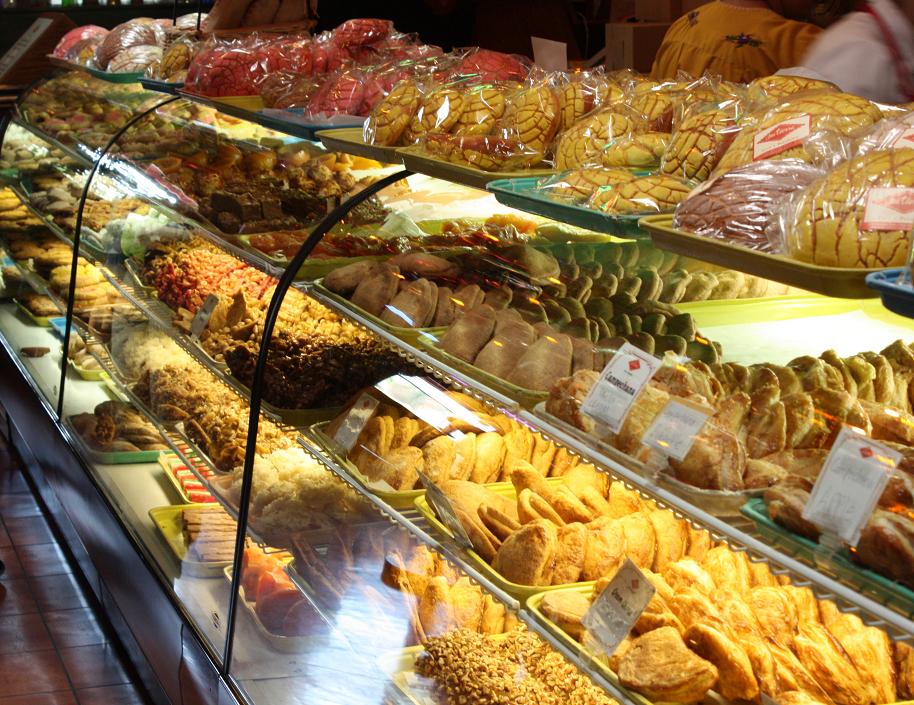
Then there are the baked goods and pastries.  Sweet pan dulce.  Sugar-dusted churrosTres leches cake.  Empanadas stuffed with every imaginable kind of tropical fruit.

Bakery case, Mi Tierra Bakery & Cafe, San Antonio, TX

You can get a Mexican sugar fix in the States at Mi Tierra Mexican Bakery on the Mercado in San Antonio, where acres of glass display cases are chock full of the most amazing range of pastries and confections.

The sub-tropical climate must surely help to make frozen treats – nieves – the most popular of all Mexican sweets.

Homeward bound schoolchildren and mothers with very young children cluster around ice cream shops in the height of afternoon heat.  Up until quite recently the town square in my little Mexican village boasted THREE shops and there are at least as many more within blocks.

The most popular items include ice  cream (helados) and ice pops (paletas), as well as the sno-cones (raspados) commonly sold by street vendors.

In Dolores Hidalgo, where Father Hidalgo sparked the Mexican war for independence by uttering his famous grito, ice cream shops are overabundant and there’s a sense of competition among them to introduce the next original flavor.  Avocado.  Jalapeno.  Tequila.  Nopalito.  You get the idea.

Ice cream vendor on Guadalajara’s Plaza Hidalgo

Michoacan, though, seems to be the acknowledged capital of Mexican ice cream.  Entire villages collaborate on the making and distribution of ice cream.  A chain of Mexican retail shops bears its name and Michoacan-style ice cream is widely sold at shops in U.S. Latino neighborhoods.

The striking thing about all of these sweets, though, is their richness of flavor.  Maybe it’s because there’s less need for preservatives because so much of this food is still made from fresh products in small batches very near where it’s sold.

Mostly, though, it’s the vibrant and distinctive flavors extracted from native fruits, nuts, and berries stamp these sweet concoctions as indelibly and indisputably Mexican.

Dulce!

Bicycle perspective

I blogged earlier about the way in which open windows free us from the quarantine of our airsealed homes and reconnect us to our neighborhood surroundings.

Opening windows is a good first step, but because it goes no further than to let the outside seep in seems to invite action far less passive.  It would be a delusion, though, to think that driving through the neighborhood fits the bill.  Most times we are as firmly airsealed into our vehicles as into our homes, consumed by the chatter of passengers, the blare of the radio, or the distraction of a cellphone.  My East Dallas neighborhood sprawls from Mockingbird Station to the lower end of White Rock Lake, and at almost any time of day plenty of dog walkers, joggers, and baby carriage pushers immerse themselves in the neighborhood at a pedestrian pace.

Bicycling, though, seems to strike a balance distinctively well-suited to this neighborhood.  It plunges the rider into the outside at a pace fast enough to deliver ever-changing scenery that’s still revealed slowly enough to be taken in fully.  Here, where most homes were built in the 1920’s and ‘30’s, it produces a particularly rich experience.  Trolleys and early autos and horse-drawn transit all

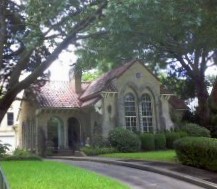
Home in Dallas’s Lakewood neighborhood

still shared these streets in their earliest days, and it’s reflected in the neighborhood’s intimate scale.  Here you can still see storefronts built in small clusters no further away from any home than a few blocks’ walk or a couple of trolley stops; more ambitious shopping in a vibrant downtown was within easy reach.   Here there is no tract housing; houses were still hand-crafted one at a time and today they present block after block of charming architectural diversity.  Here churches and schools are less often located at major crossroads and more often nested deep within the neighborhoods they serve.  Here trees are far older than homeowners, and in summer their filtering canopy renders the Texas heat and glare benign.  The Rustbelt neighborhood into which I was born and where I spent my early childhood was not unlike this, and each time I traverse it I’m also reconnected to a past that holds many warm memories.

Every time I drive through the suburbs there seems to me a sameness to them that throws a bland drape over existence there and I can’t wait to get back to my own turf.  Metropolitan Dallas sprawls across the landscape, continuously filling out and filling in.  Its neighborhoods are diced up by expressways that just as often separate as

Another home in Dallas’s Lakewood neighborhood

join together, and inhabited more and more by those born elsewhere who have little sense of Dallas’s soul. I’ve lived in nearly twenty different cities, some with far more going for them than others, but it’s been my experience that where you live in a city is at least as important as what city you live in.  Dallas’ soul is alive and well here in East Dallas, and the lives of those who live here are richer for it.

Chilling in Dallas

An antidote for the sweltering Dallas heat presents itself at 6AM every morning.  Even though eighty degree heat clutches at me as I walk the bicycle out to the street, in only the time it takes to crank through the gears my airstream becomes a steady breeze that chases it away.

1930’s Boat house on White Rock Lake

All across East Dallas a blanket of air chilled by lawn sprinklers hugs the ground beneath the shade of 90-year-old trees.

The route is a time machine that begins in the 1930’s and reaches backward for 50 more years:  Greenland Hills… Vickery Place… Lower Greenville… Swiss Avenue… Junius Heights.  Then it follows the paved Santa Fe Trail until it emerges from the trees at the old art deco public boathouse to reveal White Rock Lake brightening in faintest dawn.

Much of the route is well sheltered by overhanging trees, but nearly half of it circles the lake.  Ducks and geese are beginning to stir along the shoreline, die-hard fishermen are casting lines, and on occasion a lone oarsman pushes a scull through the water ahead of a solitary wake.

Fishermen at dawn on White Rock Lake

These summer doldrums beg for a cooling breeze to skate across the water, but even when the lake is becalmed and glassy the mere sight of so much water seems to refresh.

The rising sun finally catches the brightly colored sailboats bobbing at anchor around the marina and beyond them the downtown Dallas skyline glows a shade of  rose.

Not much further down the trail the cultural center which now occupies the 1930’s bath house is still hours away from opening.  Below the dam the spillway carries only a trickle of water, its parched stone terraces looking like some fairytale giant’s staircase.

The sun arcs toward another 100-plus-degree day, but I arrive home to begin the day thoroughly chilled out by my sunrise excursion.

Open windows

August in Dallas means labored air conditioning and drivers jockeying for shaded parking spots, but along the shores of Lake Chapala windows eleven hundred miles to the southwest windows are comfortably open 24 hours.

View of Lake Chapala from the mountains overlooking Ajiijic

The mile-high air is dry and on many nights the surrounding mountains wring cooling seasonal rains out of clouds passing from the Pacific Coast.  Americans come here from places like Texas and Florida and Arizona during the summer to beat the heat.  The Canadians come to winter.

Horseback riders on Ajijic’s cobblestone streets

The local real estate people put great stock in Lake and Mountain views, but many homes can afford at least a mirador view of the mountains and the lakeside pier and malecon are within walking distance of anywhere in the village.

The lake and mountains may flatter each other, but it’s the ever-changing reflections of clouds upon the lake – and their shadows upon the mountains beyond – that make for daily spectacle as the sun moves across the horizon and slips through the seasons.  Its contemplation can be at times meditative.  Gazing upon it through open windows, though, is about more than shirtsleeve comfort.  It’s about inviting the outside to become a part of the inside and in the process removing the distinction between them.  It’s about savoring the smells of burning wood fires and sidewalk kitchens and corner groceries.  It’s about hearing the sounds of sidewalk footsteps and cobblestoned vehicles and street talk.  It’s about breaking down the walls of an air conditioned quarantine and enriching the fabric of each waking moment for all of the senses.

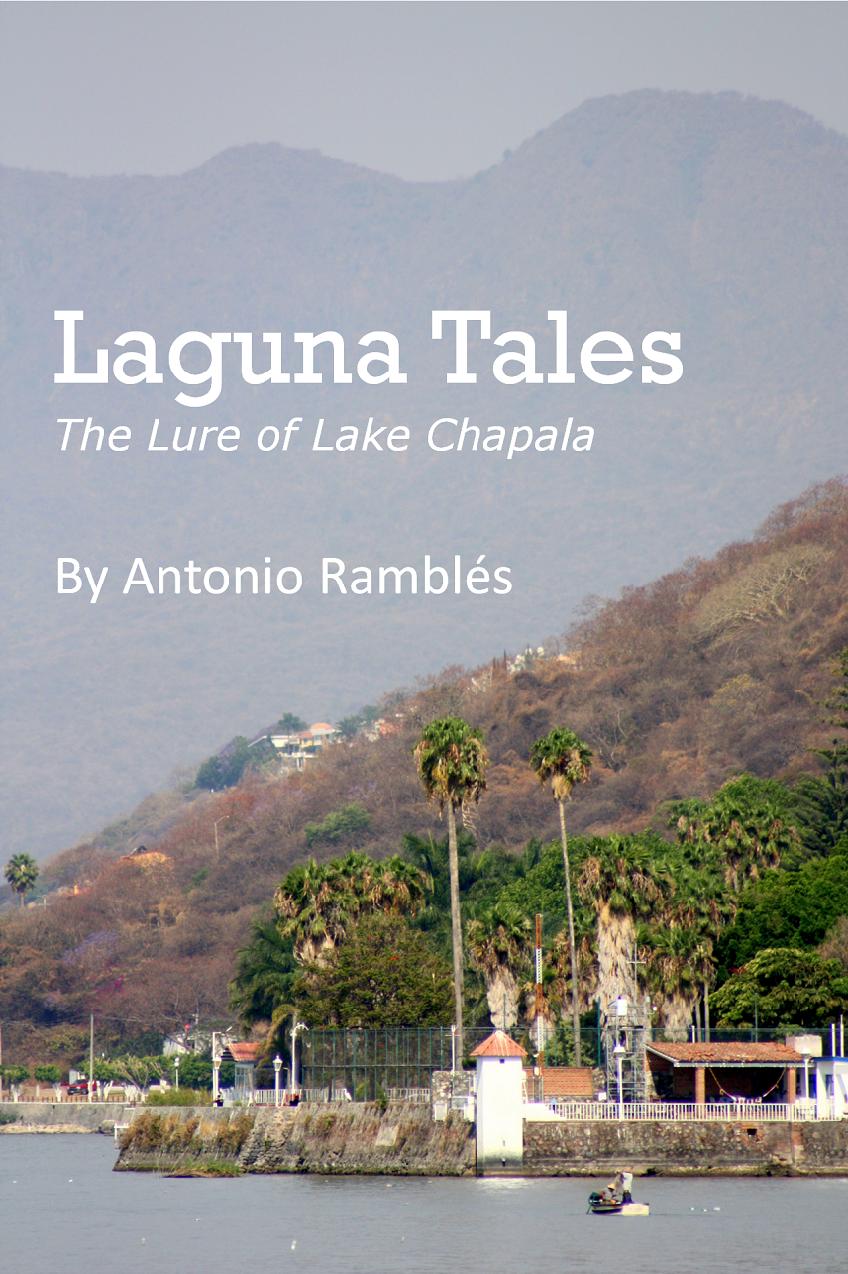
My new book provides a glimpse into expat life that’s not to be found in tourist guidebooks:
Laguna Tales: The Lure of Lake Chapala is a collection of serial short stories about six American men and women separated from each other by thousands of miles and born dozens of years apart who are all drawn at turning points in their lives to a not-so-fictional village on the shores of a mile-high mountain lake in Mexico’s interior.
The book began as a single short story published in Mexico’s English language El Ojo Del Lago at the suggestion of its editor Alex Grattan-Dominguez.  The story acquired a life of its own, becoming a 5-part series that won the publication’s award for Best Fiction in 2006, and spawning the other characters whose stories comprise the rest of the book.
Laguna Tales can be purchased for download to PC’s and most popular e-book readers including Kindle and iPad here on Amazon.

Buenos Aires’ regional airport sits at the heart of the city along the river, and the city has clearly outgrown it.  As my flight from Mendoza taxis to the terminal I can see that all gates are occupied and planes are double-parked on the tarmac in a line three hundred yards out,  where busses ferry passengers back and forth.  My flight arrives late, buffeted by some of the strongest updrafts I’ve experienced in a lifetime of flying, but my remise driver is waiting patiently in baggage claim.

We pass into the city on an elevated highway within eyesight of the trendy neighborhoods I walked a week earlier. On either side of the highway is a shantytown, a secret Buenos Aires that many foreign visitors may never see.  These are not cardboard cartons, but crude brick-and-mortar buildings rising up as high as three stories.  Pirated electricity runs through lines draped among them and on the highest floors residents sit in this warm, humid evening on cheap lawn chairs in “wifebeater” shirts at eye level, watching us pass.  I have seen this many times in Mexico, but it is my first sighting in Argentina.  My driver explains that these are second and third generation squatters whom successions of socialist governments have been reluctant to evict.

It’s nearly 11PM by the time the remise turns off the Avenida 9 de Julio beyond the obelisk and begins winding through the side streets toward my B&B.  We pass the graffiti walls and shuttered windows of the Montserrat neighborhood and cross Calle Chile into San Telmo.  Block by block shops and cafés appear ablaze with light and young people walk the sidewalks or cluster in doorways to share talk and laughs and smokes.

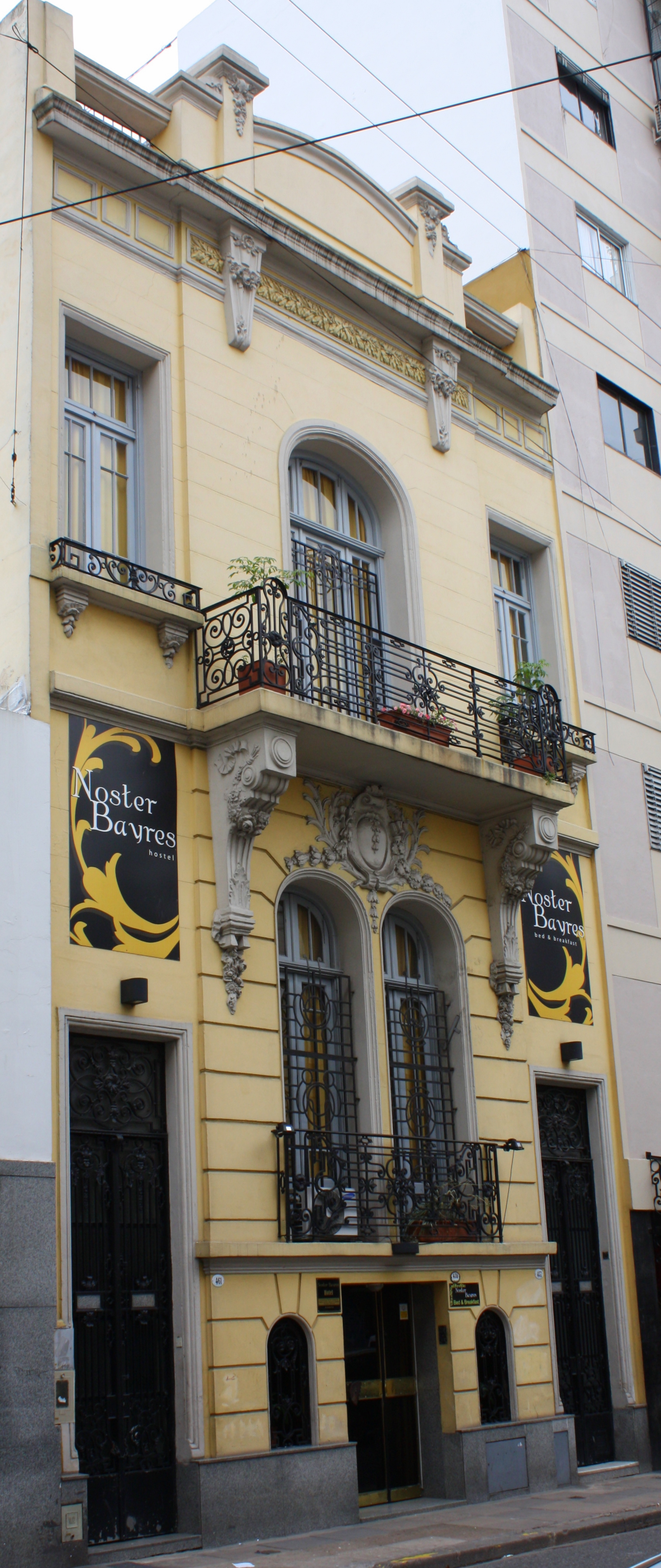
Nostre Bayes hotel San Telmo, Buenos Aires

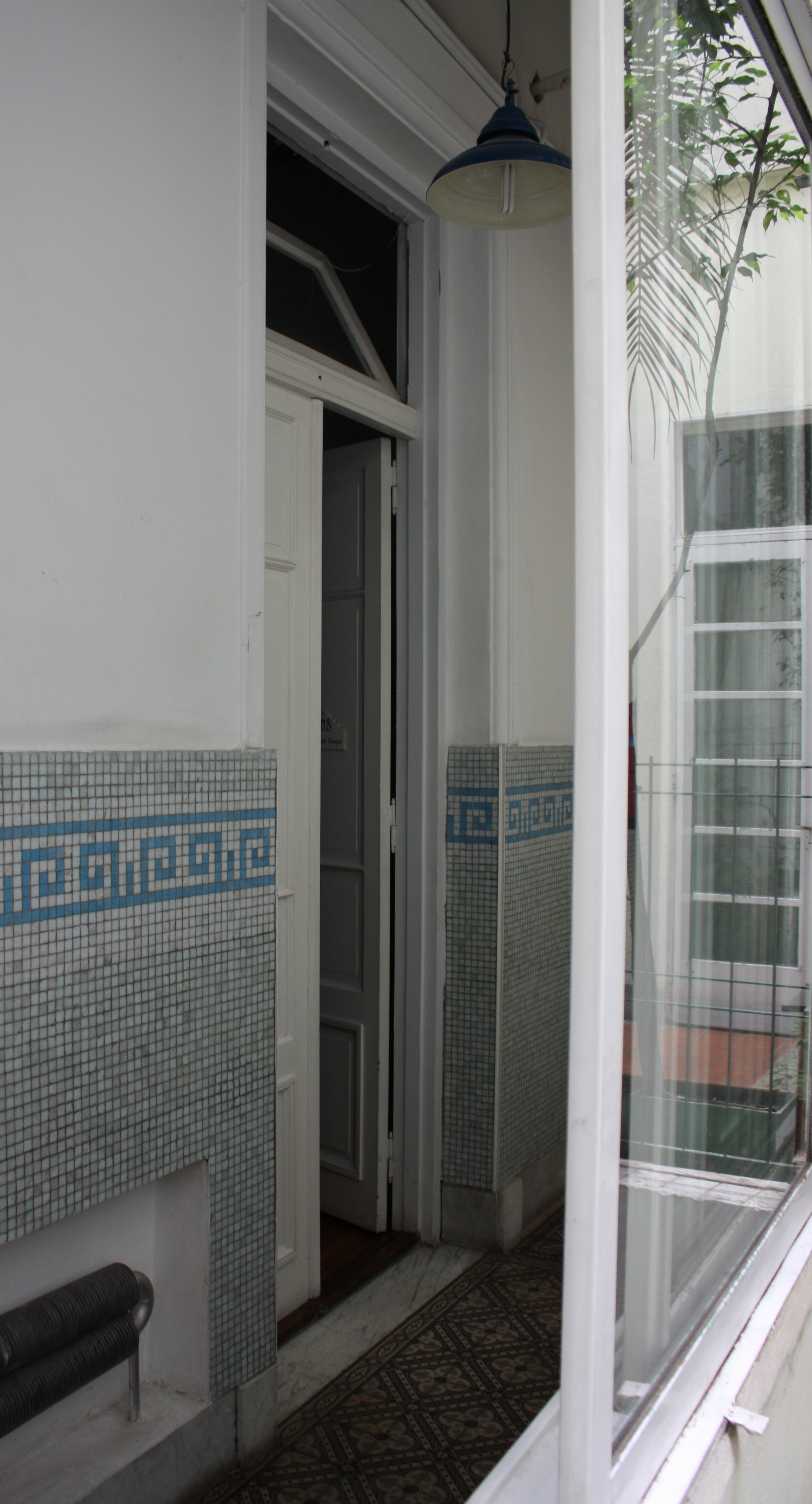
The Noster Bayes Hotel is a classic.  Floors probably laid before my father’s birth lead from the lobby up steep, narrow stairs between tiled walls.  The night clerk, indistinguishable from many I have just seen outside on the street, checks me in.  Our conversation shifts quickly from my bad Spanish to English, hers well-spoken with an accent I can’t quite place.  As we decide when to schedule my next day’s remise to the international airport she calculates the transit time out loud, “cinq, six, sept, huit…”Vous etes francaise?” I ask.  “Swiss,” she replies.  I’m not surprised; I’ve met world citizens like her throughout my time in Argentina.

She leads me up the stairs to my room as I trail behind boosting my large bag up one step at a time and feeling a bit like Marty Feldman in Young Frankenstein.  “There is no lift,” she says out of some need to state the obvious.  The staircase and hallway at the top look into an open-sky atrium, and below is a small patio predictably hidden from the street in the old Spanish style.  High, narrow-paneled double doors lead offf the hall opposite the atrium, glass panels above them tilted open for air to circulate.  She turns the heavy key in an old lock and opens one of the door panels.  I wrestle the big bag through the narrow space as she fumbles for the light switch in the dark within.  The air inside is still, hot and humid.  “The air conditioning?” I ask.  She flips a switch and the ceiling fan begins to spin.  High on the wall above an air conditioning unit sits dark and mute.  I turn to ask her about it, but she is already gone.  It recalls a similar incident in Mendoza, and in both cases the lost-in-translation comedy works out well in the end .

Nostre Bayes hotel, San Telmo, Buenos Aires

The room is not much wider than it is tall.  The floor is finished wood plank and a giant armoire serves as a closet.  The spartan furnishings are a combination of ultra-modern and kitsch.  Each is themed fo a famous Argentinian and on this night I’ve drawn Buenos Aires Formula One race care driver Juan Manuel Fangio.  It takes three tries to get the wi-fi connection to stick.  “It is better on the lower floors,” the clerk tells me upon check-in, “but sometimes it goes out in bad weather.”  I’m thinking that the storm I’ve just flown through should arrive here in a few hours.  I check email and transcribe some handwritten notes made on the plane before preparing to turn in.  I encounter my first Argentine bathroom without a bidet, but the old commode here has been ingeniously retrofitted with a chrome arm tucked inside of the bowl and attached to a lever outside that swings the arm and its small shower head into the center of the bowl.  I wonder for the umpteenth time – but not for very long – what European women know that American women don’t… or vice-versa.  Then I turn in.

At 9AM on my last day in Argentina any expectation that the neighborhood will be sleeping off its late night partying is quickly disproved as I forego the B&B fare to walk the neighborhood in search of a café con leche and the perfect atmosphere in which to nurse it.  There is no lack of choice and I settle on the Café Roli, located at a busy neighborhood street corner on Calle Peru.  I pick a windowside table where I can watch the comings and goings and settle in.

Roli is another of the city’s endless classics.  The place can’t possibly seat more than 50 or 60 people.  Real wood tables and chairs are neatly arranged on a marble tile floor. At one end sits the requisite granite counter service bar covered with trays of fresh medialuna pastries.  Behind it on mirror-backed shelves is a fully stocked bar.  The patrons match the eclectic mix of the people on the street walking briskly to the Subte, catching one of the frequent standing-room-only busses or on rare occasion catching a taxi.  There is a young couple in jeans, pullover shirts and tattoos looking much like those out on the streets only a few hours before.  There is an obviously retired old gentleman engaged in a morning ritual of reading the newspaper front page to back.  There are workers dressed for the office.  The waiter looks remarkably like my Italian grandfather when he was still in his white-haired prime.  He wears a crisply pressed, short sleeve shirt and a black pin-striped apron is tied at the waist. I can’t resist logging on to the wi-fi; no telling what I’ll find when I again attempt it back at the B&B.

I spend what remains of my day walking the neighborhood bistros, bookstores, markets, and antique shops.  The thing that strikes me most as I people-watch is that this is a vibrant organic community, home to a full spectrum of sub-cultures that co-exist in the same space from dawn to closing in a sort of time-share framed by centuries of architectural history.

I’ve read that the true measure of a travel destination is its half-life:  the number of days it takes for its luminescence to lose half of its radiance.  Another measure of its power, I think, is whether or not we deem it worthy of a second visit.  An accident of my itinerary has afforded me the opportunity to return for one day to my choice of the many B.A. neighborhoods visited a week earlier.

I picked San Telmo.

Leaving Mendoza

Mendoza may sit at the periphery of Argentine geography, but is also the subcontinental crossroads.  As such it seems to look more to the west and to connect more closely to the region’s indigenous cultures than does Buenos Aires.

The earthquake which in 1861 wiped Mendoza’s geographic slate almost cleans seems also to have freed it of many vestiges of Spanish colonialism.  The ornate architecture that everywhere else marks the alliance of the Hapsburg monarchy and Jesuits is noticeably absent in the orderly geometry of its broad streets and public parks, and in the Latin contemporary lines of a more subdued skyline that conforms to the land rather than imposes upon it.

Mendoza vineyard against Andes Mountains backdrop

Few crops require a more highly tuned sensibility to the relationship between harvest and end product as the one between grapes and wine.  That same sensibility seems to have translated into an aesthetic reflected in parks, monuments, performing arts, and dining that far exceed expectations of a city this size.

Andean earthquakes and avalanches, a propensity for harvest-threatening hailstorms, and the vineyards’ ever-present thirst for irrigation seem to have instilled in this place a clearer sense of man’s vulnerability to nature, and a longer view of its own economic rhythms.


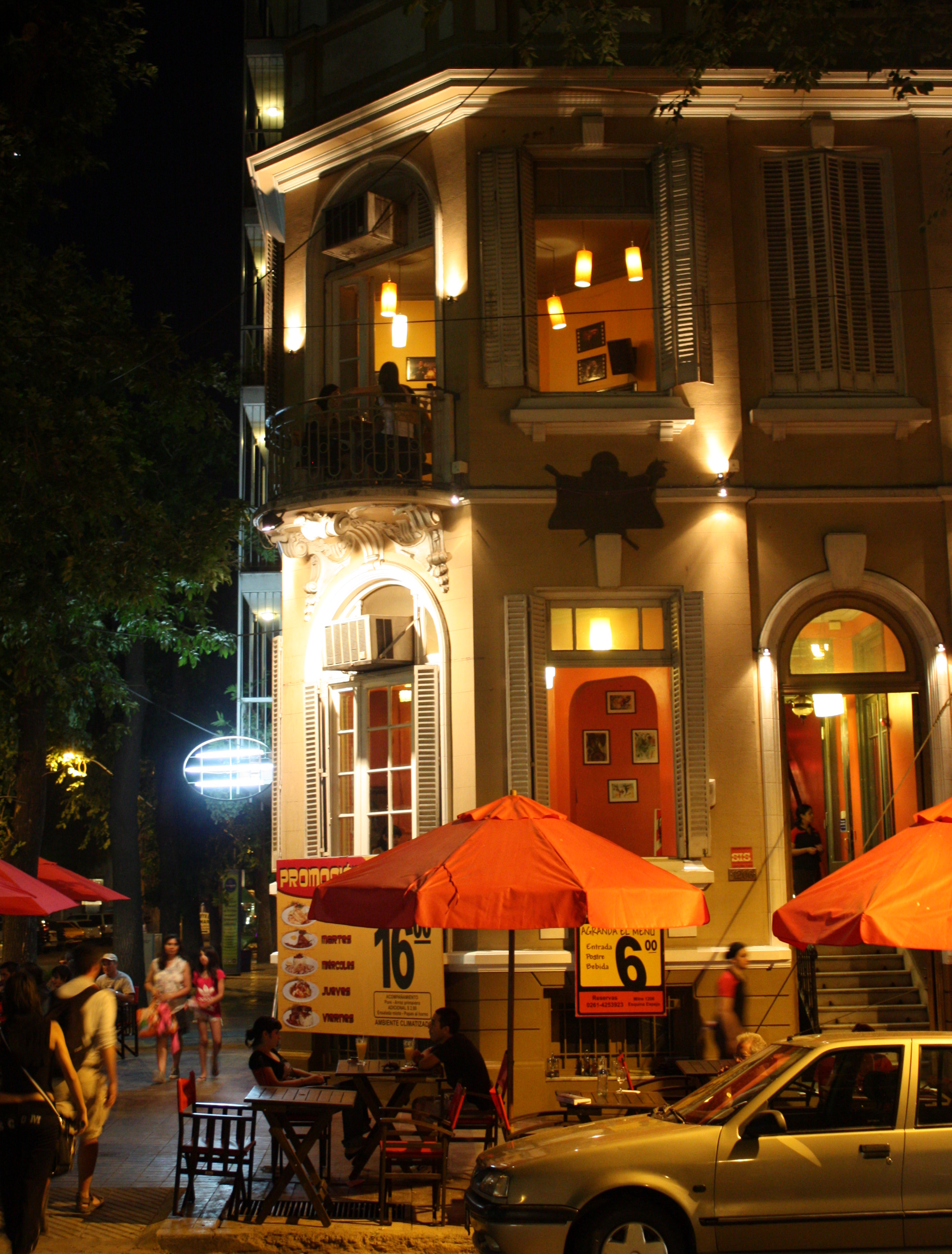
Restaurant along the Plaza Independencia, Mendoza

It is after sunset as I venture out onto Mendoza’s streets.  Warm light spills over diners seated in stylish sidewalk cafes as aproned waiters ferry meals out to them.  I wander down the block to the Plaza Independencia where a Christmas tableau stands outlined in colorful lights.


Arrayed in a semicircle around the vast square are artisans at their booths, many working at their crafts as residents of all ages stroll among them.

Puppet artisan booth, Plaza Independence, Mendoza


A young guitarist strums soulful American blues as the beat of Latin drums begins to pulse at the opposite end of the plaza.  A Christmas theme headlines at the performing arts theater across the way, but American jazz appears prominently in its schedule of upcoming shows.

Tonight I fly back to Buenos Aires, and it will be interesting to see how it will now feel in contrast to this place… and how this place will look as seen in B.A.’s rear-view mirror.

The end of west

As the wheels roll it’s about 100 miles from Mendoza to the Chilean border, but that’s only the short of it.

Andes Mountains near Mendoza, Argentina

Most of the serpentine route winds upward into the Andes, sometimes for miles at a time behind a semi truck or tour bus, and on the way it passes through several micro-climates and a thousand or so years of human history.  Even now in the heart of the Argentine summer there is snow on every peak in sight at the far end of the trip and a couple of the waystations resume their real lives as ski lodges every winter.  There you can stop for coffee and a hot meal, purchase bottles of Malbec or boxes of chocolates made in local villages along the route, or collect campy souvenirs.

The trip starts out feeling like the westward drive from Northern California or the state of Washington; the first vineyards appear within twenty minutes or so.  In fifteen minutes more, though, they give way abruptly to an arid landscape in which grows only sagebrush and wisps of desert grasses.  Later in the trip lichens and button-sized flowers  join this minimalist botanical garden and in a few small, fertile valleys oases of trees briefly appear, but these are not your Doug-fir-and-redwoods kind of mountains.

Here the earth is laid open in great, tilted slabs.  Sometimes it is stratified like slices of a giant layer cake and sometimes it lies congealed like icing dripped down its slides, but everywhere it is awe-inspiring in its grand scope.  Here primeval, molten earth is set in stone as a palette of  ochre and basalt and teal.  Where aeons of erosion have dissolved it into flake and silt, the cracks and crags and crevices are filled in smooth with a rainbow array of watercolor streaks.  Boulders ranging in size from refrigerator to boxcar litter the landscape, sometimes interrupted mid-slope in their rolling fall and elsewhere littered in mounds at the mountain’s base.

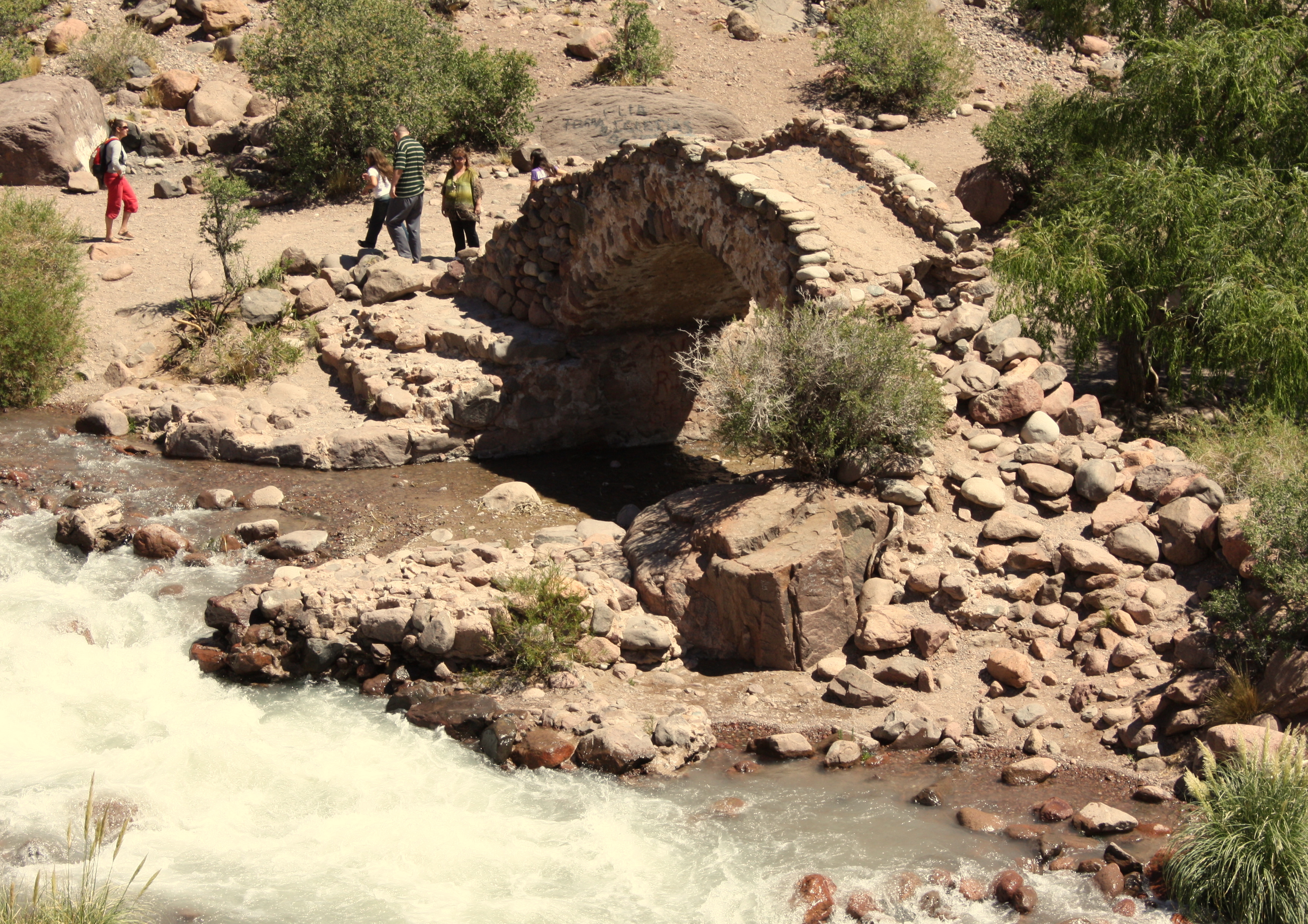
Bridge used to pass into Peru by liberator José de San Martín

A third or more of the way to the border a section of the old highway makes an off-road loop.  I follow it to the remnants of a stone bridge built across a tributary of the Rio Mendoza in 1817 by the army of General José de San Martin as his army, fresh from the liberation of Argentina from the Spanish, went on to liberate Chile and much of Peru.

Two-thirds of the way I encounter along the roadside clustered sheds and lean-tos of a bazaar from which hang brightly colored blankets and clothing in native patterns.

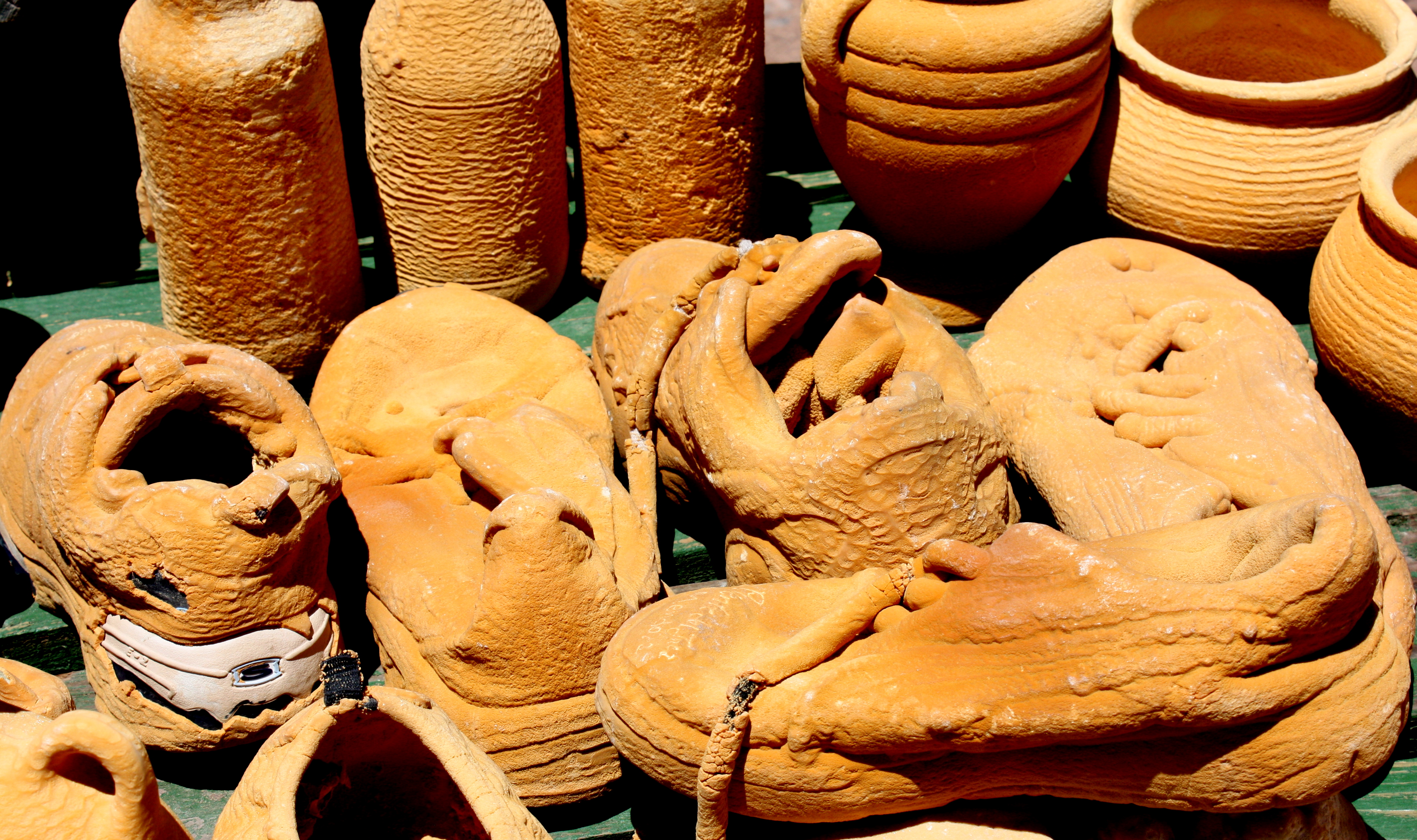
The work of artisans in leather and wood and silver and glass is displayed among them upon dozens of tables, but at the first I see everyday objects like running shoes that look as if they have been wetted and dipped in mustard-colored sand.

Shoes calcified by the hot springs, El Puente de los Incas, Andes

Just beyond the tables and booths lies a giant crevasse split by a stream, and from a building perched on the opposite side giant, fantastic shapes in the same color seem to drip into the water below, streaked also with white and pink and gold.  It is a hot spring, and the molten shapes are mineral deposits laid down over the centuries.  The running shoe sculptures that first greeted me have been suspended in their water until covered by petrified mineral shells.

El Puente de los Incas, Andes Mountains near Mendoza

This place was known to the Spaniards and long before them regularly visited by the Incas in their western-most travels.  It is in fact called El Puente de los Incas: Inca Point.  Ruins on the opposite side in the shadow of the mountain beyond are the remains of a modern spa crushed in 1971 by a landslide.

A railroad once ran alongside the river back in the day when Butch and Sundance were robbing banks to the north in Bolivia, but now only its skeleton tracks and decaying bridges remain, crisscrossing the road carrying the busses and semis and cars  that have replaced it.  Fallen timbers and rockpile foundations of  long-gone depots and coaling stations punctuate the tracks.  In places the split ends of rails curve upward like coiled springs sprung.  In others they lie draped like melted strands over gullies where wooden bridges have long ago decayed or their timber has been pilfered.  Decades of falling rock have in some places obliterated the railbed with piles of stone and in others made swiss chees of corrugated iron rock-fall shields as if in some giant shooting gallery.

Abaondone rail terminal at Chilean-Argentinian border

At Las Cuevas, the last station before the Chilean border, a faded sign at a long-closed customs station whispers “Bienvenido a Argentina.”

The new highway border station looks a lot like a toll-booth, and this is the place to turn around unless you’re going on to Santiago, Chile.  Even as a non-stop drive the trip back feels long, but it’s a one-of-a-kind that can be experienced no other way.  To come this far and miss it is to leave an important page missing in your catalogue of the Argentine experience.