Archive for January, 2012


The elusive Ribera

How do you describe the Chapala Lakeside – La Ribera de Chapala – to someone who’s never seen it?  It’s the question that drew me back to Ajijic for a second look more than 7 years ago.

Ajijic and Lake Chapala seen from the mountains above

I asked local business owners and expats  ranging from long-time residents to first time visitors.  Most touted the great year-round climate and low cost of living.  Many cited the picturesque lake and mountain views, a sizeable English-speaking expat community, and the proximity of Guadalajara and its airport.  None of this, however, seems to conjure up in the mind’s eye a magical picture like images of San Miguel de Allende or Cabo San Lucas or Costa Rica or Belize.

What, then could lead one resident to gently plead with me to “Come, but PLEASE don’t tell all of your friends about it” while a Stateside friend said, “I don’t get it.  What is there to DO there?”

Sometimes it’s in the understanding of the empty portion of a glass that we begin to understand the way in which the remainder is full.

I first stumbled upon Santa Fe, New Mexico more than 30 years ago before the Northridge (California) quake and the dot-com bust sent thousands of refugees scurrying there to open galleries stuffed with revisionist Southwestern art and to affect ridiculous excesses of Native American jewelry and clothing in a Rodeo-Drive-meets-Geronimo caricature.  In more recent visits I can’t shake the feeling that the authentic image of Santa Fe now lies obscured by caked layers of faux pueblo like a European nude masterpiece over which clothing has been later painted.  These are the sorts of people who probably wouldn’t “get” La Ribera, either.

The Chapala Lakeside is, after all, not a Los Cabos Phoenix-sur-Mer where the gringo has only to strap himself into the seat of a fishing charter or a championship golf course cart and simply wait for the ride to begin.  It’s not a San Miguel backdrop of quaint native garb and Spanish colonial street scenes into which many gringos simply peer through vacant oval cutouts as if in some fairground souvenir postcard photo.

The Chapala Lakeside is not so much a place in which to be seen as a place in which to live.  It seems not so much to serve up things to DO as it serves up the freedom to BE, like a perfectly stretched blank palette inviting the newcomer’s brush strokes.  It seems to retain the sense of community long lost in an America afraid to make eye contact with passers-by and automatically and unreservedly extend to them a daily greeting.  It can be sensed in vignettes come to life at the weekly tianguis or in the sheltered shade of the plaza in its quietest hours.  It percolates tranquilly and unobstrusively behind modest street-fronts that shelter exquisitely intimate courtyards and gardens.

The Chapala Lakeside is not ostentatious or overbearing and it may be that therein lies its special charm.  Perhaps La Ribera is the perfect destination for those who need no place from which to draw an identity, but only the most hospitable of places in which to fully realize the identity they already have.  If that’s so, then it doesn’t matter how many friends I tell, because only those for whom it is well-suited will truly be able to see into its soul.

This post is an excerpt from my earlier piece published under the title “Elusive Lakeside” in the December, 2004 issue of El Ojo Del Lago http://chapala.com/elojo,  and named its top feature article for that year.

Whitecaps on White Rock!

White Rock Lake dam & spillway

It’s a bit mind-bending that Dallas, after a summer of record heat and drought, was doused by more than 4″ of rainfall in 24 hours earlier this week.

By Wednesday the spillway below the White Rock Lake dam – bone-dry enough to walk across as recently as September – had become a miniature Niagara flowing so briskly that birds fishing its surface were quickly swept downstream.

By Thursday morning the flood was cresting as upstream runoff continued to swell White Rock Creek.


White Rock Lake boathouse bridge


Rising water had spilled over onto the lake trail loop and was lapping at the undersides of its foot bridges.


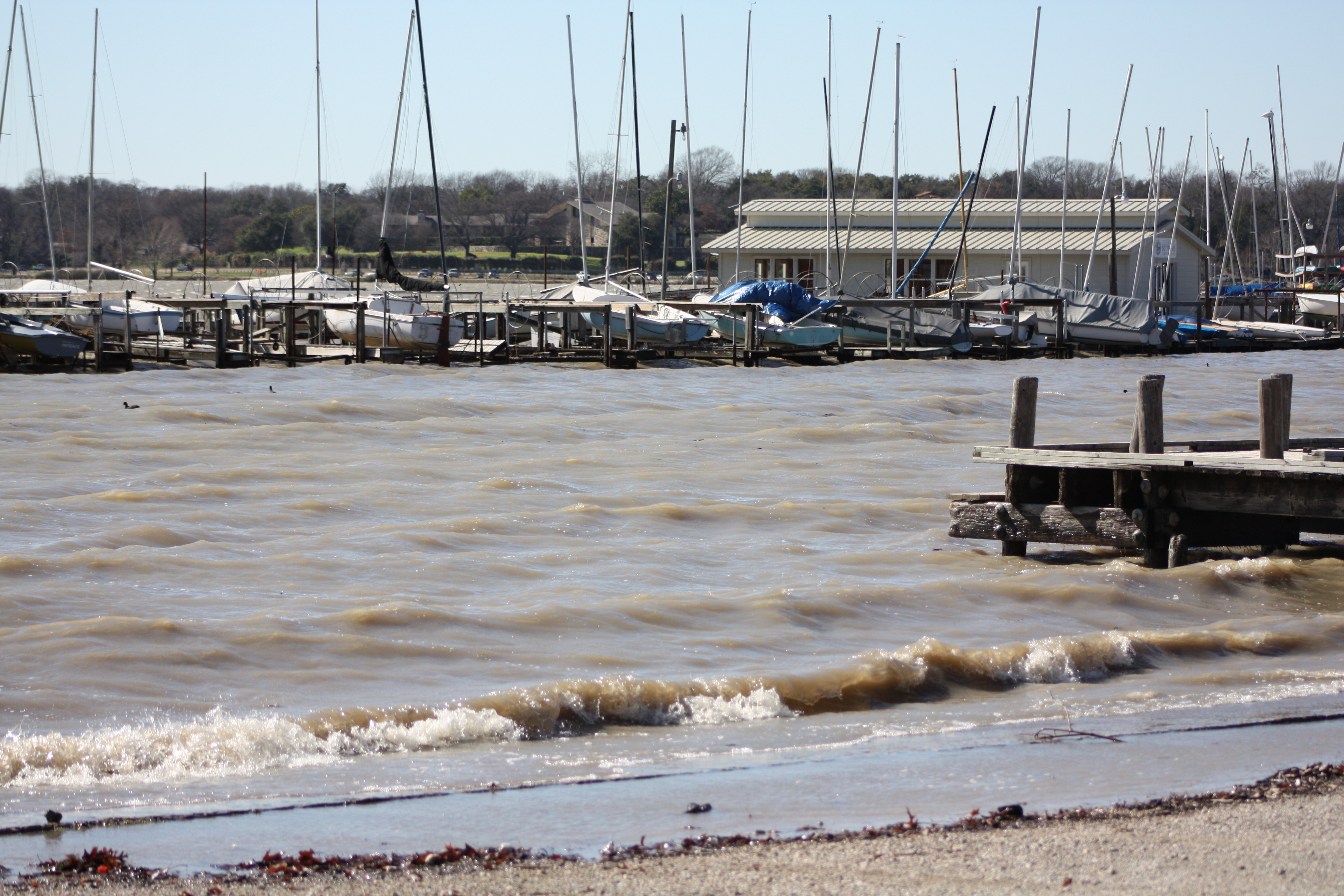
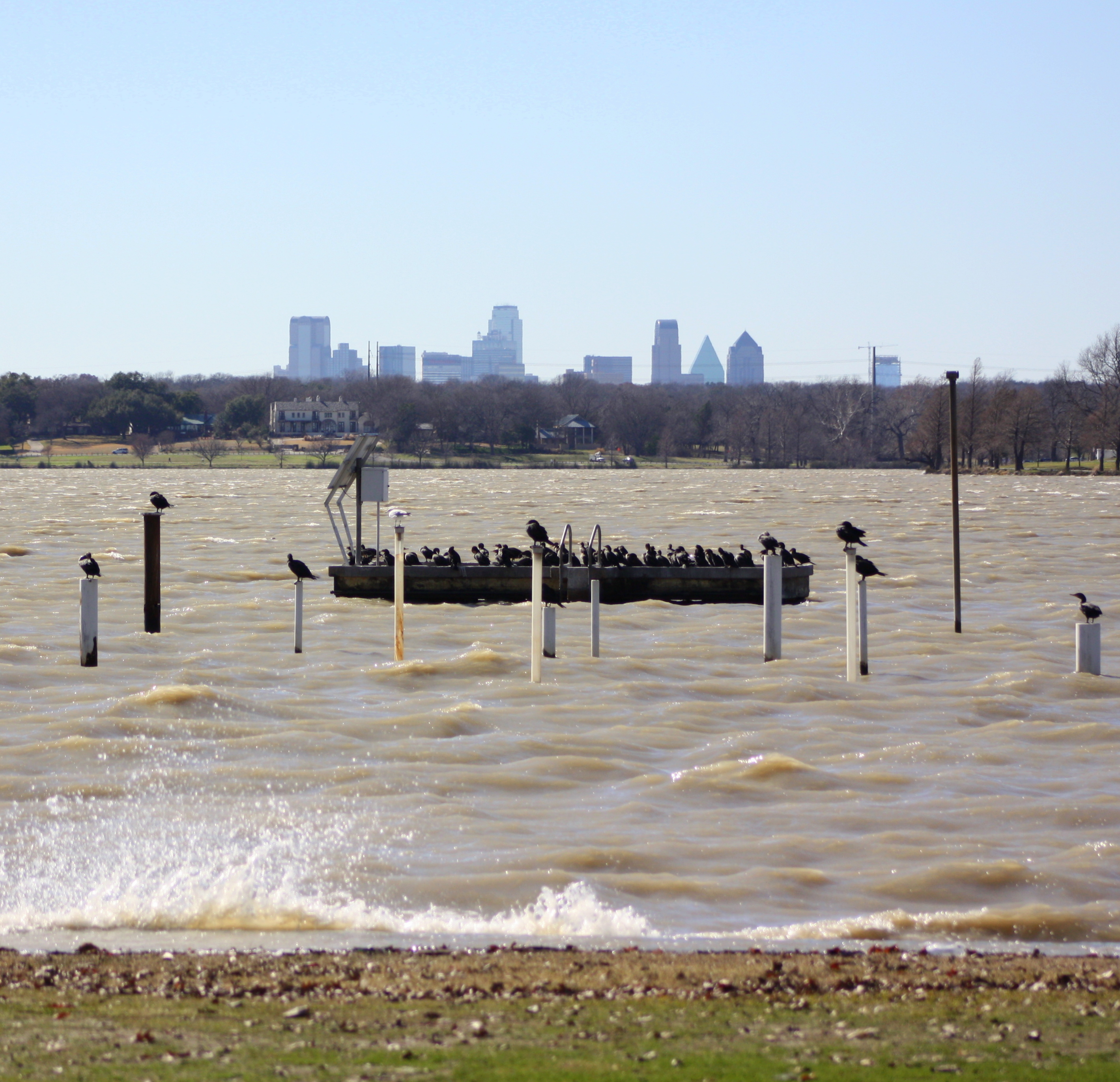
A stiff breeze was whipping up whitecaps.

White Rock Lake Corinthian Yacht Club

Dallas skyline from White Rock Lake Cultural Center

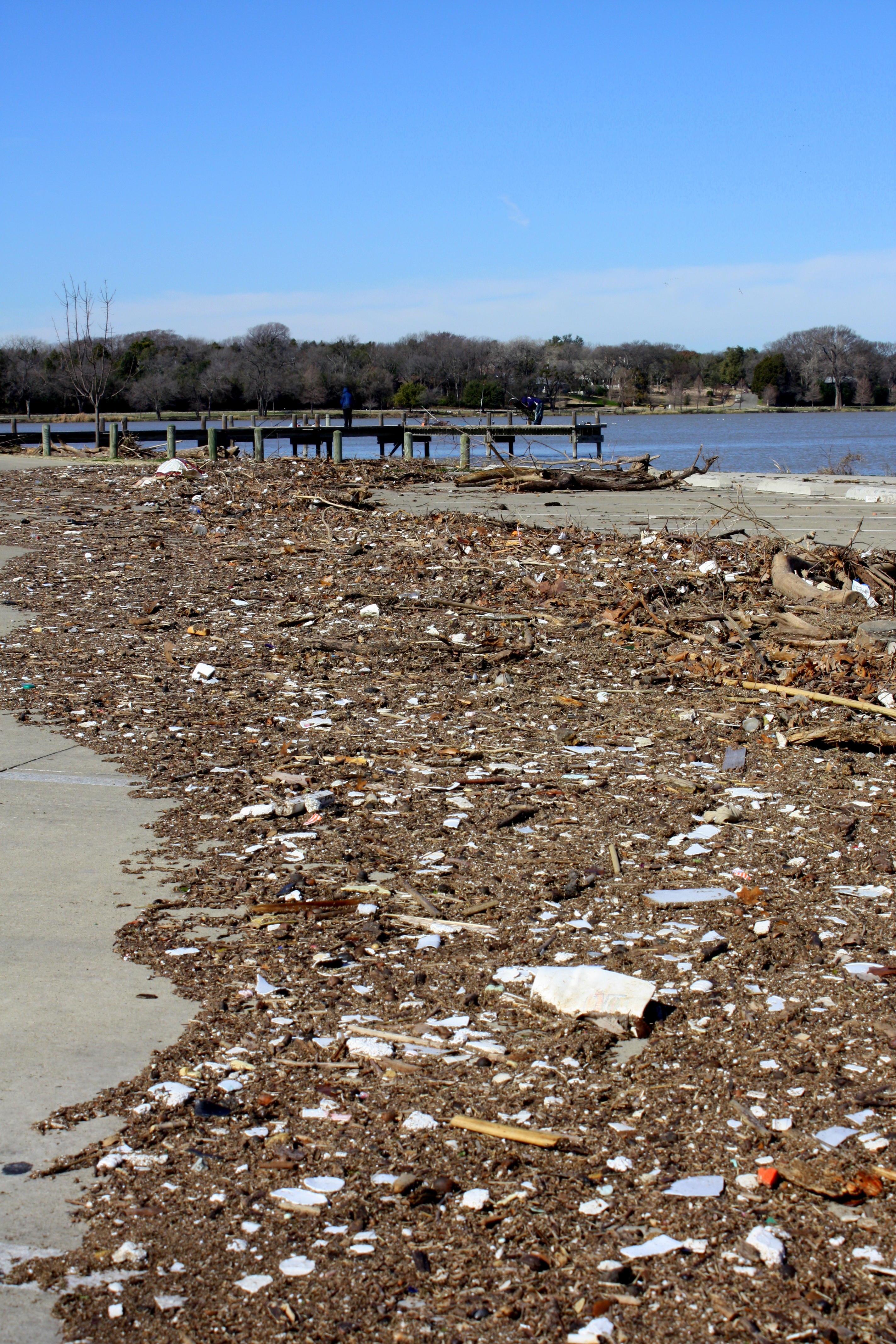
It was no surprise that the storm swept lots of refuse downstream, and as the water began to recede the shoreline was littered with twigs and tree limbs.

White Rock Lake rainstorm aftermath

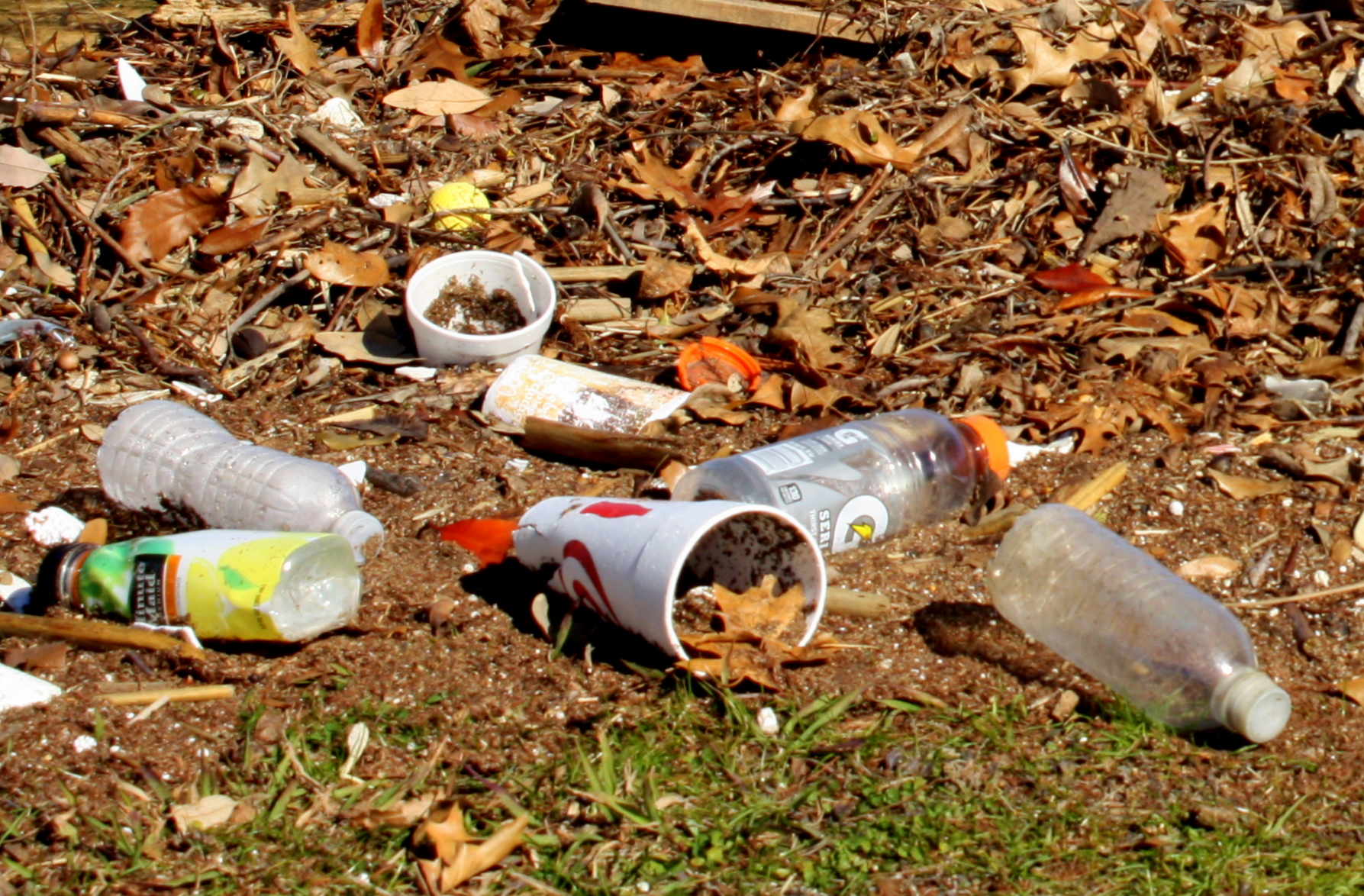
The amount of man-made trash among it was truly sobering, and none among it was more was more prominent than unrecycled plastic and styrofoam packaging bearing the logos of the nation’s largest beverage bottlers and fast food chains.

No one seeing this could help but reflect upon the reality that it was only the tip of an iceberg.  It gives pause to wonder if, centuries into some post-apocalyptic future when man no longer walks this earth, this will be his only legacy.

White Rock Lake rainstorm aftermath

Dallas’s erasable past

In fairness, it must be conceded that late-blooming Sunbelt cities can’t be held accountable for their comparatively short histories.  It should also be allowed that it’s a lot harder to maintain tradition when more residents than not are Rust Belt refugees steeped far more deeply in the traditions of their origins than those of their adopted city.

Dallas, though, seems more than most cities to view its past as an etch-a-sketch pad to be erased and rewritten at will.  Perhaps that’s because it has, dating from the accounts of its earliest years, aspired less to be the first among Texas cities than to become the Big Apple of the Southwest.  If Houston, Austin, Fort Worth and San Antonio seem thoroughly comfortable in their Texan-ness, Dallas often seems almost apologetic about it and bent upon transcending it.

Magnolia Theater, West Village, Dallas

In Dallas there’s no Ghirardelli or Larimer Square and no French Quarter.  No Pike Place Market or Gaslamp Quarter.  Not even a Riverwalk, Sundance Square,  Strand, or Sixth Street.  For its size Dallas has few historic residential neighborhoods (Lakewood and Bishop Arts are notable exceptions), and those like Southside on Lamar and West End are yet insufficient in density to support the merchants of retail goods and services that mark the difference between a residential complex and a vibrant, organic neighborhood.   Almost nothing remains of the historic Cedars neighborhood and in less than 10 years many Oaklawn homes worthy of historic preservation have been razed and replaced by new townhomes or low-rise apartment buildings.

Retail space, West Village, Dallas

Real estate developers and promoters from founder John Neely Bryan to Trammel Crowe have always been a prominent part of Dallas’s past, and it now often seems as if there’s no land in Dallas that can’t be repurposed for a new office skyscraper or luxury condos.   While there seem too few attempts to assure that new construction in historic neighborhoods conforms to historic architecture, there are exceptions worthy of emulation.

Dallas’s West Village, centered on McKinney @ Blackburn may be only 10 years old, but its developers far exceeded the just-enough-to-get-by standard in its design.  It has very much the look of a 1930’s neighborhood, and even though it’s only a couple of miles from Northpark Center has very much the feeling of a self-contained community.

Terilli’s, Greenville Ave., 2010 fire

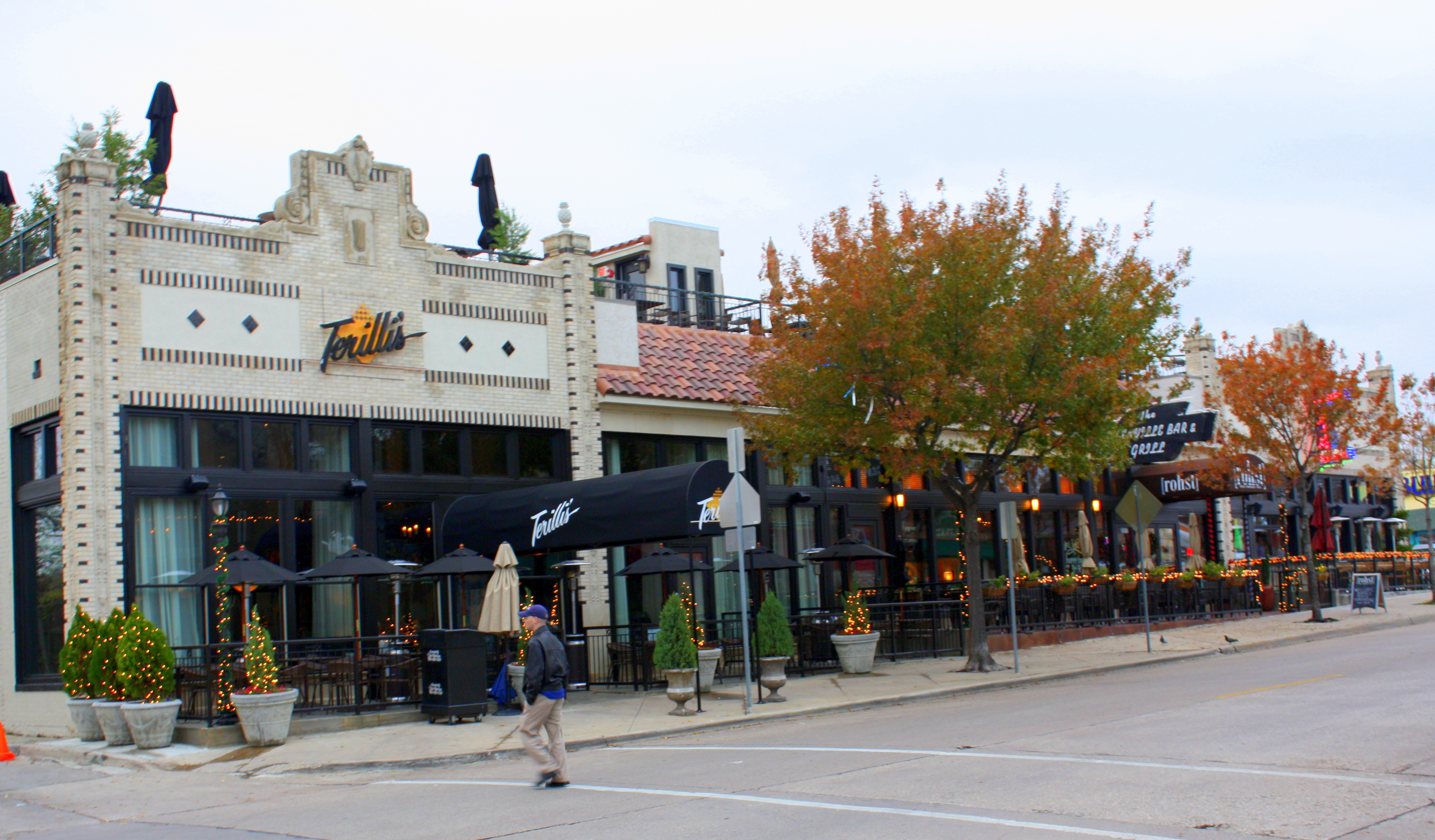
When Terilli’s Café, a longtime Greenville Avenue landmark, burned almost to the ground in the spring of 2010, its reconstruction conformed very closely to the original structure.

Terilli’s, Greenville Avenue, restored 2011

It was such a revered icon of the community that neighbors donated funds to aid a speedy reconstruction, and proceeds from charity sales were sent as relief to waitstaff members made unemployed by the disaster.

These are the kinds of landmarks that distinguish a neighborhood from just-another-complex and that make it memorable and continuously worthy of revisiting.

They’re a lesson admirably embraced in the old town centers of McKinney, Frisco, and Lewisville, but sadly lost on the suburban developers of perfectly gridded streets and look-alike intersections always populated by the same chain retailers.

And they’re a continuously available glimpse into the way we once were that helps us better understand where we’ve come from as a culture and informs where we’re next going.

Today U.S. stores are wrapping up the business of Christmas gift returns and poised to promote – with hardly a pause in between – Super Bowl party food, Valentine’s Day candy, and Easter bunny baskets.  Christmas may already be history for Americans, but in the villages along the shores of Lake Chapala the sacred season enters its third week.

Observances began on December 16 with daily Posada reenactments of Joseph and Mary’s search for a room at the inn.   Entire neighborhoods turn out to watch costumed children re-enact this timeless drama nightly through Christmas Eve, punctuated by a live nativity scene.  As in much of Latin America, observances in Mexico will continue through the twelve days of Christmas, ending on the January 6 Kings’ Day holiday.

Anyone who’s experienced Christmas in Mexico, though, will testify that it doesn’t just last longer, but often feels far more tangible.

Mexican folk art crucifixes

It’s admittedly easier to keep the fires of Christmas cheer stoked in overwhelmingly Catholic Latin America.  Within U.S. government agencies and many large corporations it’s now widely considered a faux pas to offer holiday best wishes that are a reflection of any particular religious faith. The separation between church and state in Mexico has been a pillar of governance since the Catholic church leadership ended up on the wrong side of the Mexican Revolution over a century ago, but religious icons are routinely displayed in government offices and other public places.  Can it be that Mexicans have more ably resolved the relationship between personal faith and politics than their cousins to the north?

The biggest difference between Christmas in Mexico and the U.S., though, may be the role of gift-giving.  While every U.S. holiday has long been a retail event it is only this year that I noted for the first time in Mexico extensive retail advertising for Black Friday.  It was as disheartening as first seeing not that long ago the retail assault on the venerable Dia de los Muertos observance, seeking to replace homages to departed loved ones with superhero costumes and trick-or-treat candy.

Even though American-style conspicuous consumption is simply not an option for the many, many Mexicans of modest means, the holidays here seem particularly joyous.  It’s the time of year when many Mexicans and Mexican-Americans make their sole yearly pilgrimages – often riding busses for 20 or 30 hours – to visit their Mexican relatives.  When they arrive they’re as likely as not to find two or three generations of the family still living in close proximity within their ancestral villages.  On Christmas Eve the villages seem like extended block parties as people take the edge off cool night air around curbside fires, street vendors cook at sidewalk stands, and children light firecrackers until the dawn.

Christmas is certainly what we choose to make of it, wherever we may happen to live, but Christmas in Mexico is effortlessly hospitable and universally inclusive… a truly communal experience.

Old-fashioned as it may seem, the words “Happy Holidays” just don’t seem to convey the spirituality and heartfelt sincerity implicit in holiday greetings now out of fashion, and we’re all arguable poorer for it.  How can it be lost on so many that the sentiment common to all of these greetings is a wish that the spirit of peace and harmony rekindled over each faith’s sacred holidays grace the lives of others throughout the year?

So… regardless of your religious tradition I wish you Feliz Navidad, today and every day throughout the coming year!