Archive for August, 2012


Etched glass bus stop shelter on Alberta Street

Before I begin four days of camping and hiking around Mt. Rainier I head to Portland, Oregon for the weekend, catching Amtrak’s Cascades train just a stone’s throw from Sea-Tac airport.

Artist with flowered hat on Alberta Street

The trip takes a bit more than 3 hours, the train is spacious and clean, and the route winds through great forest and waterfront scenery, ending in gem of a train station that’s right out of a ‘40’s movie.
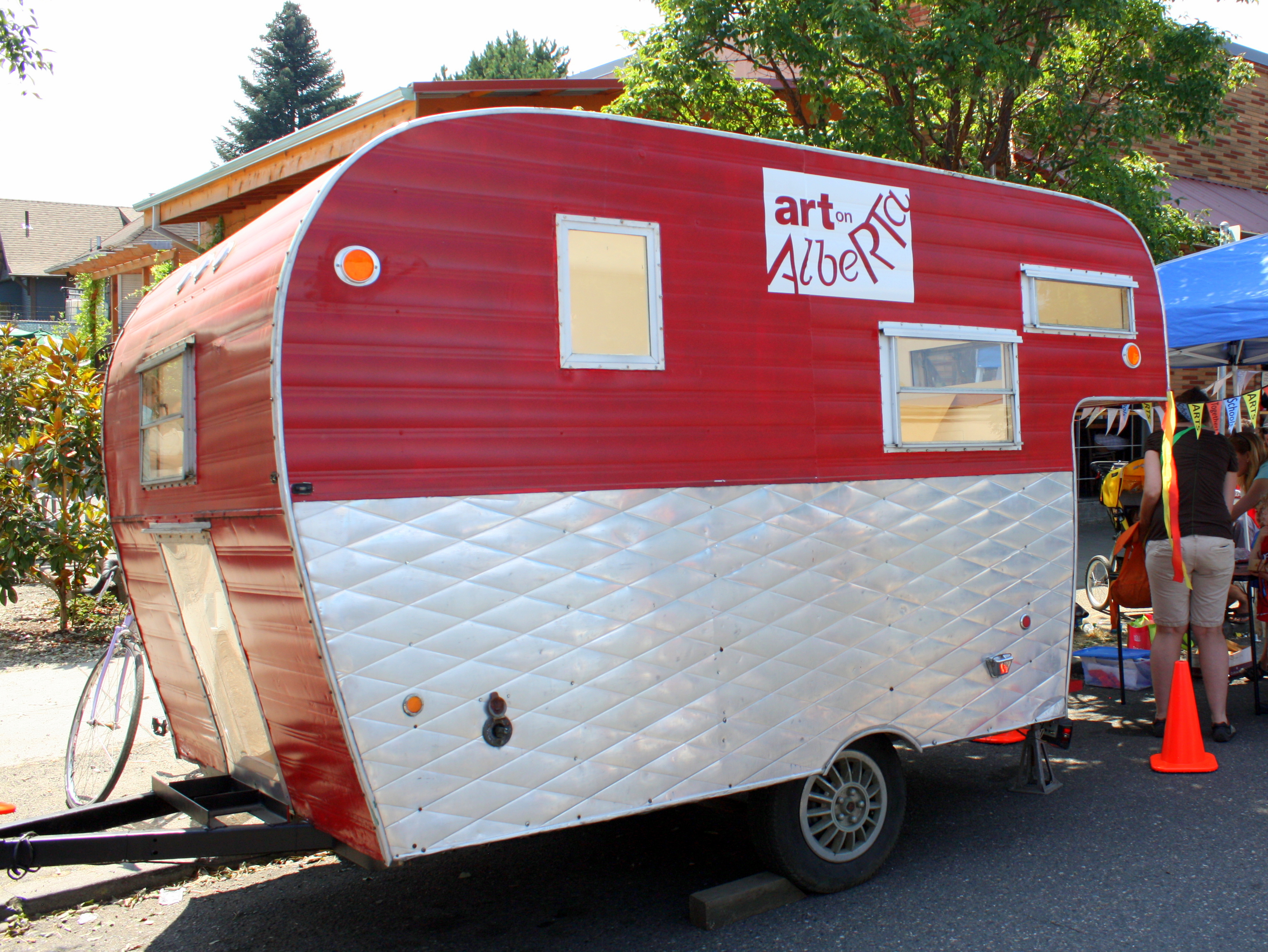
“Art On Alberta” trailer studio

The first thing that hits me is how green it is here.  More shades of emerald green than anywhere else, speckled in August by the blooms of flowers and wildflowers.

The second thing is that there’s an economy to the layout of this town.  Almost no part of it much more than 20 minutes from any other, and the local light rail and bus service sets a standard.

The third thing is that Portland is an uplifting example of a community which has so passionately embraced the values of community, diversity, and sustainability that they’re woven into the fabric of the place.

To say that Portland is pedestrian-and-cycle-friendly is a gross understatement. This weekend there’s also a bicycle event that routes 20,000 local cyclists back and forth across every bridge that joins the city across the Willamette River, where windsurfers scoot along the river’s surface.
Jubilantly recycling!

There are more great neighborhoods, microbreweries, and wineries than I can possibly see in a weekend, but it’s my good luck to arrive during the annual Alberta Street Festival, which promises to pack as much of Portland as possible into a single event.
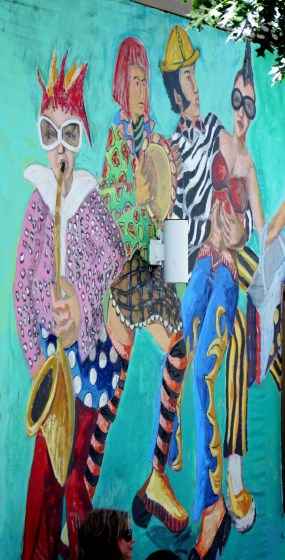
Wall mural

Muslim henna tatoo artist

This is not your typical neighborhood street fair. Originality rules here, and along the entire 20-block midway no two of anything is alike, with plenty of it likely to be seen absolutely nowhere else.

Co-op grocery

It’s hard to escape the feeling that the best of the ‘60’s counter-culture lives on here, if updated for the new century.
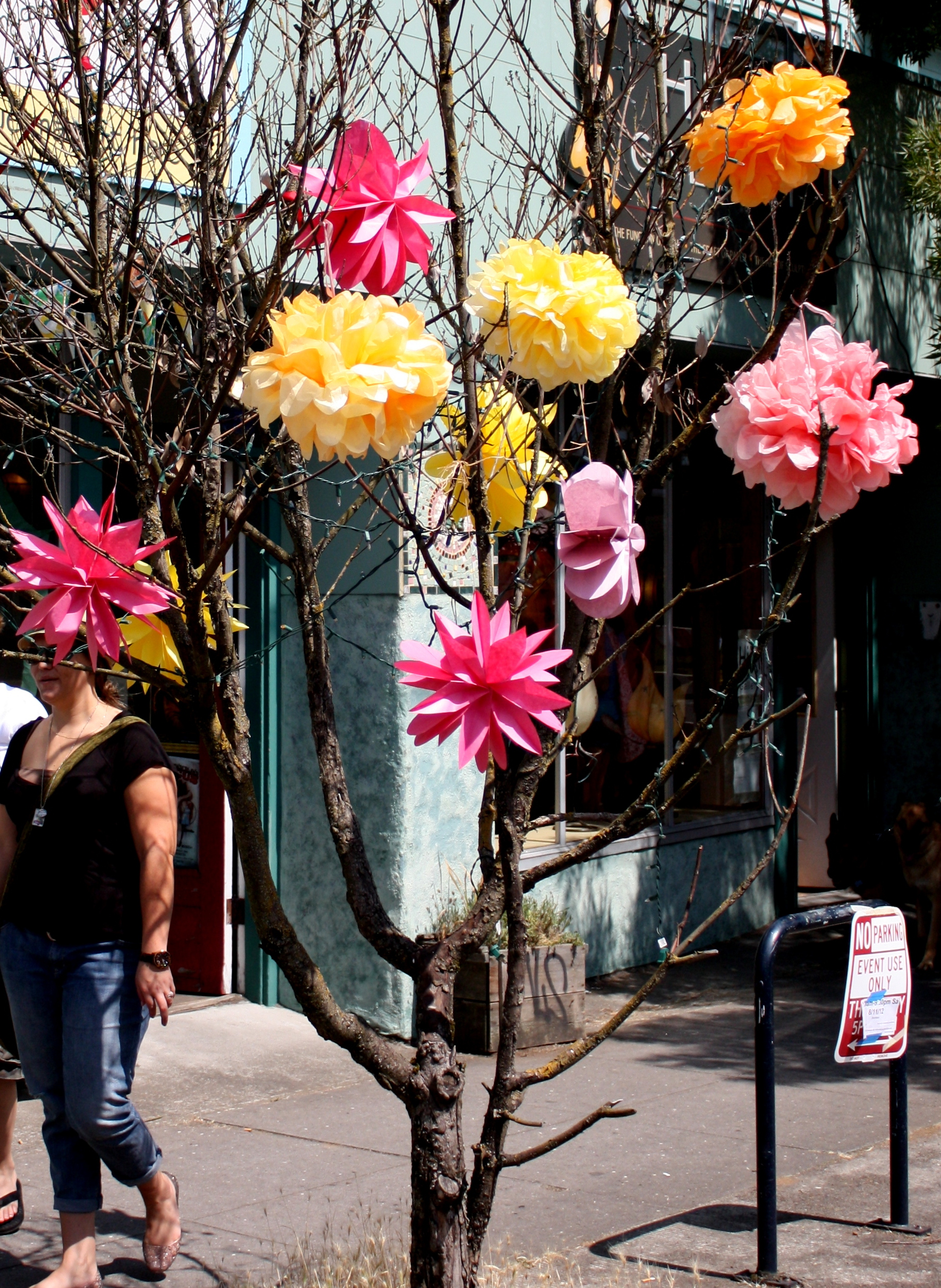
Faux flowers on sidewalk tree

The aura of jubilation here is nothing if not mellow, a celebration of an historic neighborhood revived and reinvented and a harmonious community.

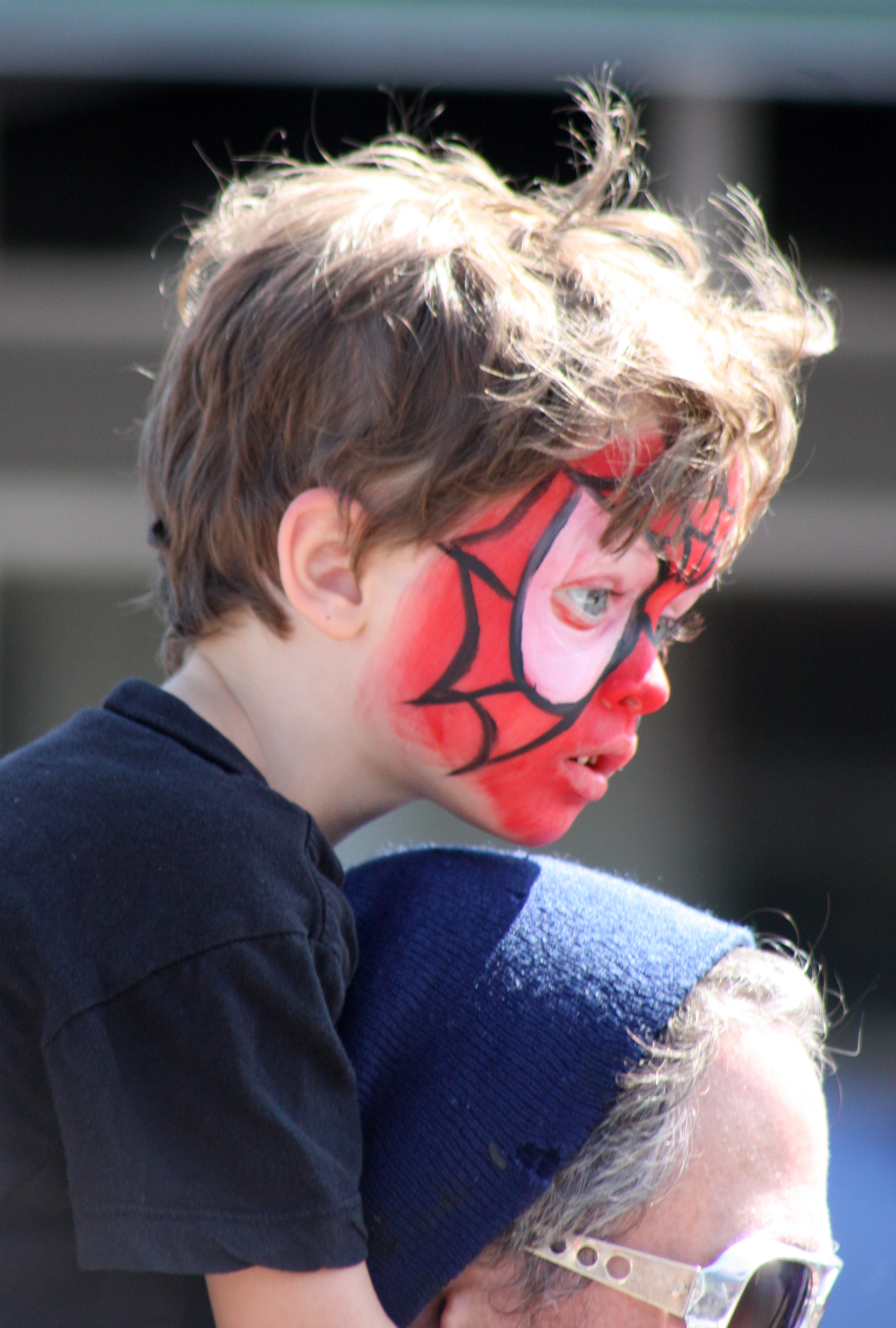
People of every persuasion mingle comfortably and unaffectedly, and no age group seems to be unrepresented.
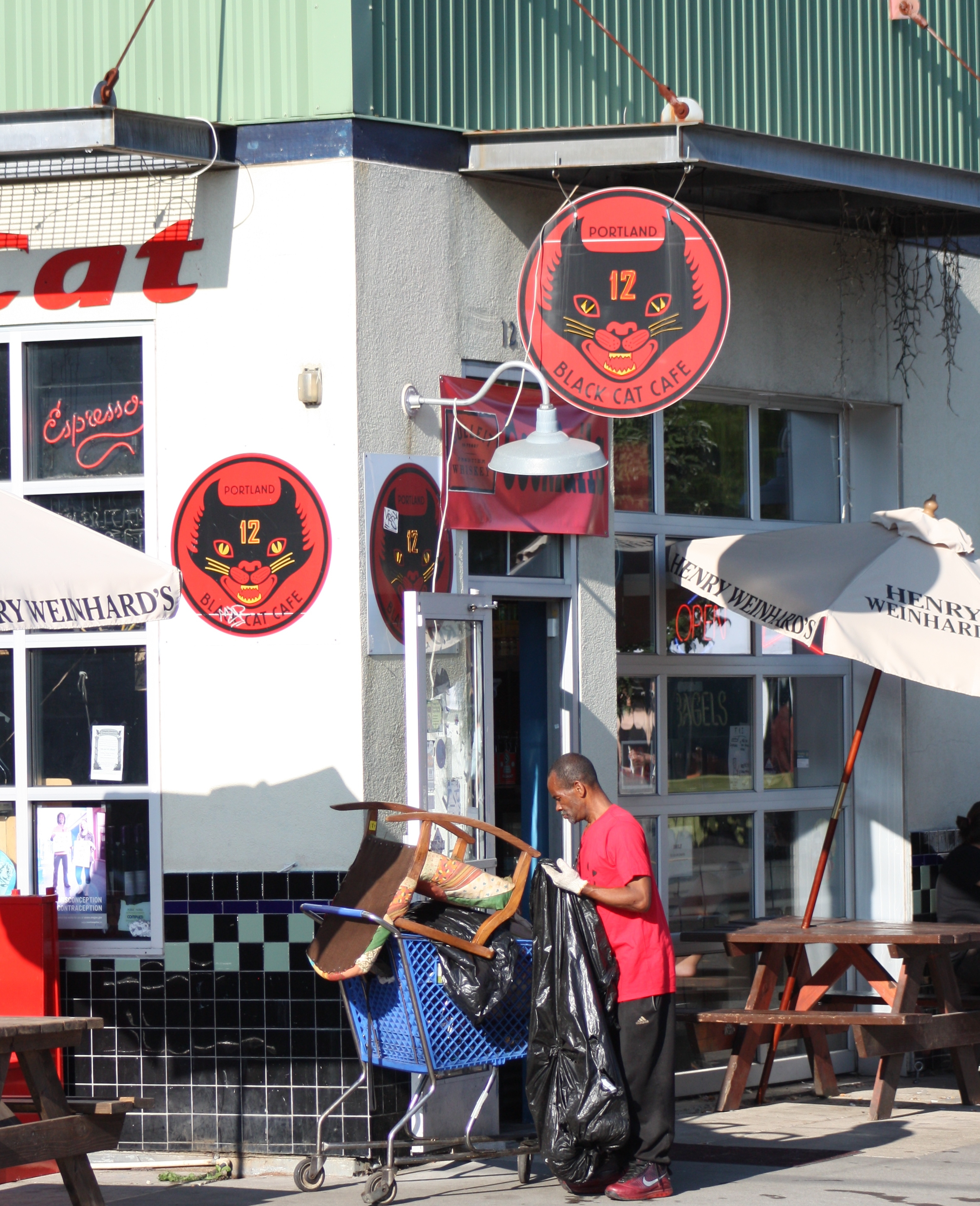
Black Cat Café

There are plenty of coffeehouses and taverns stocked with microbrews.
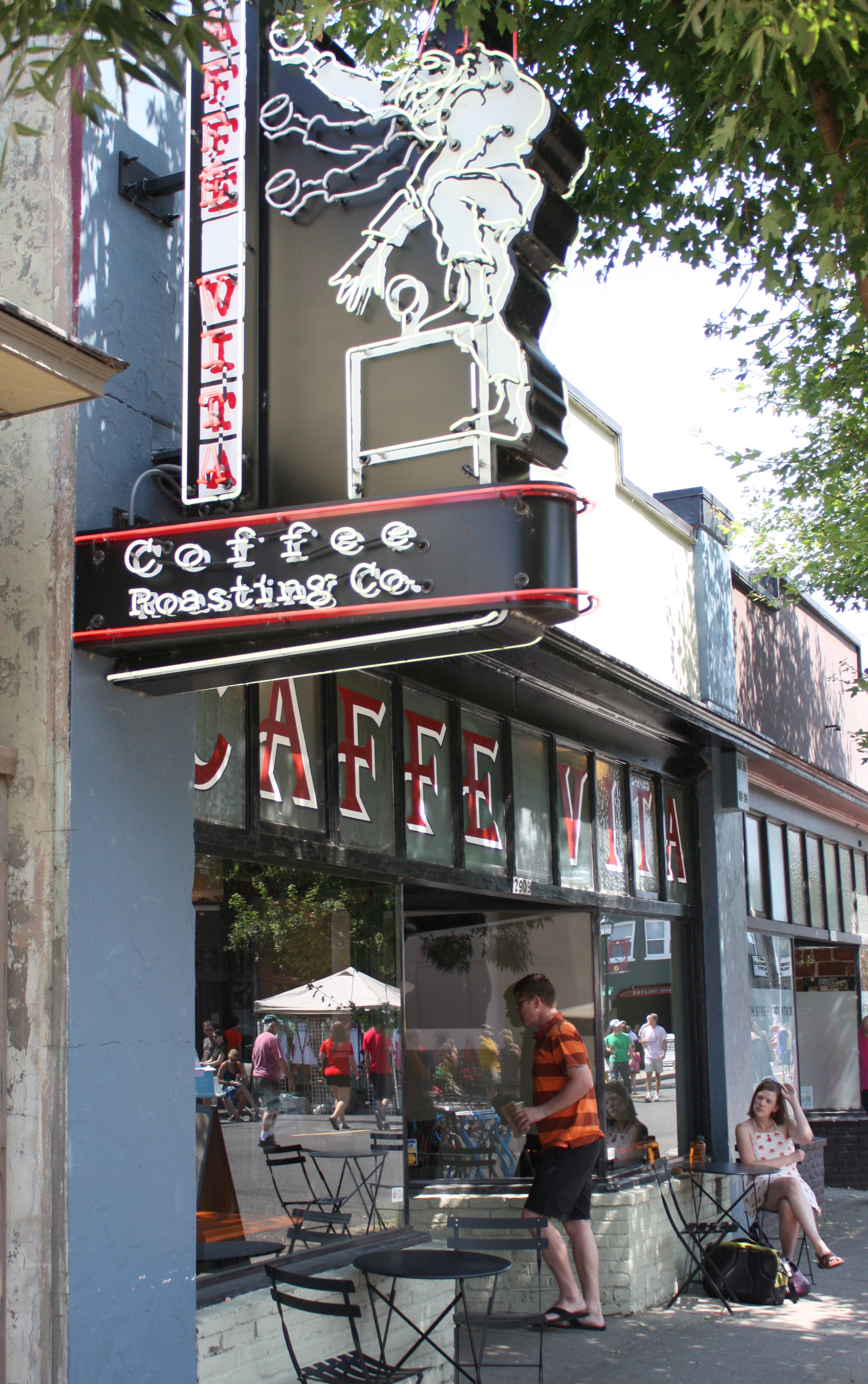
Caffé Vita

Bug-headed balloon sculptor

There’s hardly a block without some kind of street performer, and they run the gamut from jugglers to musicians.
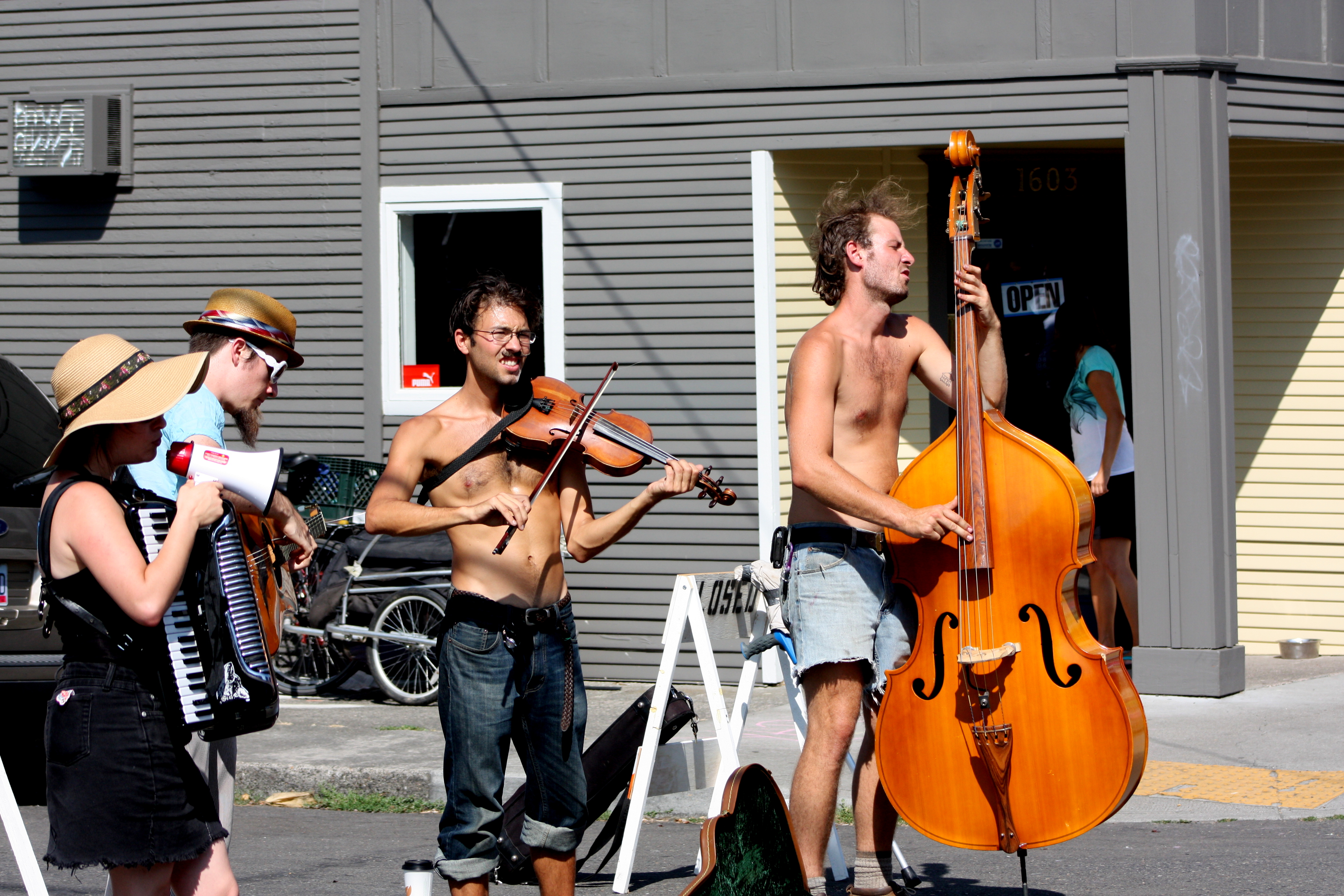
Street musician quartet
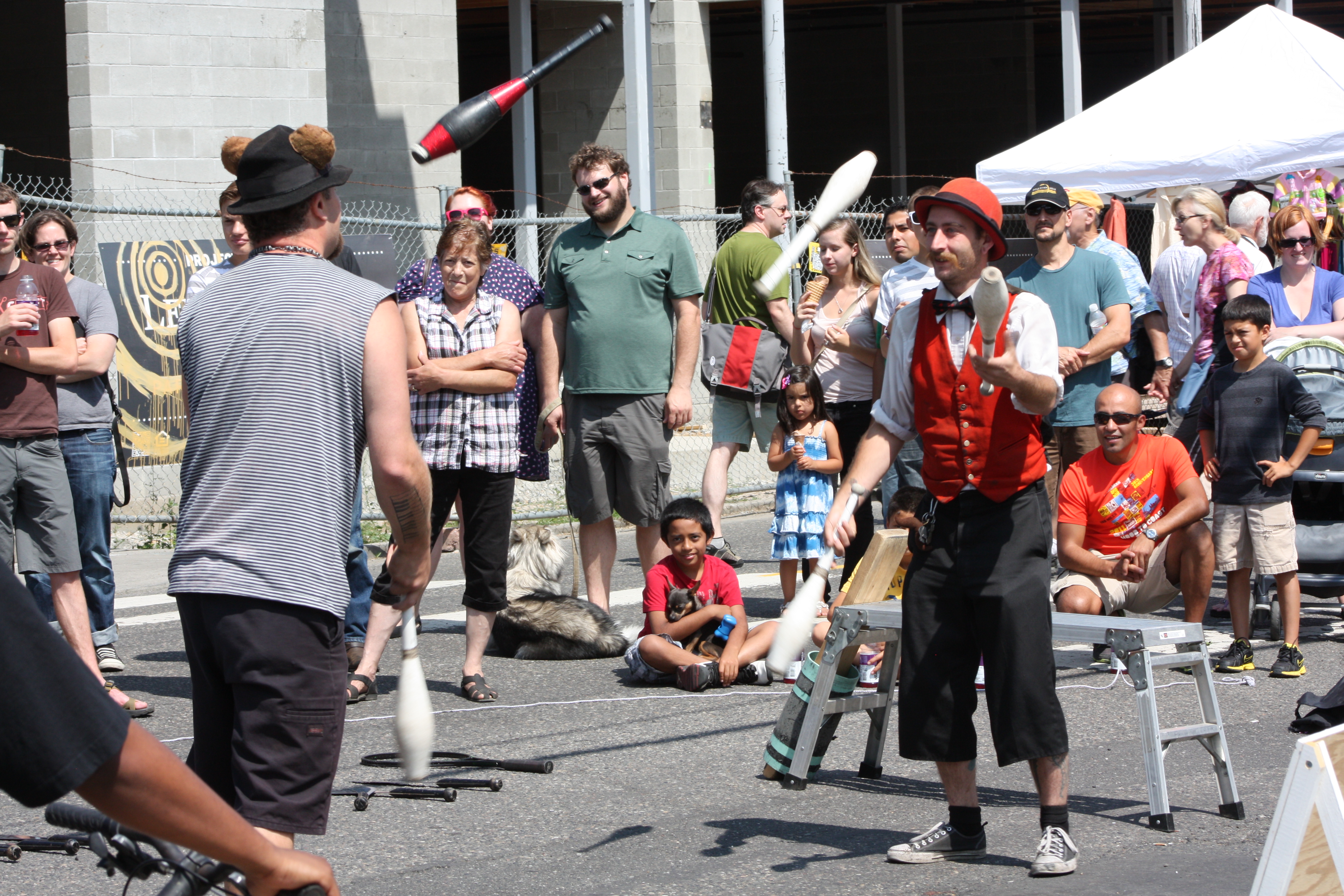
Street jugglers
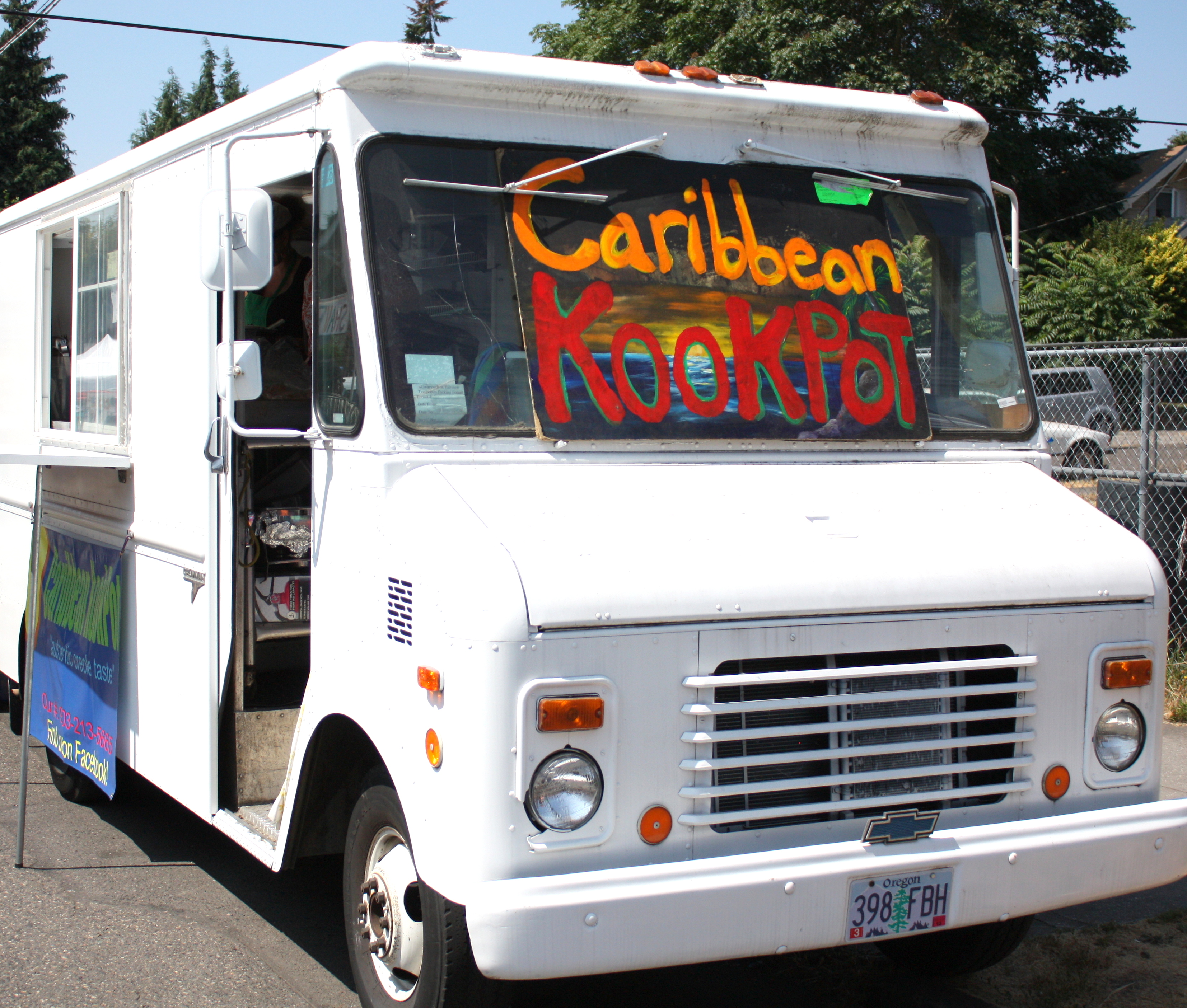
Island food truck

The foodservice here is nothing if not electic. Great eats from international cuisine to American comfort food is offered in everything from sit-down restaurants to food trucks.
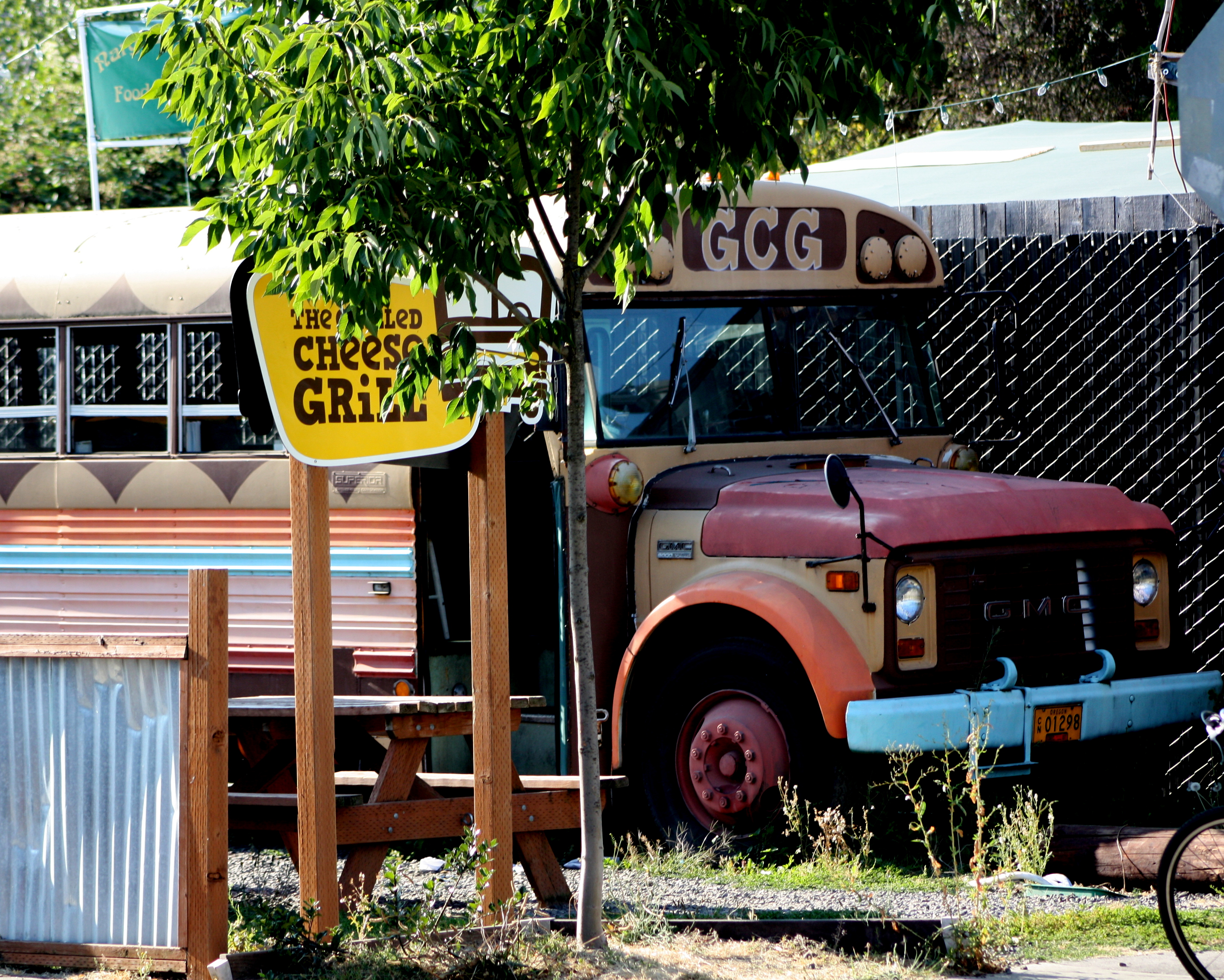
The Grilled Cheese Gril
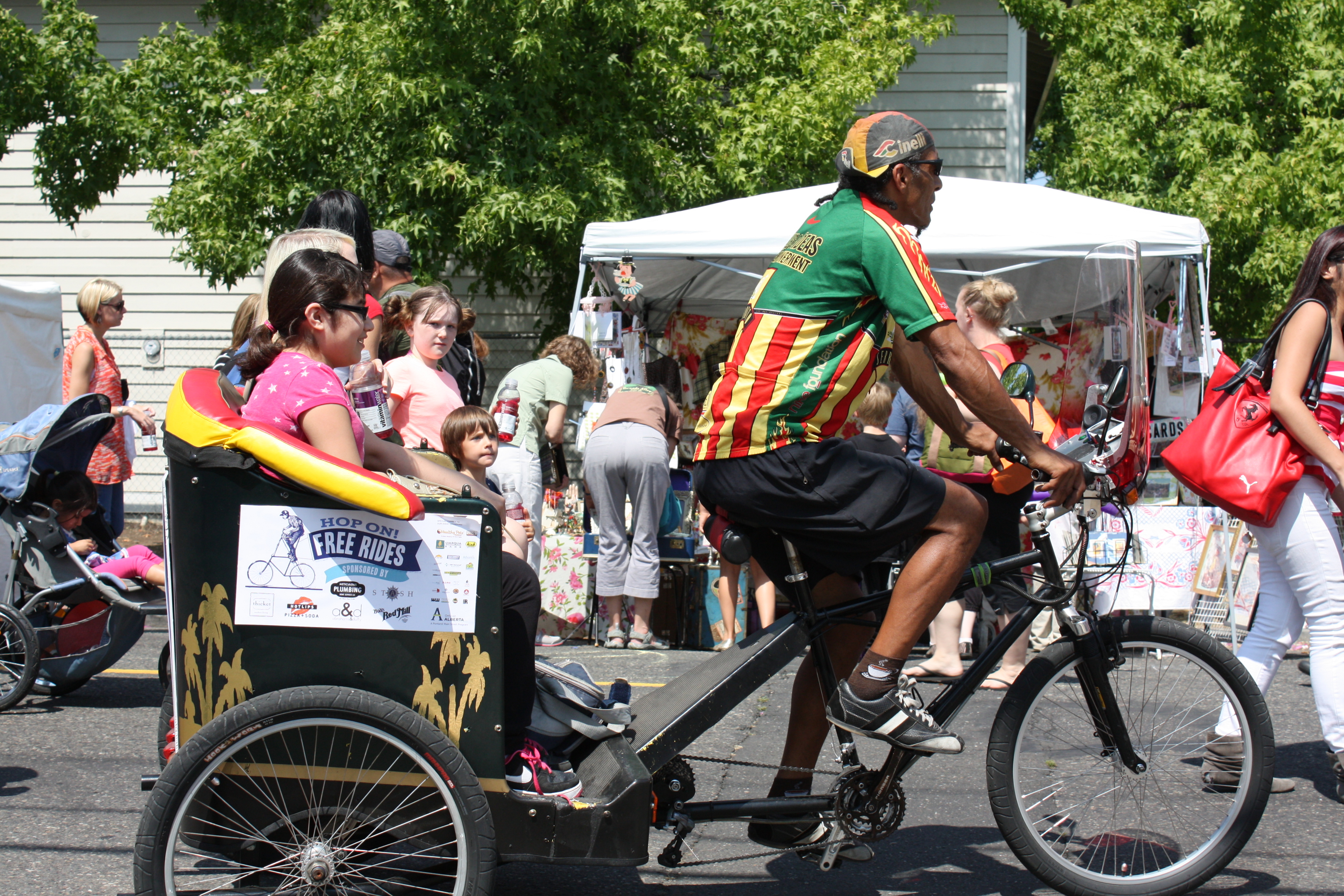
Pedi-cabbie

Pedi-cab taxis are are about as “green” as you can get!

Gargoyle…. purse not included

Vintage clothing and furnishings scream “recycle me” from resale shop windows

Art lamp chandeliers

Art and crafts in wood, leather, glass begs for a closer look at every corner, and the artists and artisans are engaged in animated conversations with passers-by.

You don’t have to be a shop-a-holic to end up buying something to take home.

Box-banjo player

Quirkiness is a virtue here, and if elsewhere it can be an annoyance here it’s almost always endearing.

The Hempress Café

The weekend runs out far too fast, but as I board the train back north I’m already looking forward to the next few days camping and hiking around Mount Rainier.
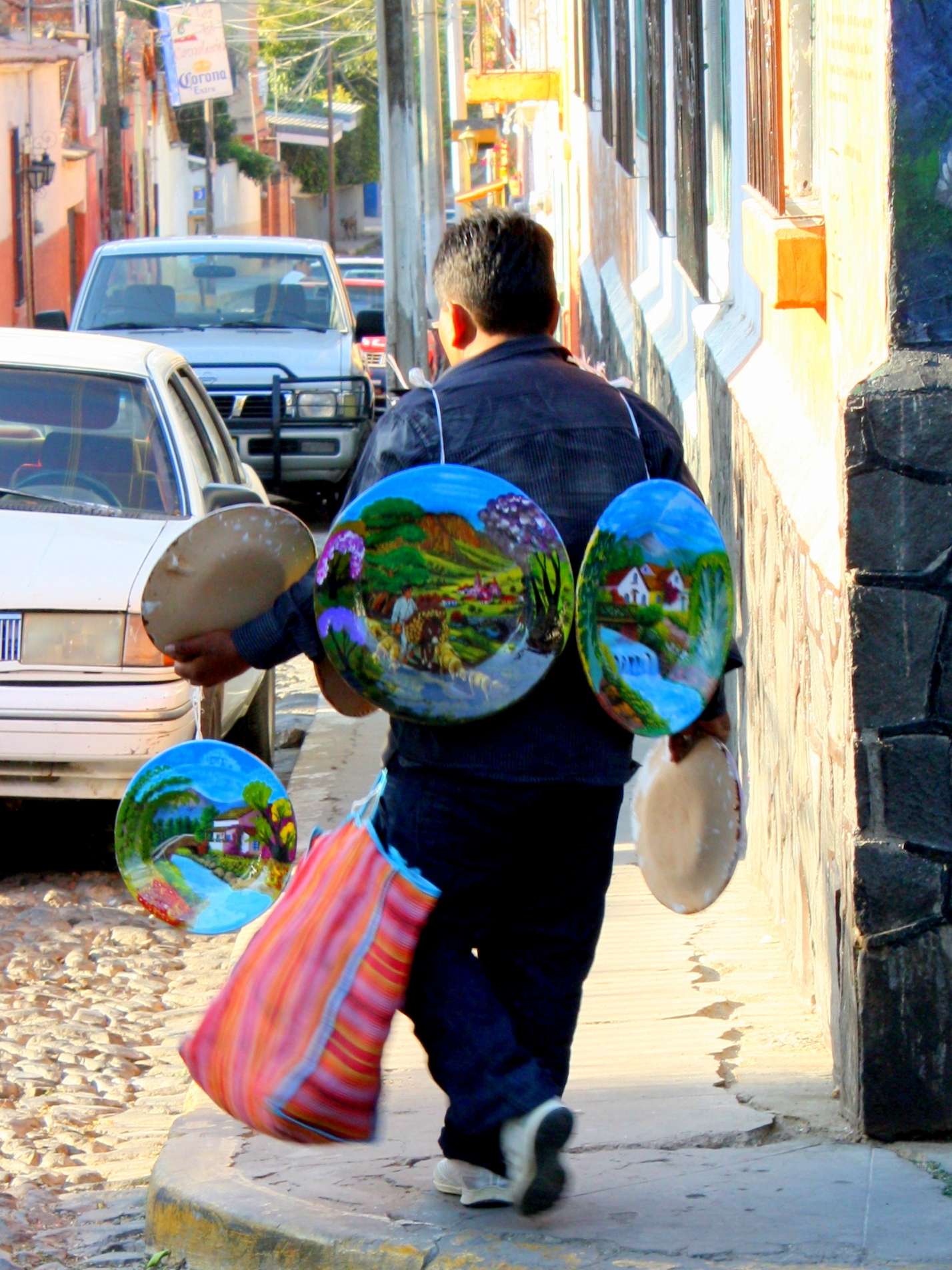
Street vendor walking on Colon

It’s nearly a century since pushcarts plied the streets of most American neighborhoods; sidewalk vendors of nearly every stripe went out of style when the nation traded Main Streets for malls.

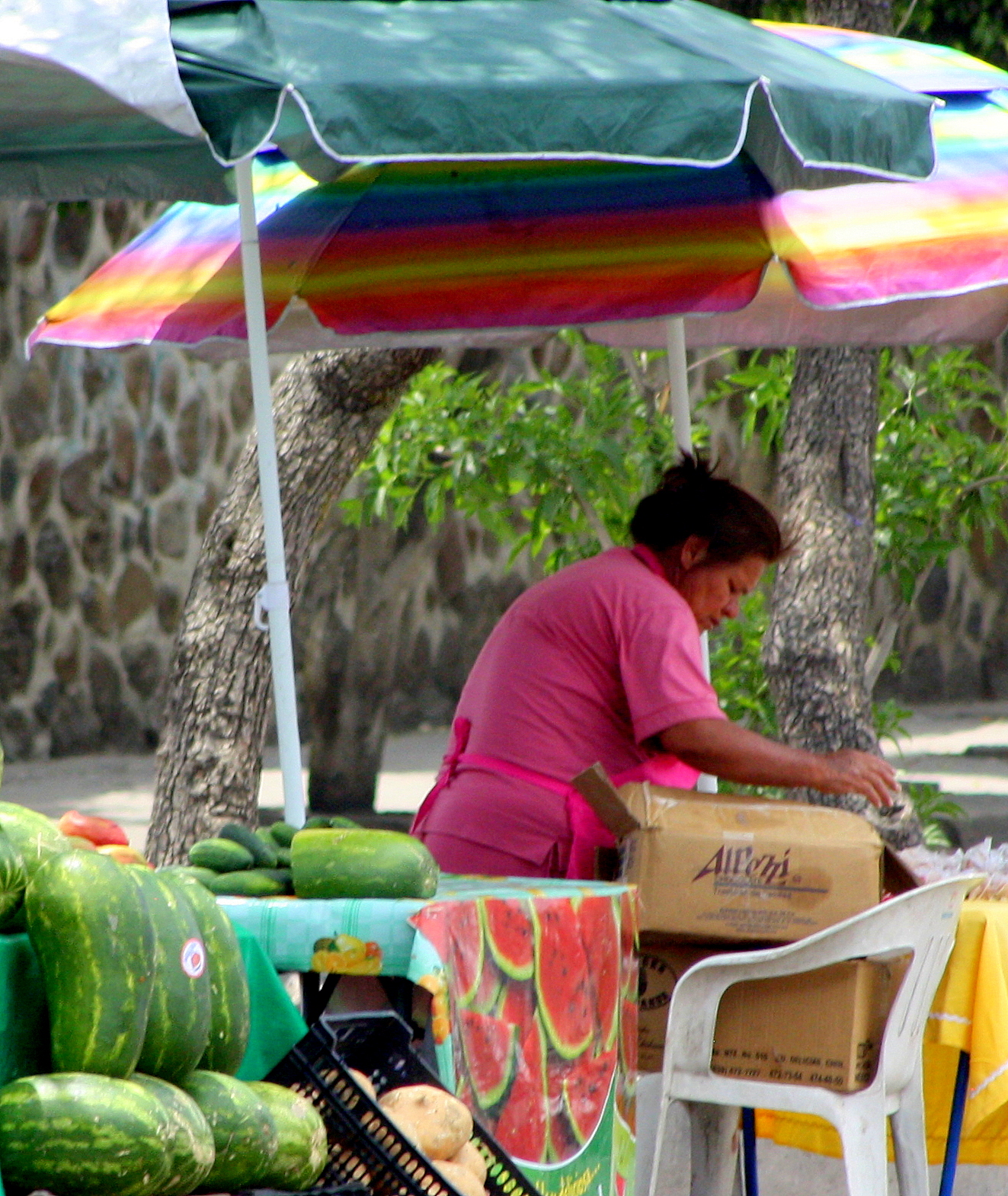
Fresh watermelons on the Carretera

In Mexico street merchants are alive and well.  It seems as if wherever in Mexico three or more people are gathered a fourth will show up with something to sell them. Retail here is up close and personal and the store often comes to you.

Ajijic’s street merchants are not the annoying chachki vendors of the coastal resort beaches, but a retail subculture that’s baked into Ajijic’s endearing DNA.

Nuts & snacks on the Plaza

More people gathered attracts more sellers, and in Ajijic the Plaza and the Carretera rarely lack for either.

Baskets & brooms on the Carretera

The variety of merchandise and services offered by these “no-store stores” often surprises.

Freshly-squeezed juices on the Plaza

Food vendors sell everything from frozen treats and freshly-squeezed beverages to prepared foods (taco stands warrant a blog post all their own!), home goods, and flowers.

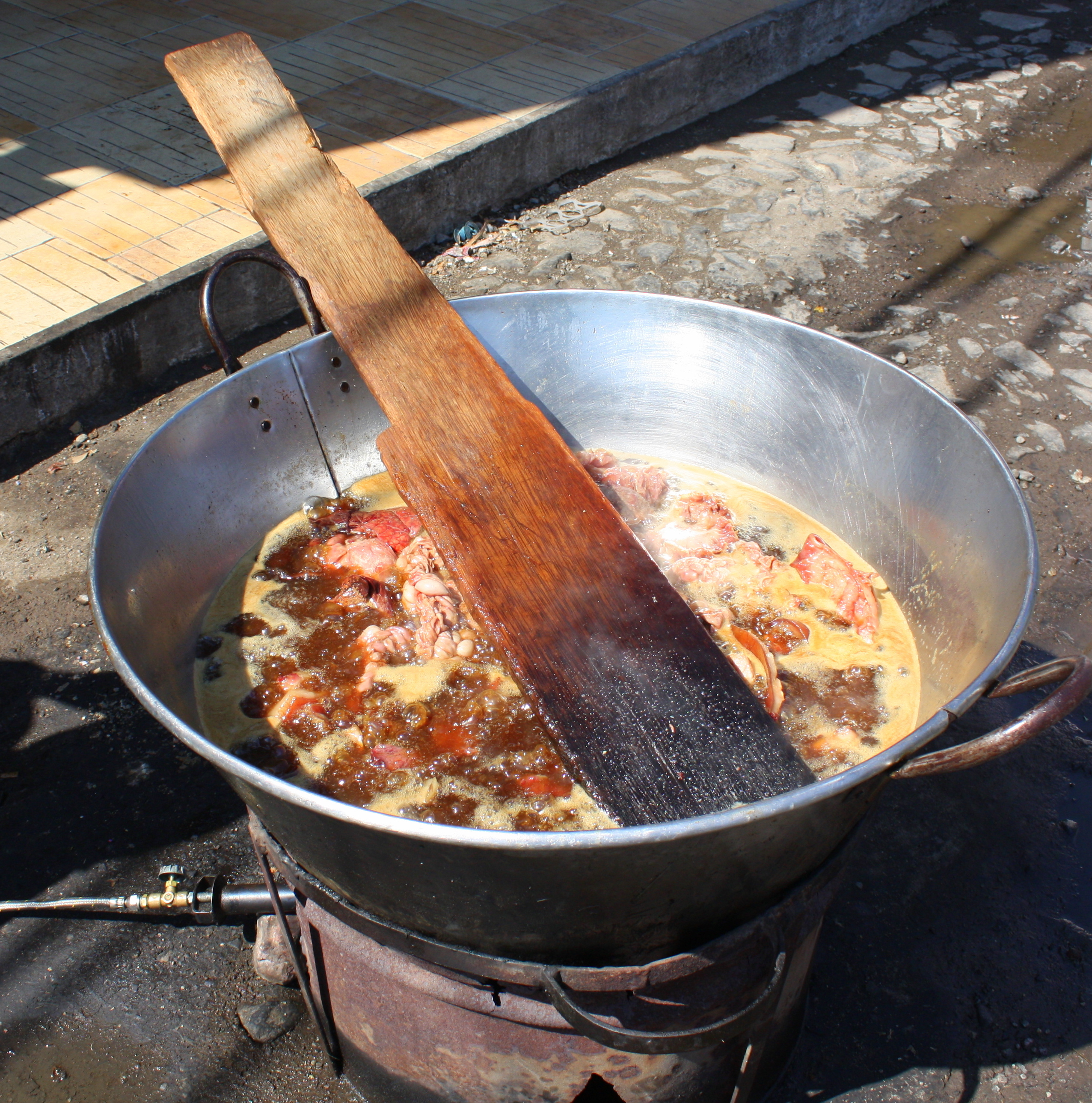
Chicharrón in the making

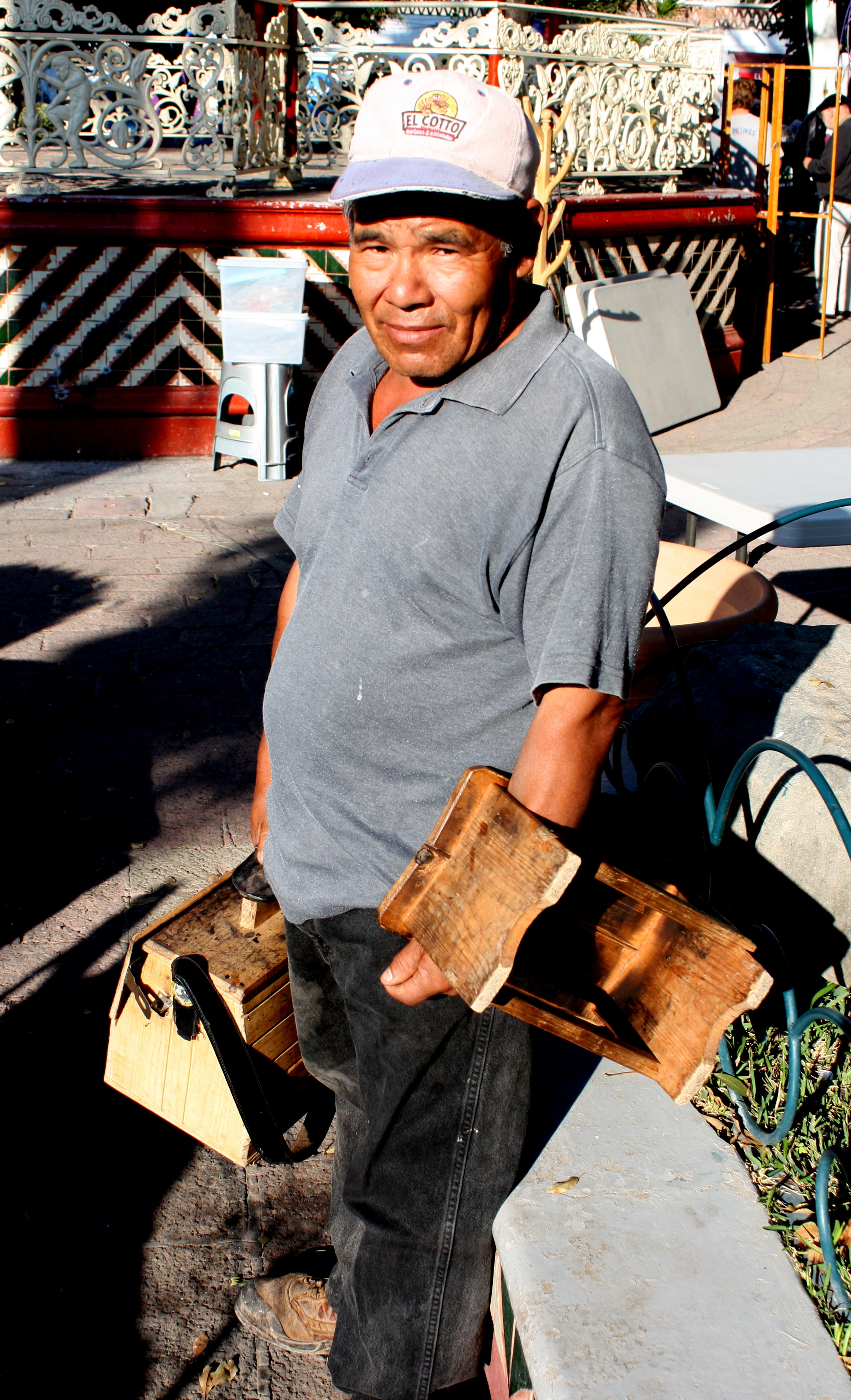
Shoe shine on the Plaza

Street merchants will also dupe your keys, shine your shoes, sharpen your knives and wash your car in less time than it takes to find a parking spot at your average Stateside Safeway.

Basket vendor on the Plaza

Walkabout vendors are the salt of the street merchants.

They carry their entire inventory on their backs, often walking miles every day.

CD & DVD bike cart on the Plaza

Some merchandise, though, begs to be wheeled through the crowd, and the conveyances are nothing if not inventive.

Other merchandise better lends itself to hanging from trees and fences each day to be carted off at day’s end and re-hung each morning.

A very few even sell from roadside kiosks not much larger than a phone booth.

Most of the street merchants not walking or wheeling about are parked so routinely in the same spots at their appointed times that people sometimes use them as directional landmarks.

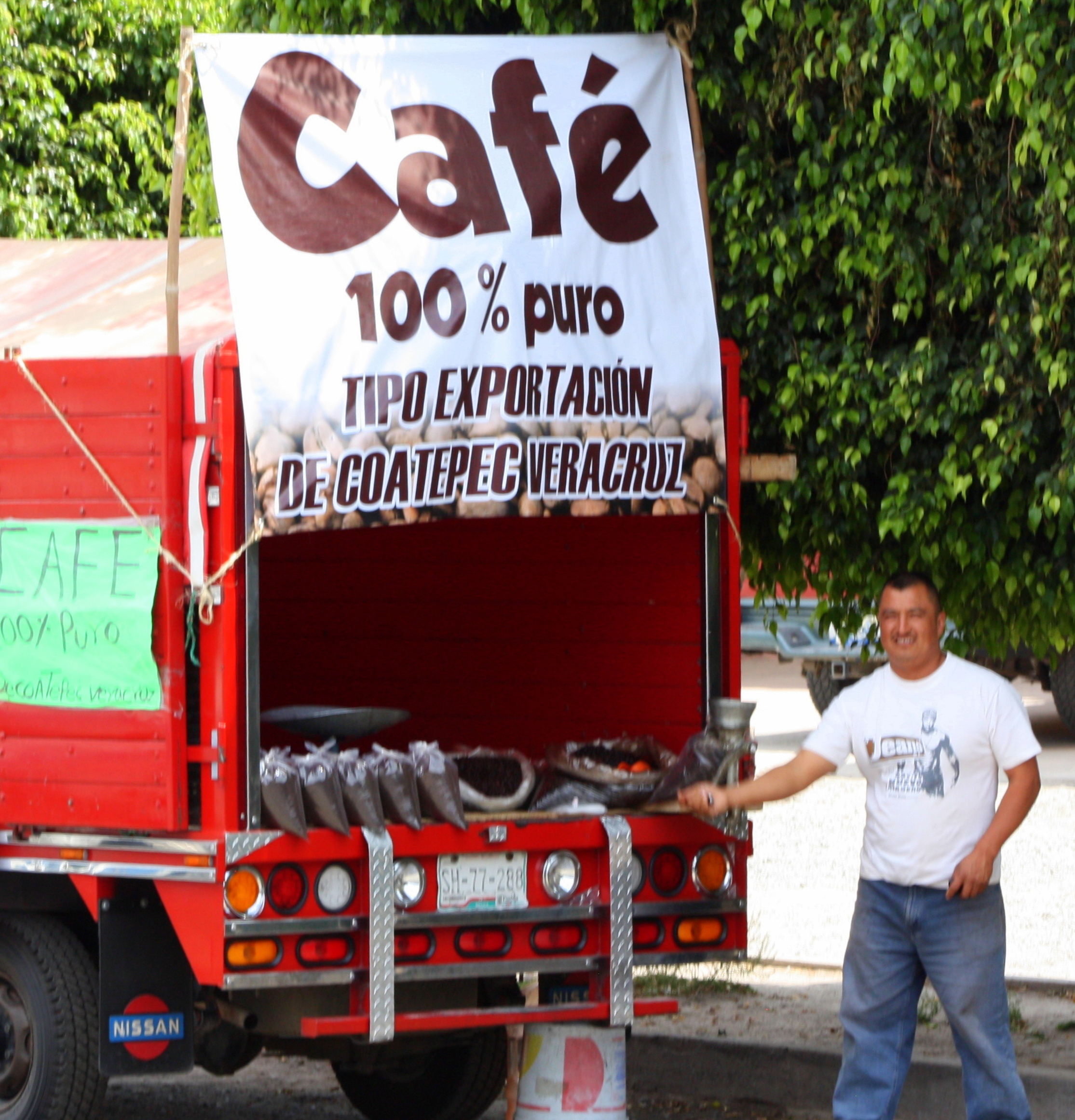
Coffee vendor/grinder on the Carretera

Among them will appear for a day or a week spontaneous street capitalists who vanish as suddenly as they appeared.

On the Plaza curb in front of BBVA

Many of these sidewalk merchants start each day very early by walking, bicycling, or riding the bus to Ajijic from homes in nearby villages.

Ice cream vendor stocks up

Others stock push carts or buy fresh products at a wholesale market before the selling day begins.

There are no bar codes or credit cards here.

There are no frequent shopper programs, blue light specials, or rebates.

There’s just cash and carry from a sole proprietor who does one thing only and strives to do it better than anyone else.

There are also plenty of merchants who are as well known to their customers as the customers are to them, and there’s no small amount of loyalty between many buyers and sellers.

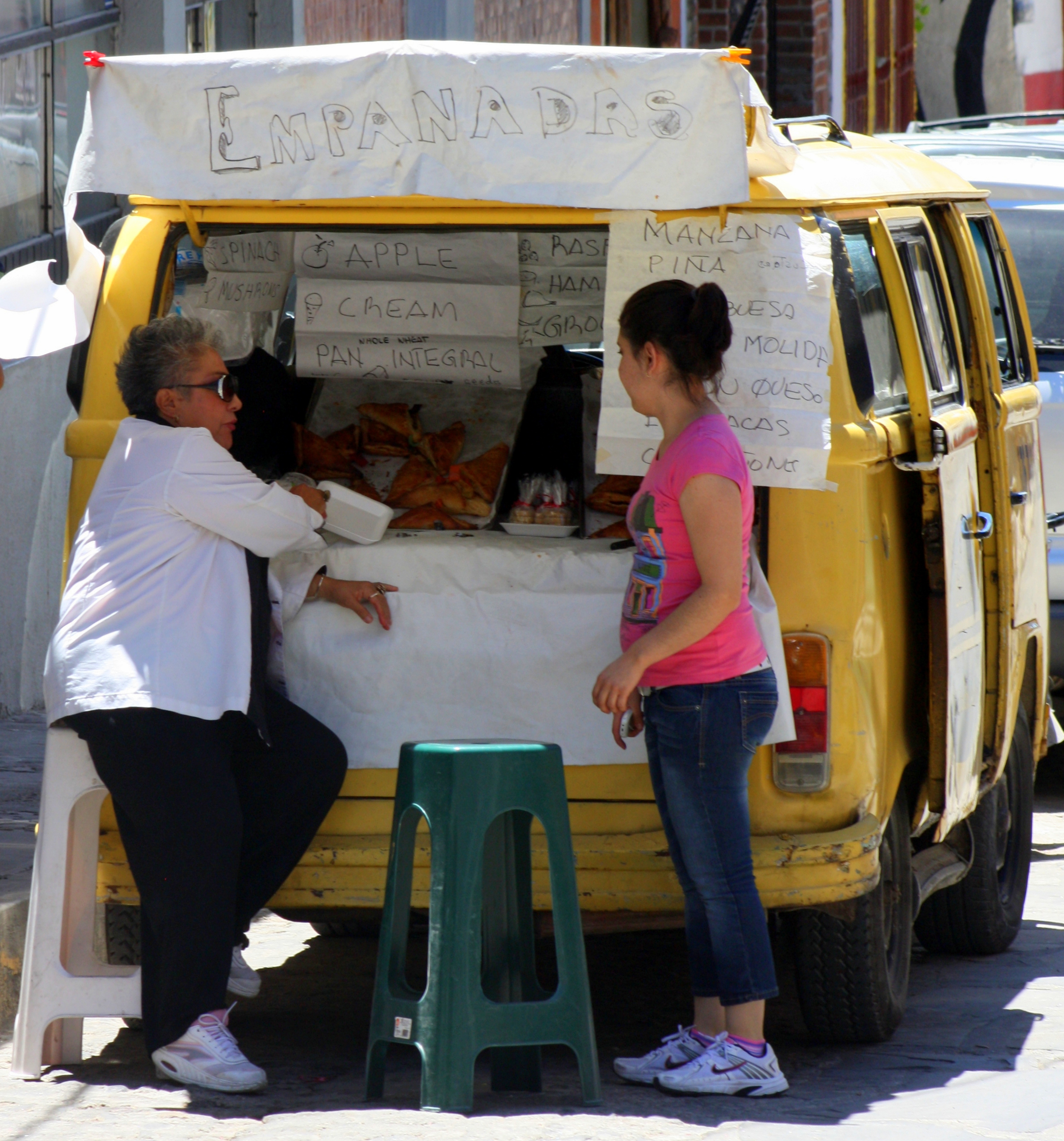
Curbside empanadas on the Plaza next to BBVA

It’s a relationship long gone in America’s retail landscape, but for those who can take it in stride it can be a richly rewarding trade-off for America’s impersonal, one-stop, “big box” shopping experience.

See my related post “American Values

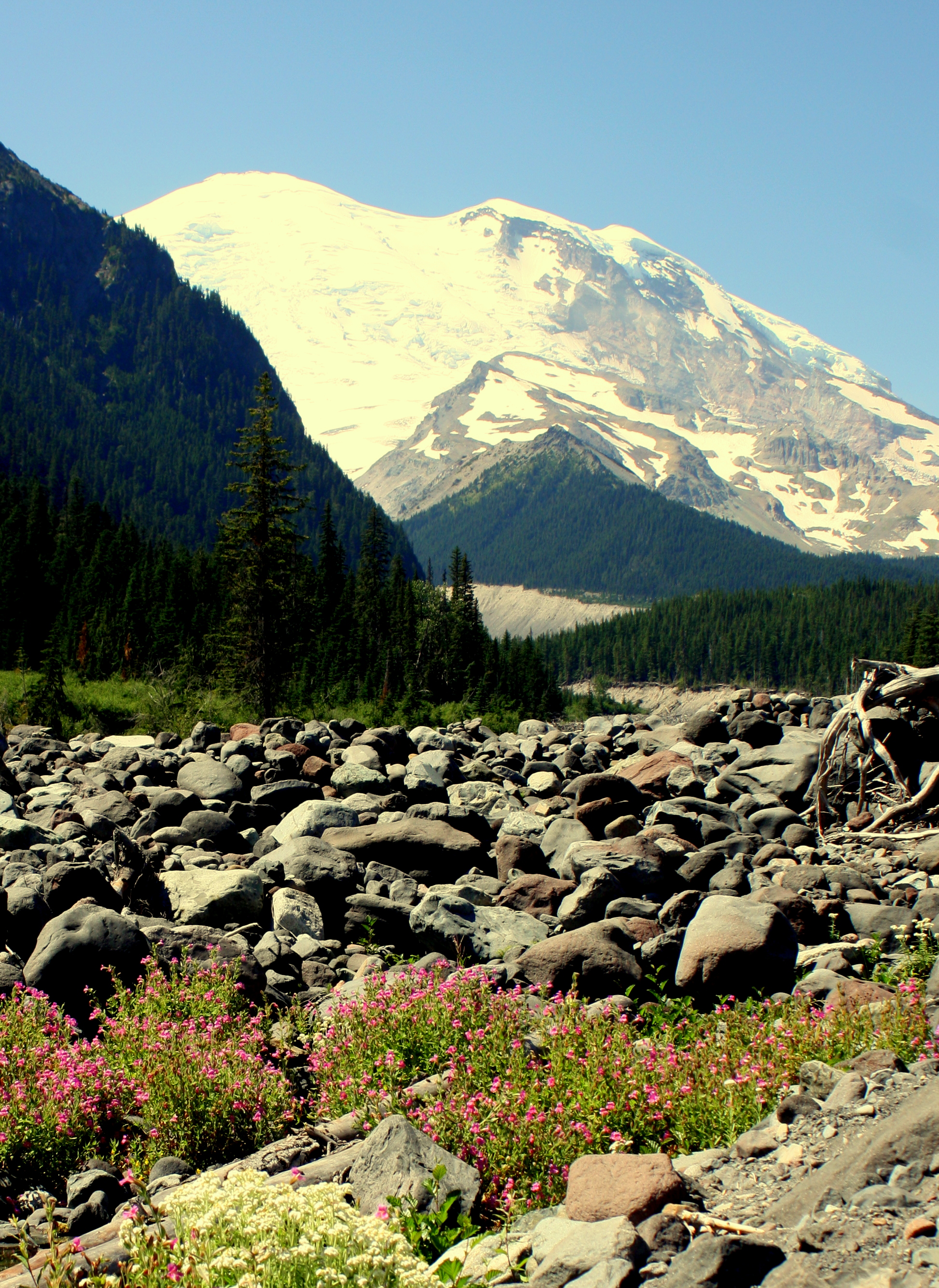
Mt. Rainier, WA from White River Campground

I’ve seen Mt. Rainier from the air on countless occasions, but nothing compares to the experience of approaching it on the ground.  At 50 miles away its 14,000-plus feet already dominate the skyline, and by the time we reach our campsite at its feet on the White River it dwarfs us.

Before dawn the sky here is pitch black and covered densely in stars that shine brightly through the thin mountain air.

Mt. Rainier at sunrise
As dawn ripens into sunrise, snow-capped Rainier glows in rosy hues.

Mt. Rainier at sunrise

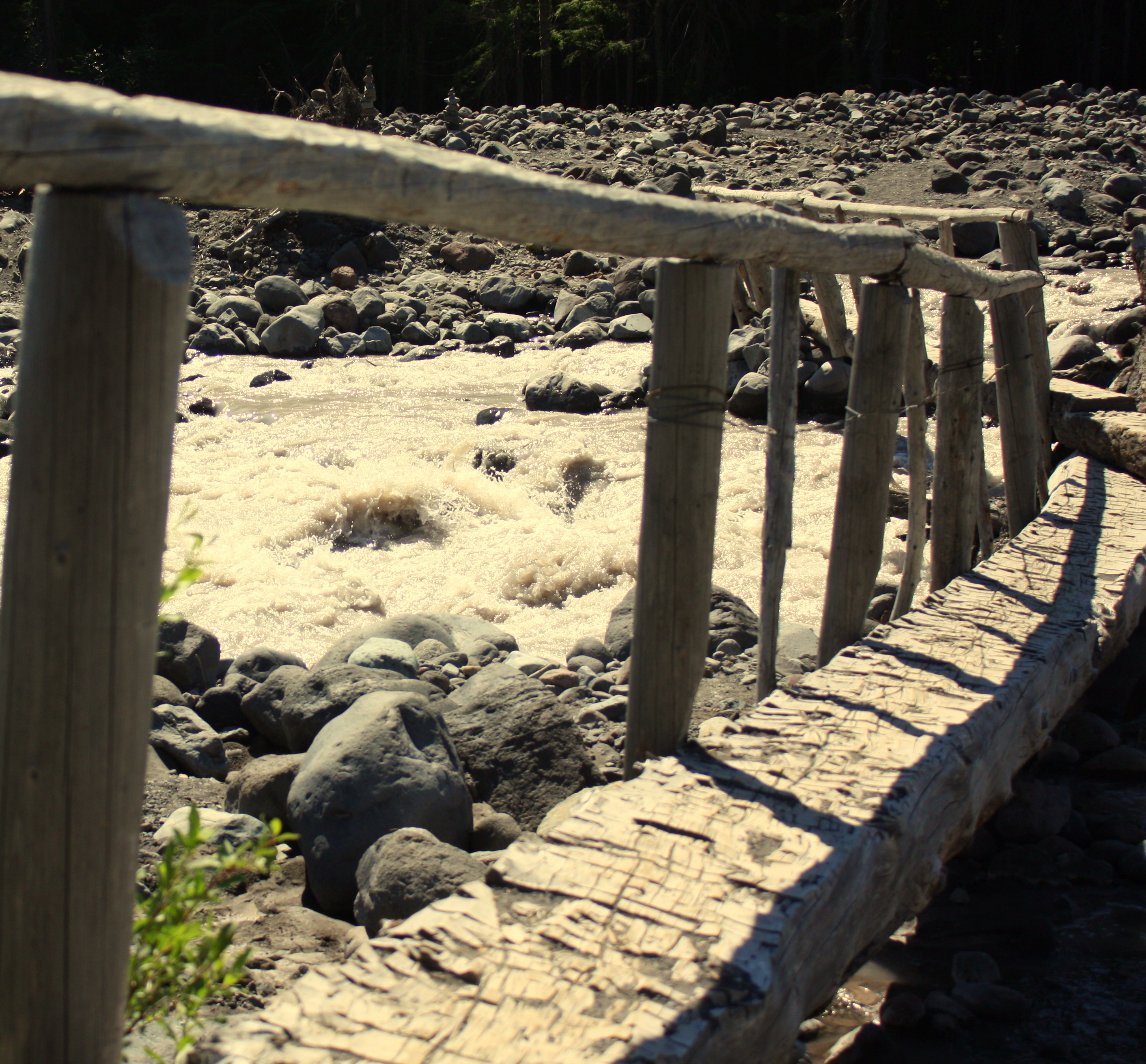
The White River flows brightly and turbulently from its invisible source at the foot of the glacier, carrying ancient and ashen volcanic pumice and rock through emerald forests at the mountain’s feet. Along its bank cairns built by hikers from river stones stand like miniature prehistoric monuments.

White River footbridge, Mt. Rainier Nat’l Park

Rock cairns on the White River

Riverbank rock cairn, White River

Wildflowers and rock cairn, White River

We’re only 6 miles from Rainier’s summit as the crow flies, but there’s no straight line route anywhere within its surrounding park, and distances are measured at least as much in altitude as in linear miles.

Wildflowers along the White River

The day’s hike covers connecting trails about 6 miles long.  The route ascends 1,100 feet from the Sunrise Visitors’ Center at 6,400 feet and then descends 3,000 feet back to the campground.  The hike will take more than 6 hours, but with no wireless coverage and no clocks time is measured only by the sun’s position and its shadows.

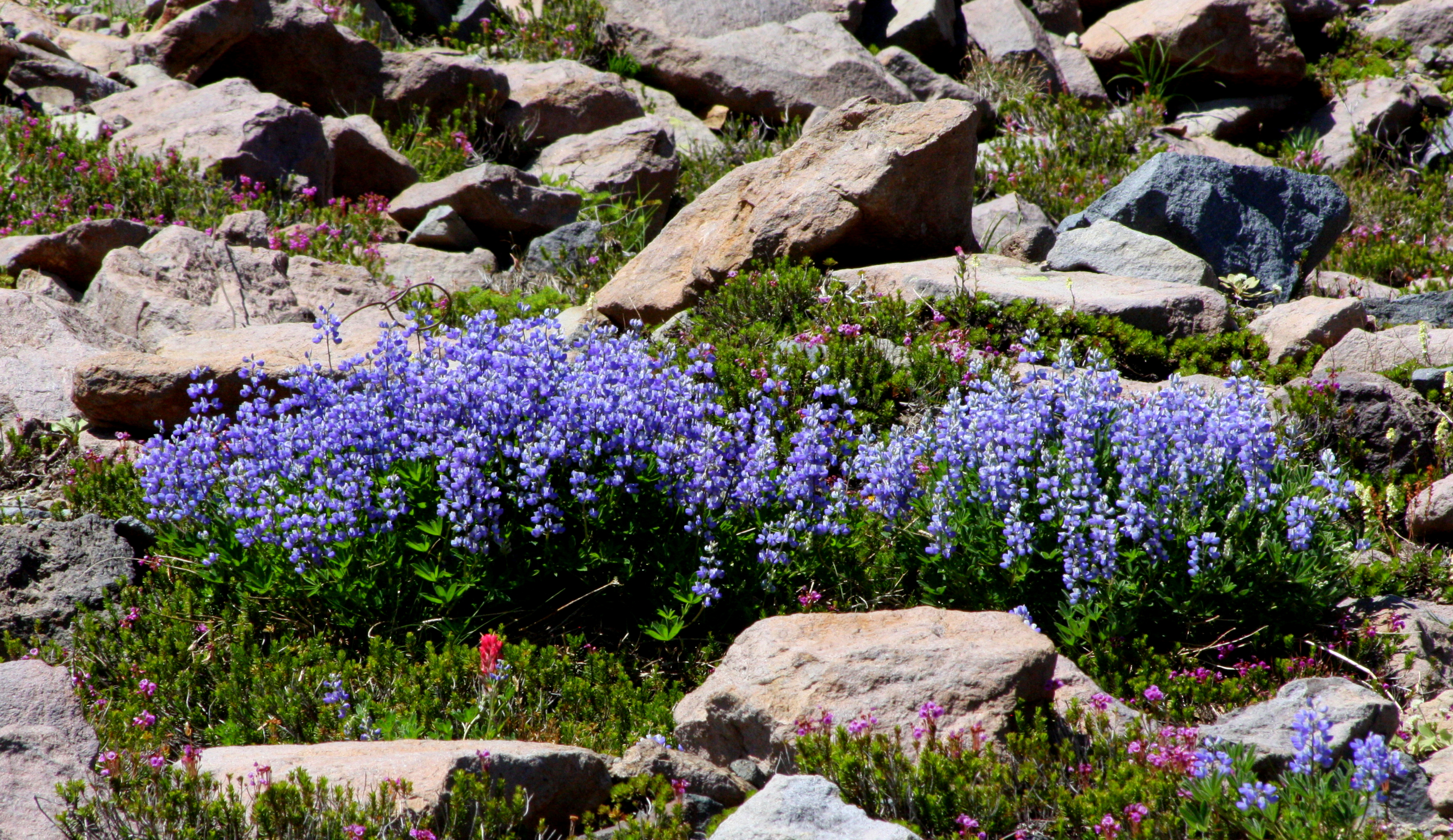
Wildflowers, Mt. Rainier Nat’l Park

The first leg of the climb winds through shallow elevation and dense evergreen forests broken by meadows covered in a riotous carpet of wildflowers.

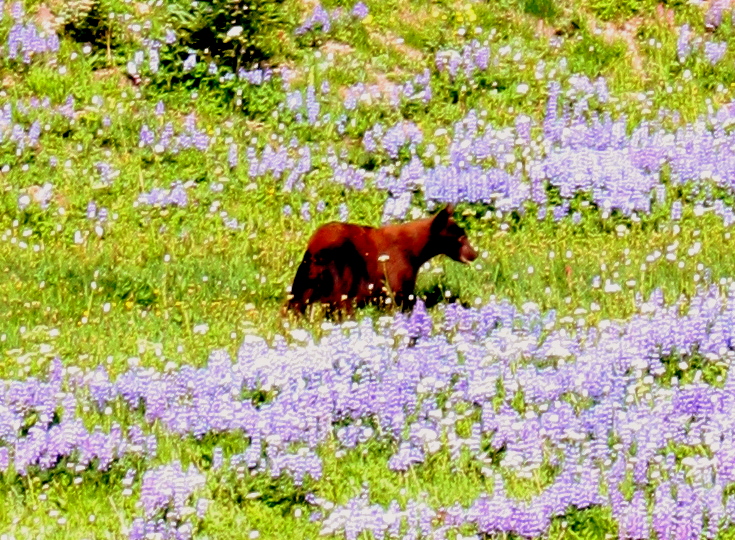
Brown bear, Mt. Rainier Nat’l Park

Not an hour into the trip a young brown bear grazes his way slowly on a converging path not 150 feet away, and we slip quickly and quietly past and ahead before the trail narrows.

White River from Burroughs Trail, Mt. Rainier Nat’l Park

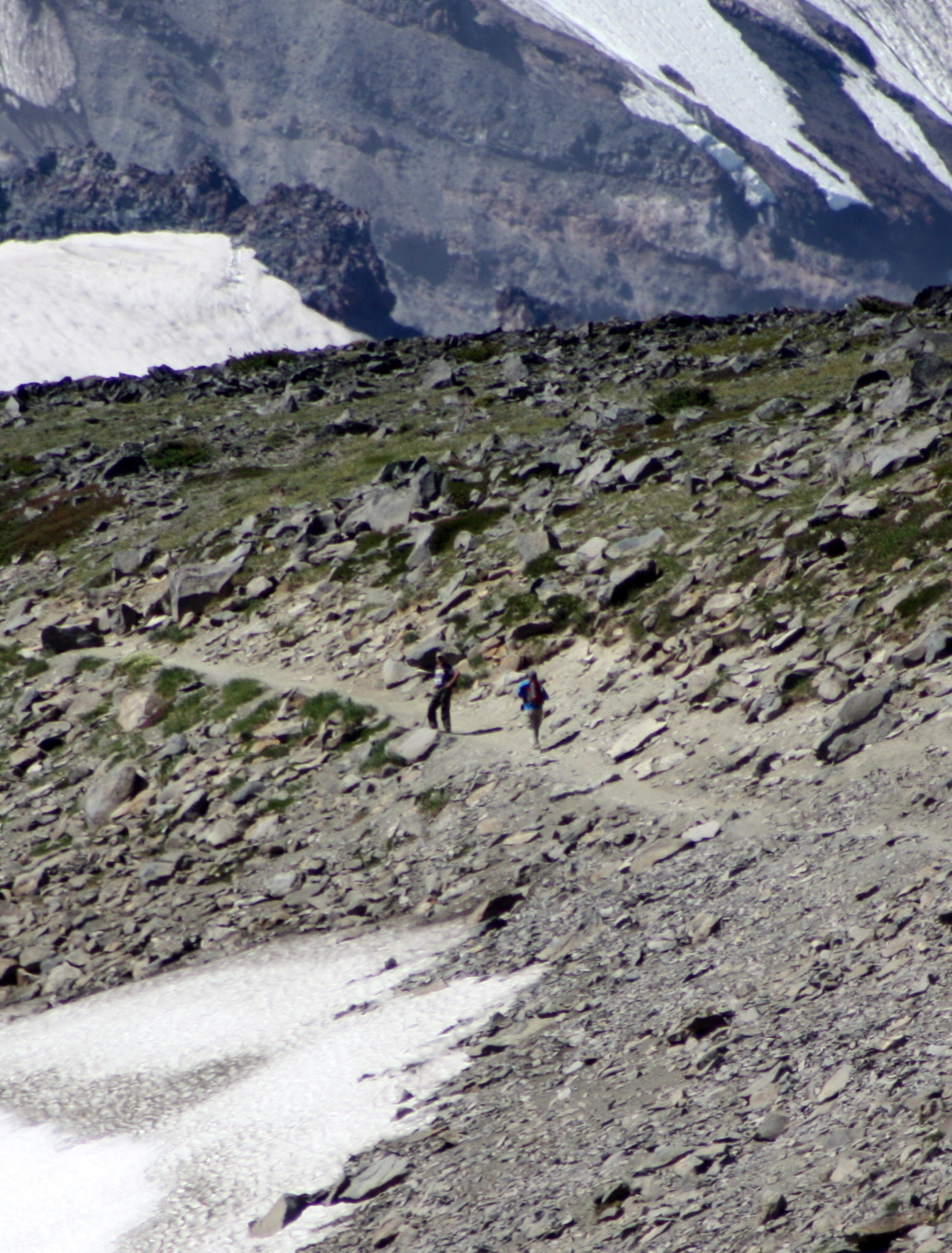
The route begins a steep ascent, at times shrinking to no more than a couple of feet wide above steep drop-offs.  The August skies are sunny and the temperature is T-shirt warm, but at one point we work our way gingerly through remnants of winter snow.

Mt. Rainier and Shadow Lake

Rainier and its surrounding peaks loom ever larger across the White River valley, and Shadow Lake sits far below us, its waters turned bright aquamarine by mineral-rich runoff.

The pines become shorter, slimmer, and fewer until they vanish at the tree line, leaving only grasses and the riotously colored carpet of wildflowers.

Wildflowers, Burroughs Trail

Looking eastward from Burroughs Trail

Burroughs Mountain, the highest point of our climb, sits between the fingers of two of Rainier’s many glaciers, and as we approach its summit ridge a stiff wind cools us from the rigorous climb and glaring sun.

Here a breathtaking panoramic view unfolds across all points of the compass.   To the east rows of mountains stretch as far as the eye can see. The Cascades are draped across the horizon to the north and Mt. Rainier still towers more than 6,000 feet above us only three miles away, the details of its glaciers now crisp and clear.  Only to the west do the mountains subside into a flat skyline. The terrain is rocky and desolate here.

Burroughs Trail summit, Mt. Rainier Nat’l Park

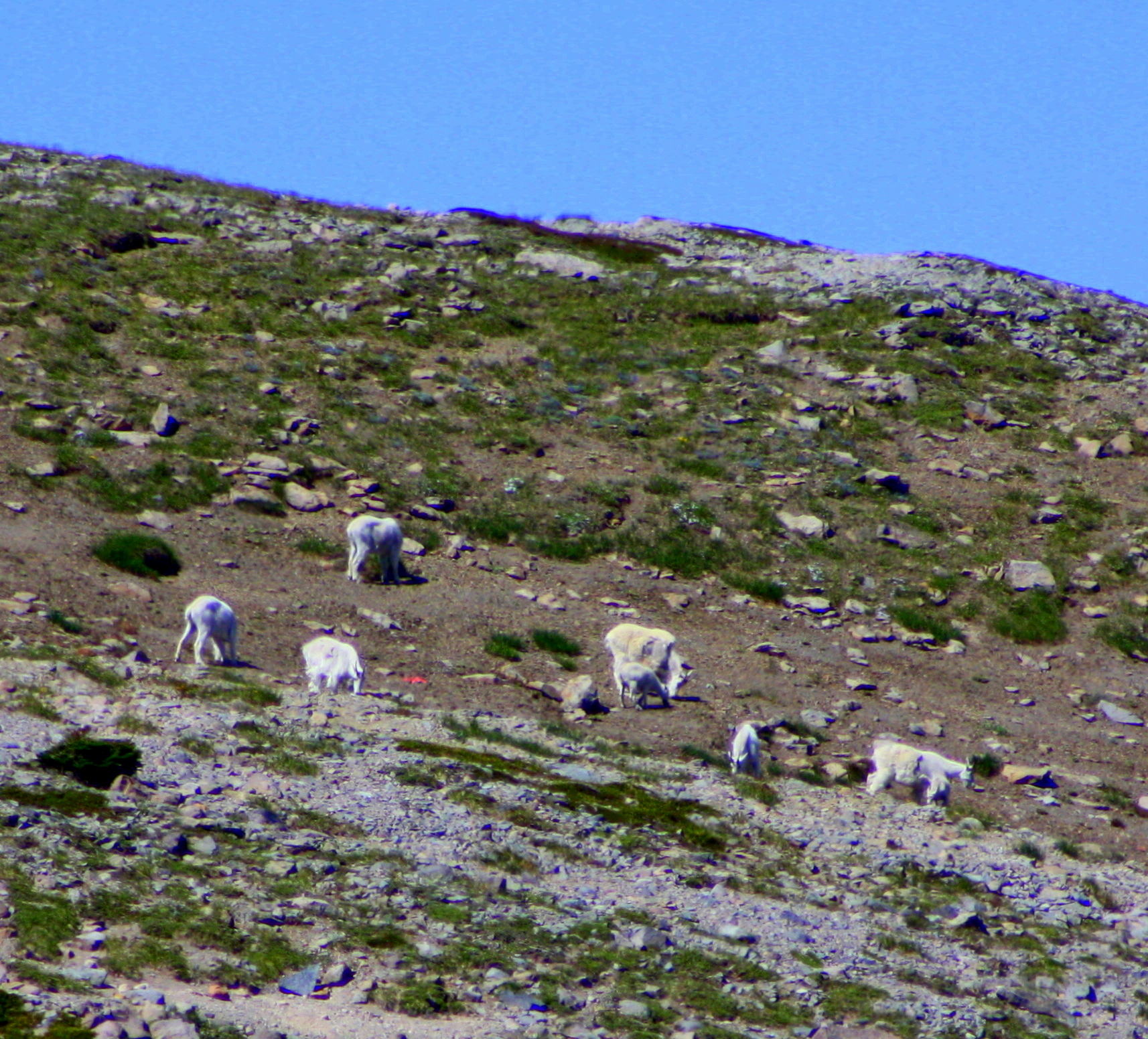
Mountain goats on Burroughs Mountain

A small herd of mountain goats, the only animal that can survive in this inhospitable terrain, grazes in a closely-cropped meadow on a plateau separated from us by a shallow valley.

We begin our descent through a grade more than twice as steep as our ascent, weaving through a seemingly endless series of tight switchbacks.

Beginning the descent, Burroughs Trail

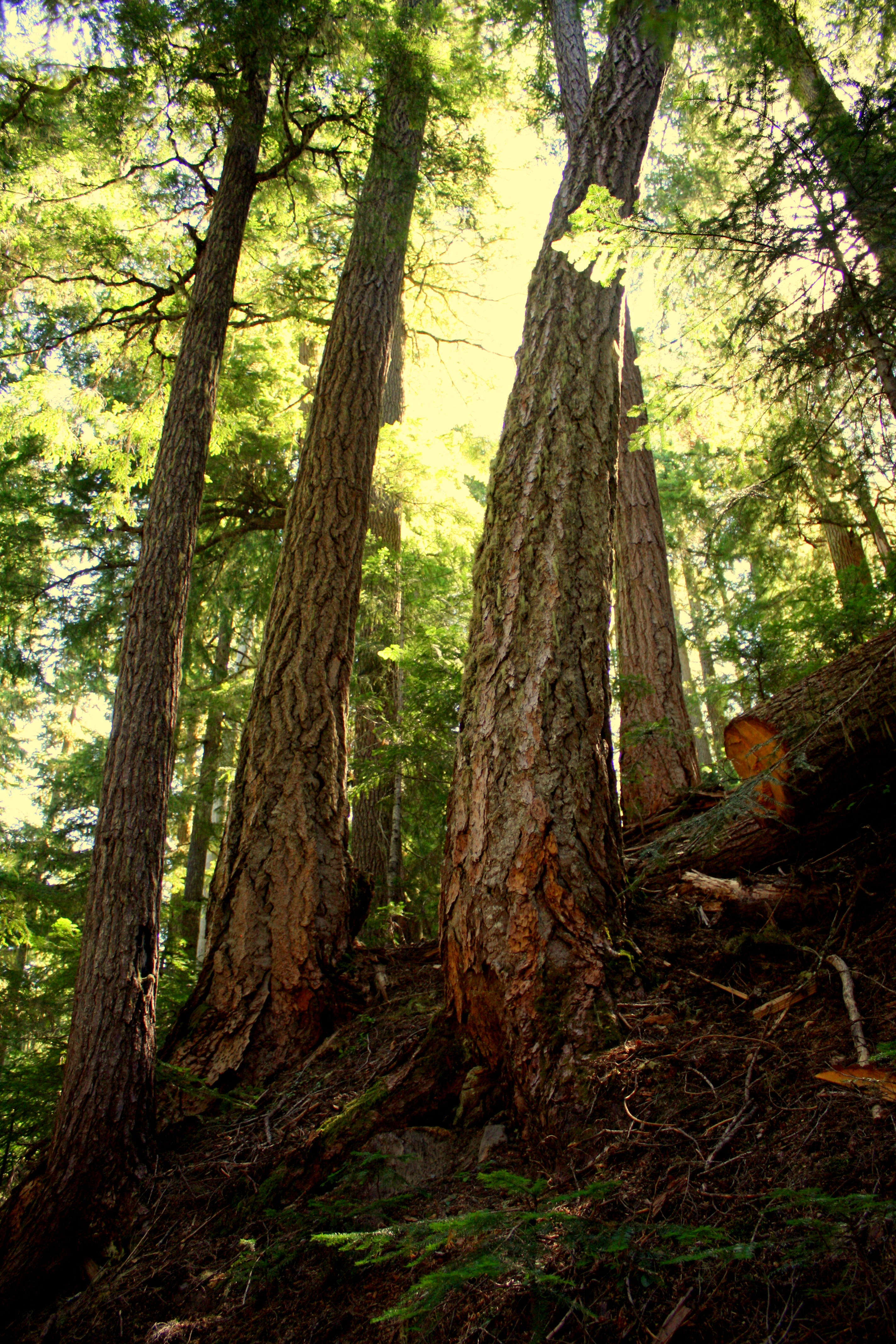
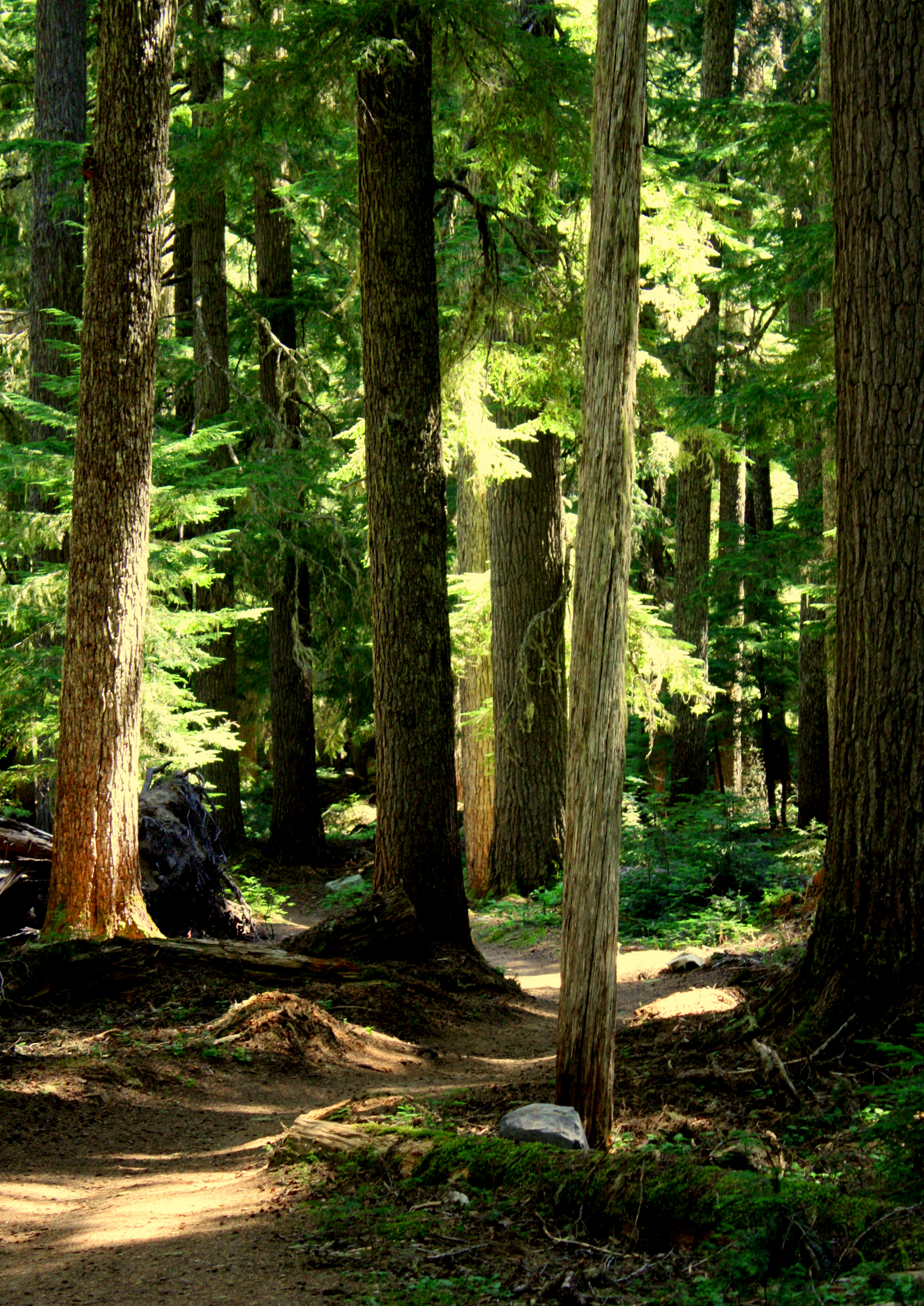
Wildflowers and grasses are the first to reappear, followed by pines which grow steadily taller and sturdier as we drop below our departure altitude.  Within a couple of hours we are hiking among trees up to three feet in diameter packed so densely that only occasional patches of sunlight filter through to the forest floor.

Burroughs Trail, Mt. Rainier Nat’l Park

Here all is quiet except for the ever-present sound of rushing water and tumbling stones in the White River far below.

Burroughs Trail, Mt. Rainier Nat’l Park

Small creeks begin to appear out of the mountainside, tumbling downward toward the river through pint-sized waterfalls that we sometimes ford and sometimes cross on narrow log footbridges.

Burroughs Trail, Mt. Rainier Nat’l Park

Burroughs Trail, Mt. Rainier Nat’l Park

By the time we reach the campsite we’ve crossed through several microclimates and geographic formations layered upon each other like some giant archeological dig.

It’s hard to experience nature as we have without reflecting upon man’s brief existence on this planet and his insignificance in the face of the forces of nature.

Mount Rainier is a memory that will remain vibrant for the rest of a lifetime for all who are fortunate enough to experience it.

Avenida Vallarta on Sundays

The Avenida Vallarta is arguably Guadalajara’s signature boulevard, cutting through the west side to expose a time-stamped cross-section of the city.

From its starting point at Avenida Juarez and Del Federalismo (there’s a subway station there) to the Minerva Fountain is about four miles, and there’s no better day – or way – to see it than Sundays, when it’s closed to vehicular traffic and given over to bicyclists, joggers, and walkers.

On the Avenida Vallarta

In the late 1800’s and early 1900’s Avenida Vallarta was a residential boulevard lined with the

On the Avenida Vallarta

elegant townhomes of Guadalajara’s well-to-do, and many of these structures still remain.

My plan is to travel the avenida east to west, beginning with the smaller, older homes that become progressively newer and larger as I go.

I start with the public architecture near the intersection of Avenida Enrique Diaz de Leon.


Templo Expiatorio, Guadalajara


University of Guadalajara

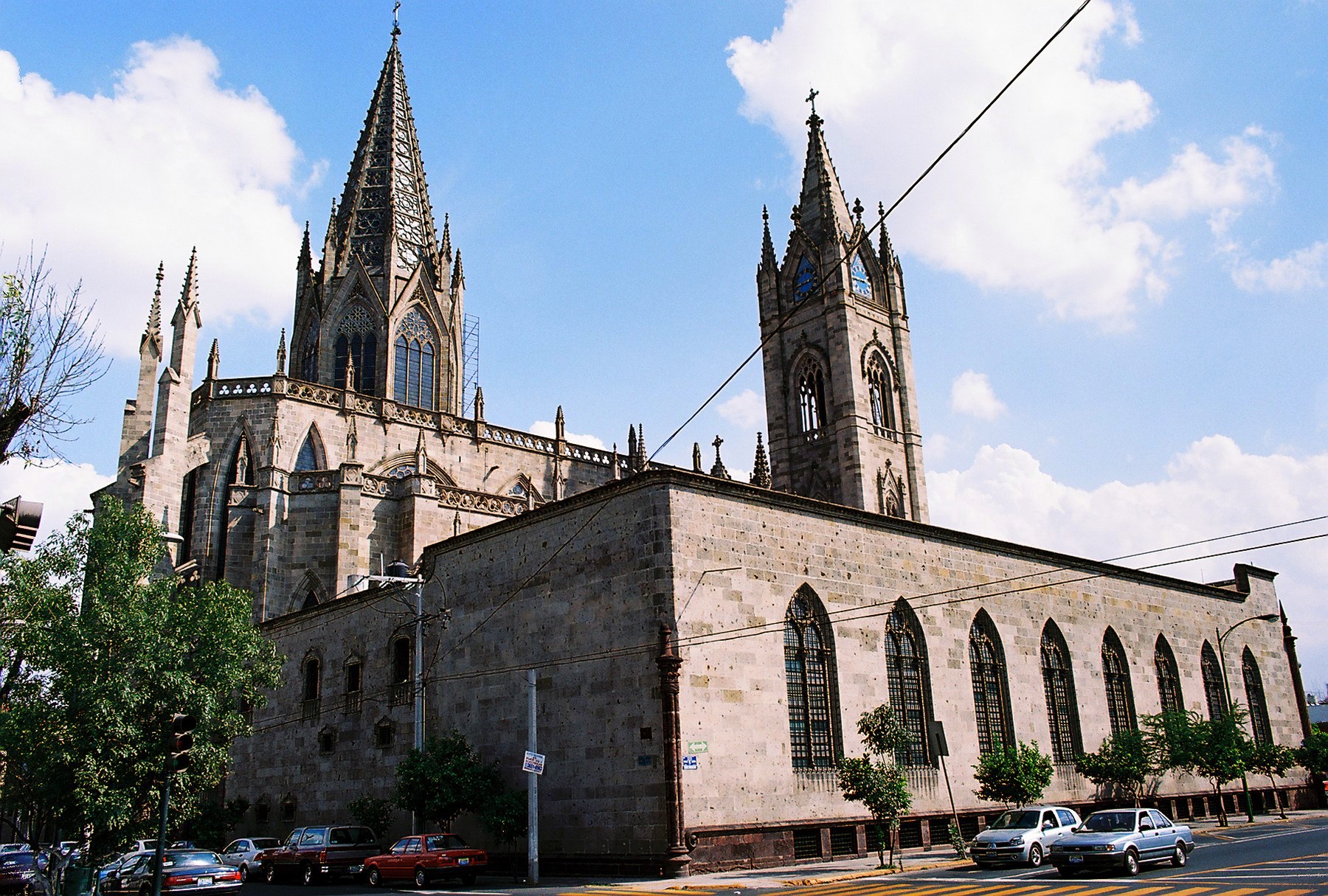
A block away on Lopez Cotilla stands the Templo Expiatorio and not much further on Vallarta the old University of Guadalajara.

On the Avenida Vallarta

Many of the grand old homes have been converted into restaurants.

If you’re not inclined to walk, run, or cycle you can pick out one with curbside dining and people-watch the passing promenade.

On the Avenida Vallarta

On the Avenida Vallarta

Chai restaurant, Guadalajara

Restaurants are plentiful along the route, and most have menus posted.

Chai restaurant, Guadalajara

Chai is a favorite of mine for a great latté, but the place also serves a Sunday buffet brunch that always draws a crowd, so it’s a good idea to grab a table early.

On the Avenida Vallarta

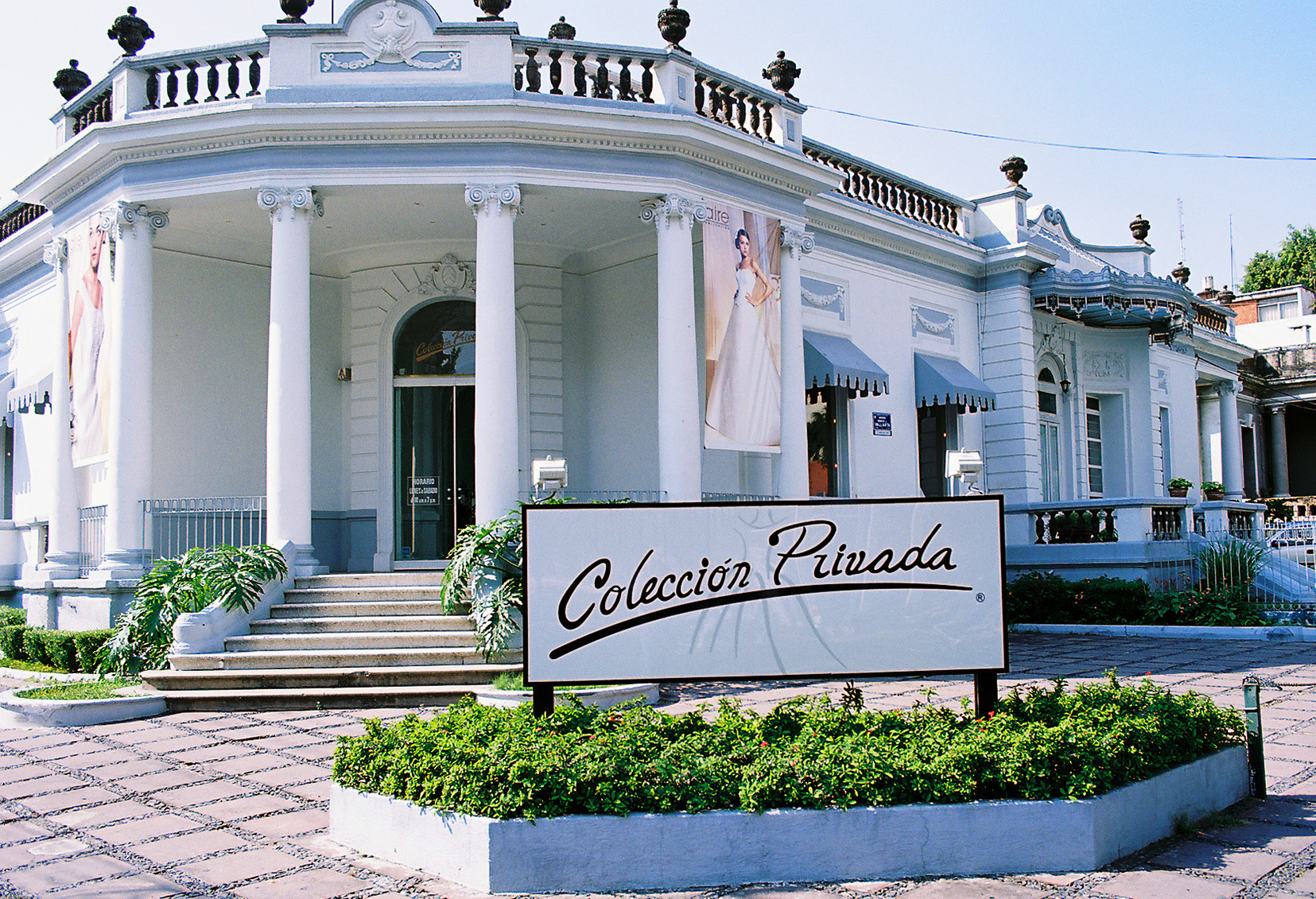
In one stretch of the avenida the old homes are now occupied by shops featuring bridal and quinceañera gowns.

Centro Magno shopping mall, Guadalajara

As the route nears its end it passes the Centro Magno urban mall (there’s a large and inexpensive parking garage there), which is full of specialty shops and restaurants.

Minerva Fountain, Guadalajara

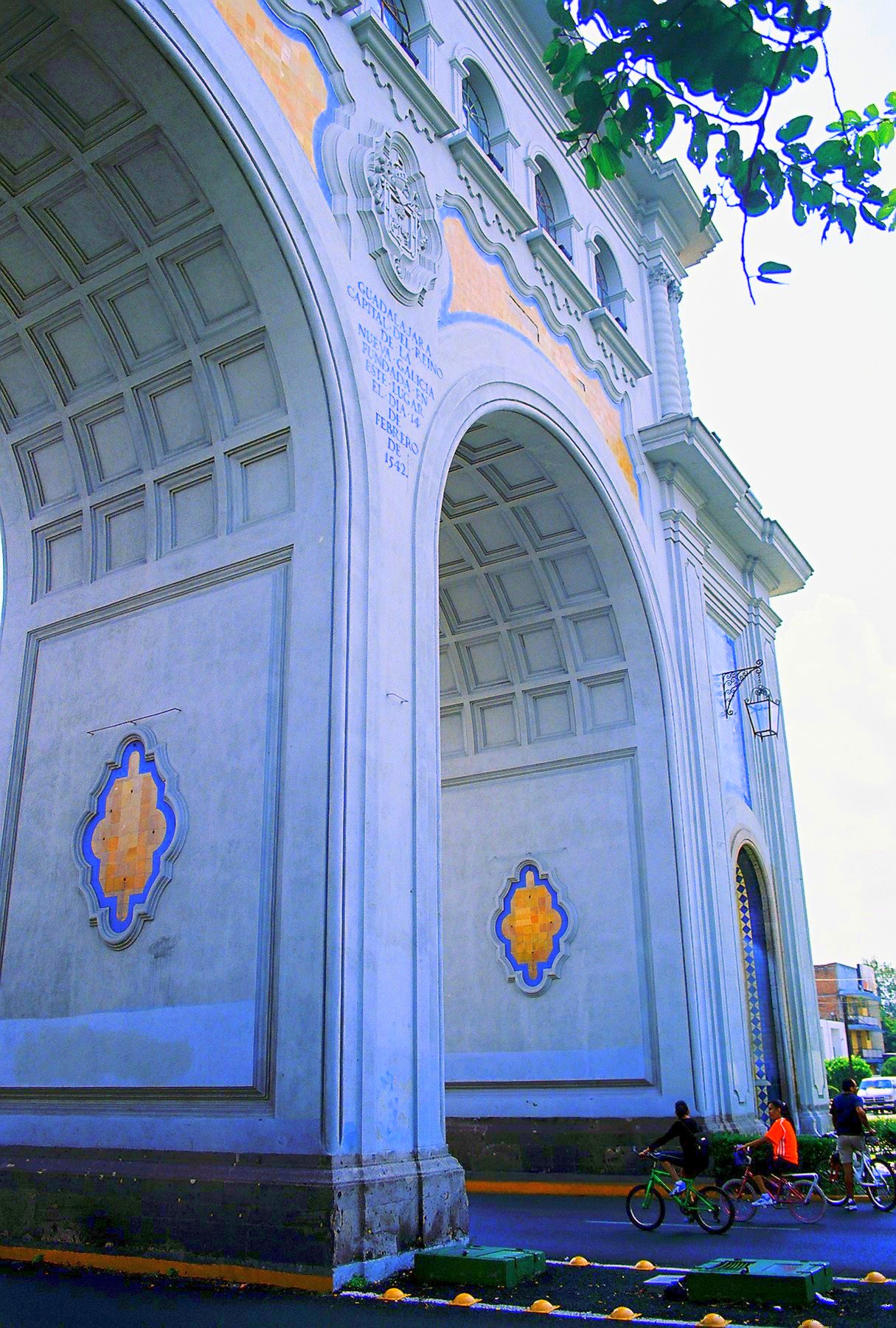
The Sunday promenade ends at Los Arcos, on the back side of the Minerva Fountain.

Los Arcos, Guadalajara

The Los Arcos double arches were built in in 1942 to commemorate the city’s 400th anniversary. The arches clear 14 feet high and stand on the avenida just before the Minerva Fountain glorieta.

Los Arcos, Guadalajara

See my related posts on Guadalajara:Guadalajara south centro

Fishy in Guadalajara

Guadalajara’s heartbeat

Guadalajara’s Merado Libertad

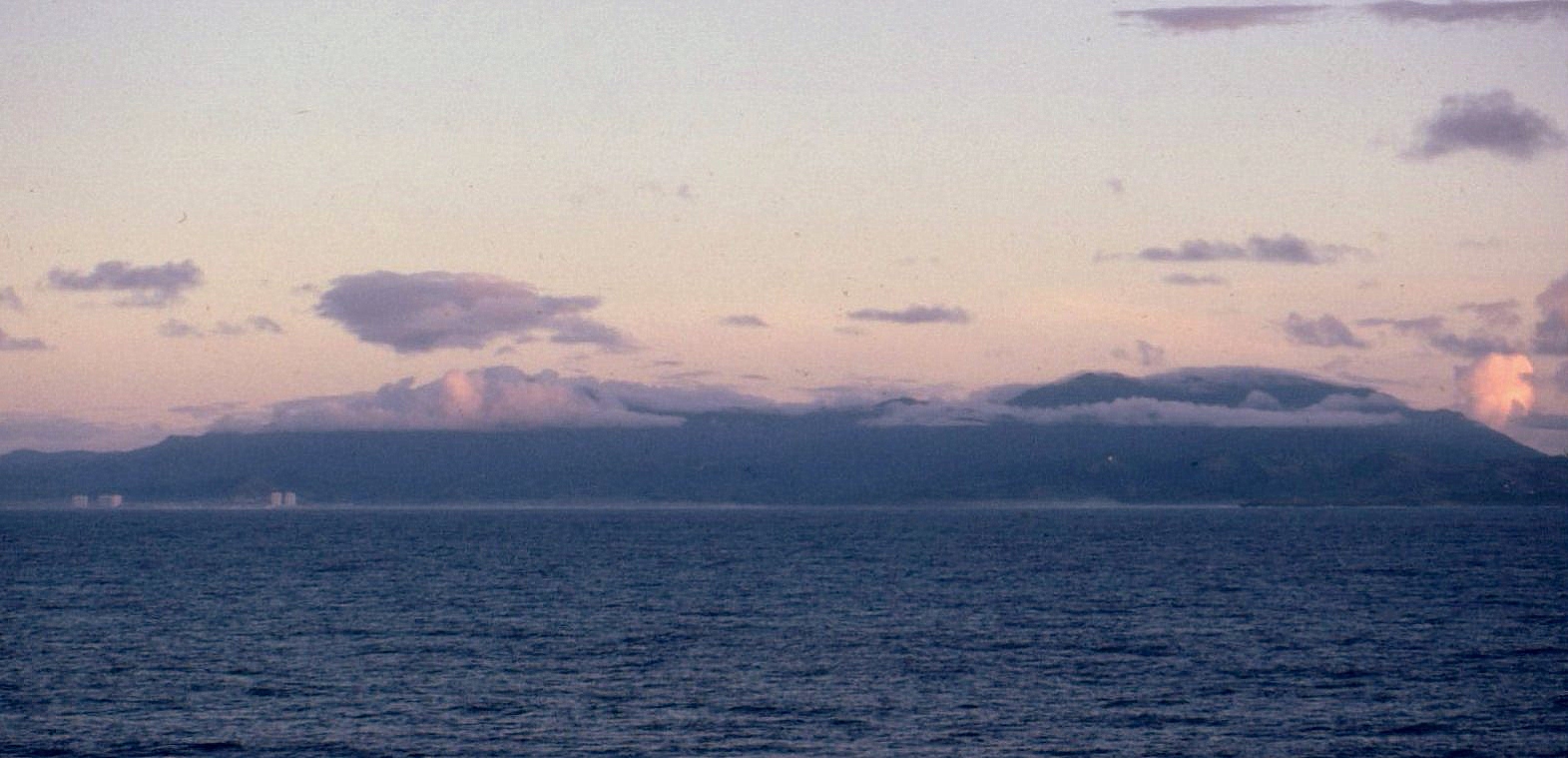
North coast, San Juan, Puerto Rico

Travel to San Juan by sea at least once because no other view can compare.

Here in the same time zone as Nova Scotia and Bermuda the sun rises early and as dawn breaks the island’s highest peaks rise out of a lush emerald carpet and thrust through the layer of clouds.

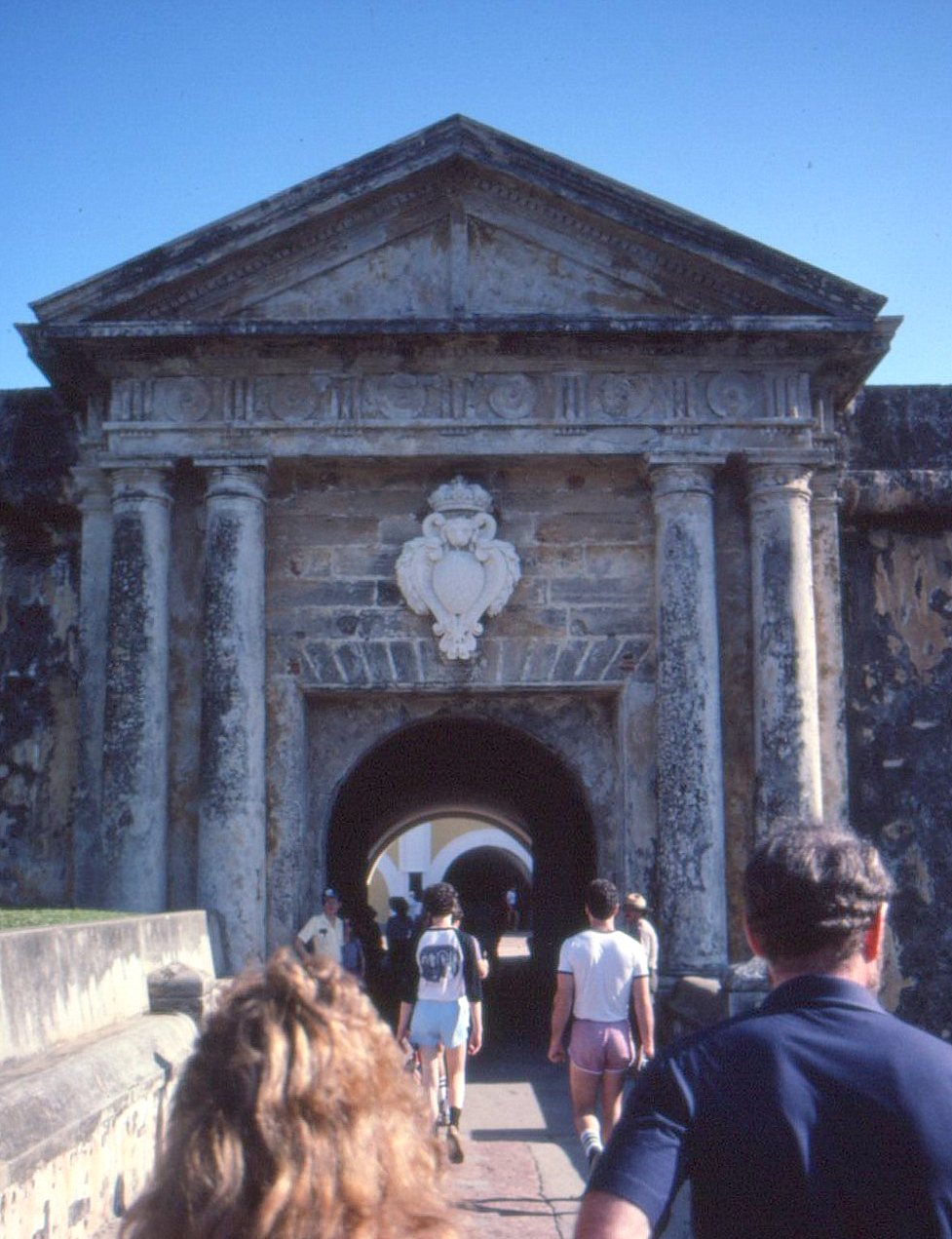
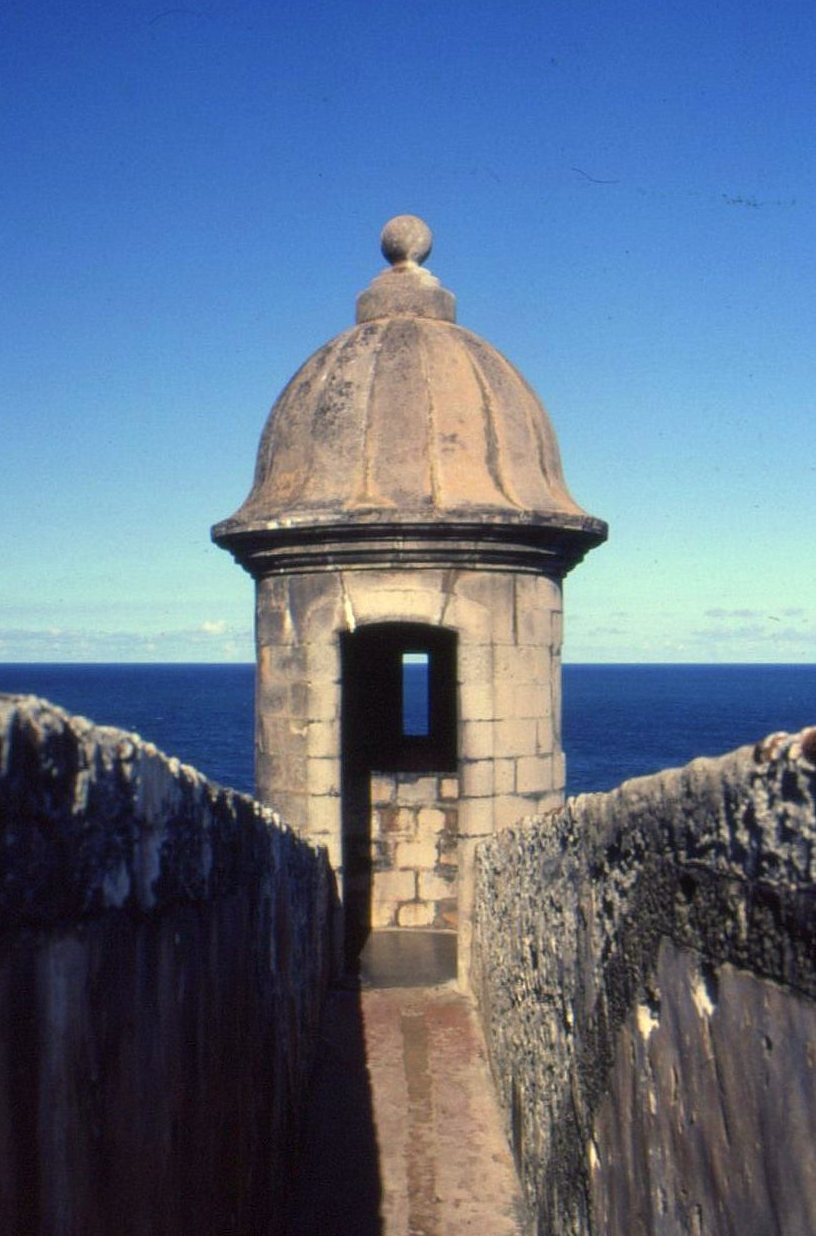
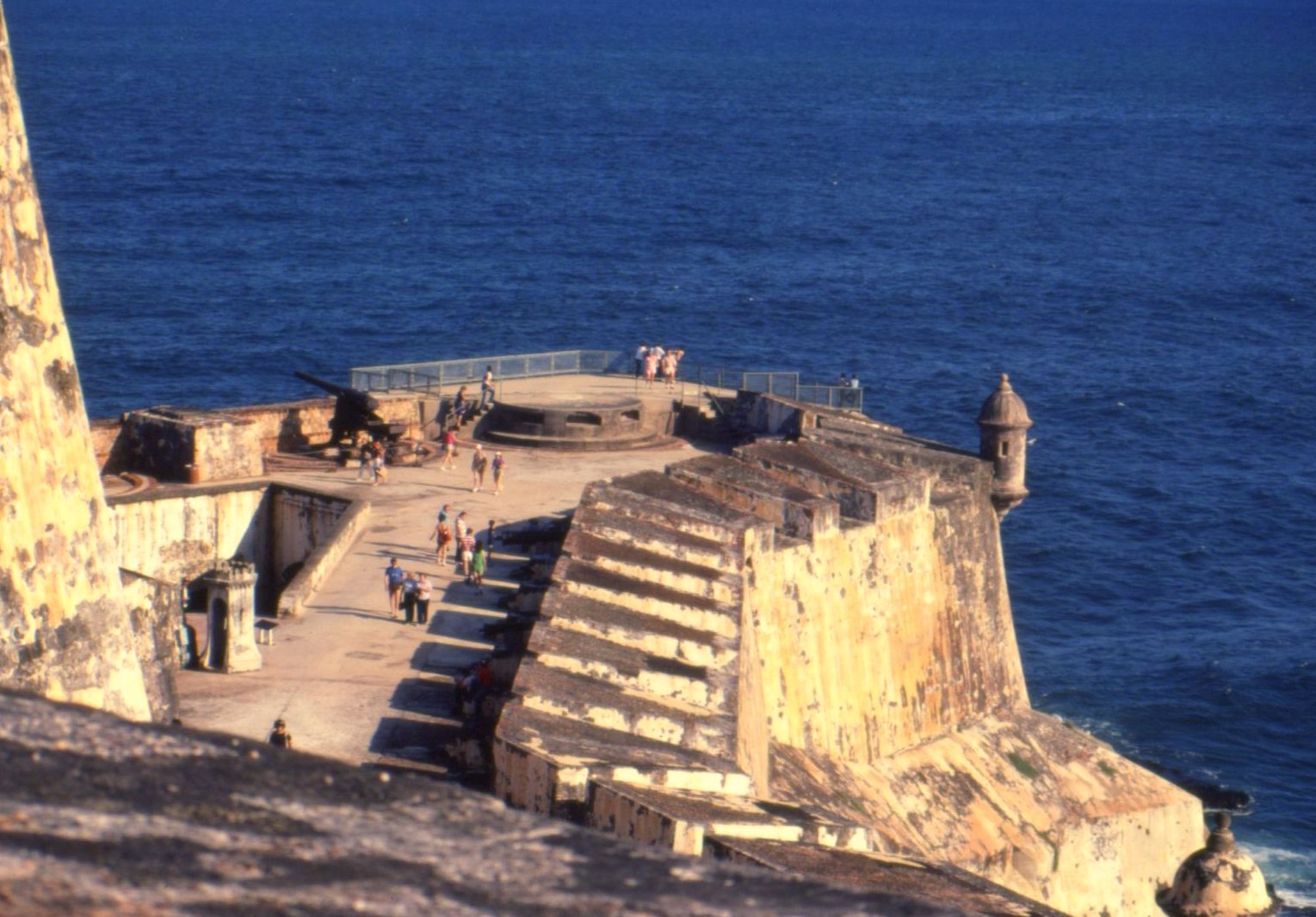
Castillo del Morro, San Juan, Puerto Rico

The whole thing seems to float on the ocean like a mirage, slowly filling the horizon as it draws nearer.

Harbor, San Juan, Puerto Rico

The ship almost completely circles the city before docking in the harbor on the inside of the peninsula.


The course delivers a 360 degree view of the city’s signature trio of castles – Castillo San d Cristóbal, Castillo San Felipe del Morro, and Fortín San Juan de la Cruz (“El Cañuelo”) – which anchor the city’s shoreline.

Castillo del Morro, San Juan, Puerto Rico

The Spaniards began building the castles in 1539, less than 50 years after Columbus claimed the island for them on his second voyage.


They left only after the Spanish-American war evicted them from the hemisphere over 400 years later.

Castillo del Morro, San Juan, Puerto Rico

San Juan was so heavily fortified for good reason. Its great harbor sat astride the entrance to the Caribbean and it was the last stop made by the Spanish King’s treasure ships before the Atlantic crossing. It was justifiably known as the “Gibraltar of the Caribbean”.

Castillo del Morro, San Juan, Puerto Rico


There’s more castle to see here for any but the most ardent military buff.


Castillo del Morro won out as my one-castle only pick and I wasn’t disappointed.

Castillo del Morro, San Juan, Puerto Rico

There’s a 20th century scale to this serpentine conglomeration of gun emplacement and turret and overlooks.

Think “Maginot Line.” The walls look thick enough to resist an atomic blast.

Hotel El Convento, San Juan, Puerto Rico

When not bunking on a cruise ship I stay at the Hotel El Convento. It’s centrally located in Old San Juan, most of which is within walking distance and some of which goes up and down the hill on which the city sits.

El Convento occupies a building inaugurated as a Carmelite convent in 1651 and sits directly across from the Western Hemisphere’s oldest cathedral. Coffee in its cloistered courtyard is a great way to start every day.

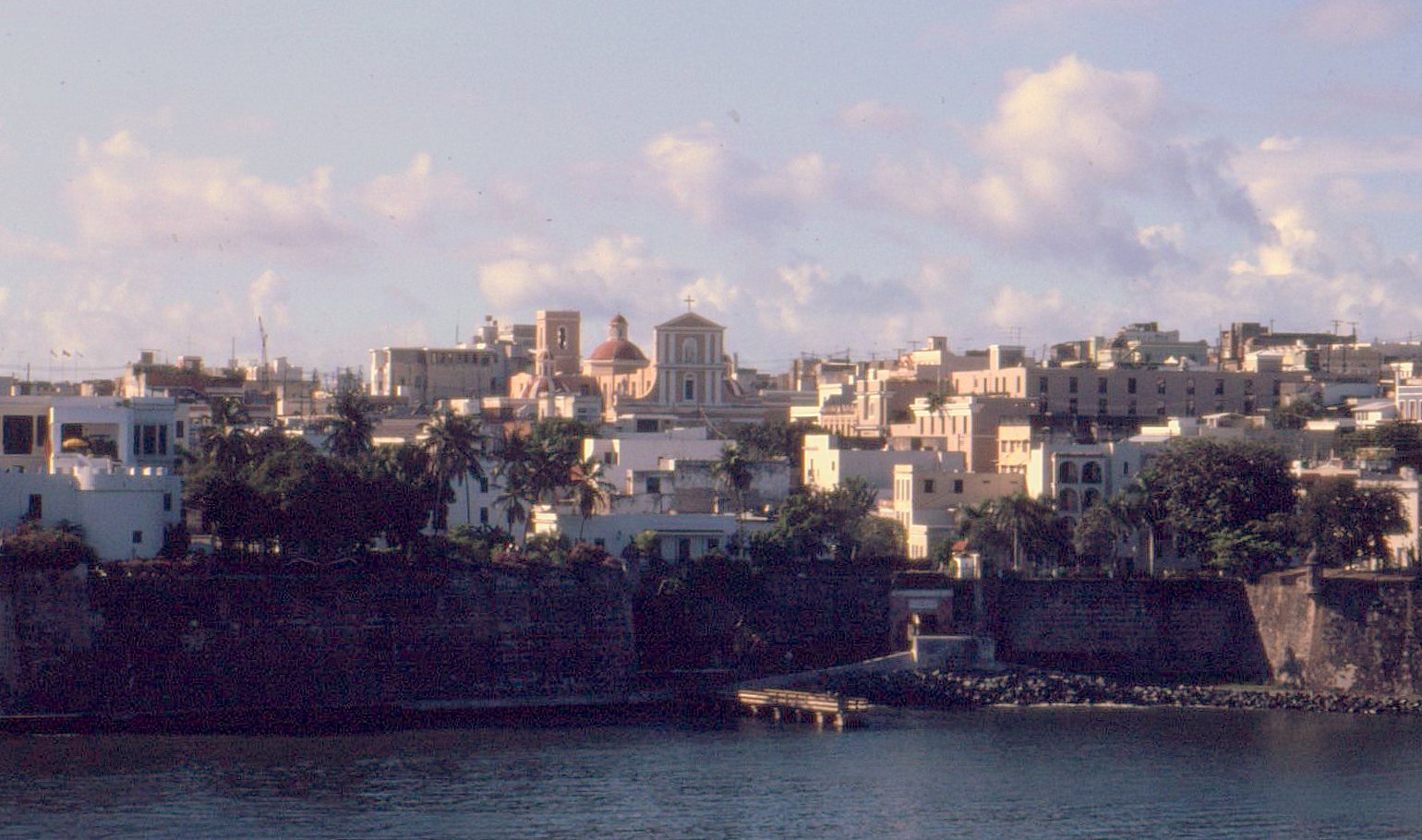
Old San Juan, Puerto Rico

The architecture of the shops and homes of Old San Juan are very reminiscent of Spanish New Orleans.

Castillo del Morro, San Juan, Puerto Rico

It has a different feeling here, with landscape views of sea and coast and fresh ocean breezes only blocks away from just about any spot .

Old San Juan, Puerto Rico

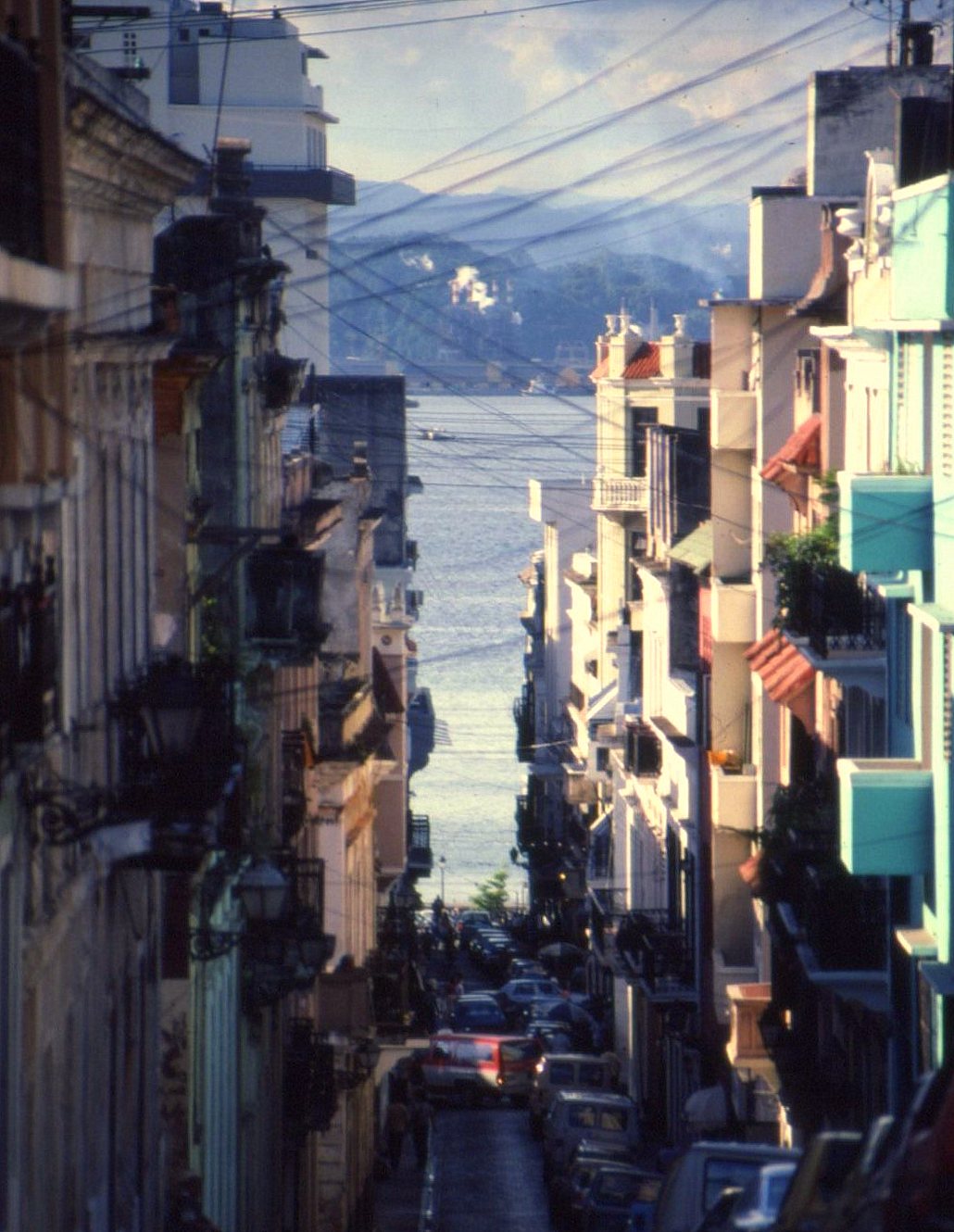
Side streets narrow until there’s no way to travel them except on foot.

Old San Juan, Puerto Rico

Plenty of street scene photos await here.

There’s no lack of good restaurants in the old city, but my favorite for authentic Puerto Rican food is a short cab ride to the Condado district.

The dining room of Restaurante Ajili-Mojili  feels like the verandah of a tropical plantation house.

Nothing on the menu has ever disappointed, but I enjoy and heartily recommend the asopaos – a bisque with rice and chicken, shrimp, seafood, or lobster – almost as much as the mofongos. A Puerto Rican original, the mofongo is fried dough made of mashed green plantains, garlic and pork rinds and stuffed with shrimp, seafood, lobster, veal, chicken or beef.

Condada, San Juan, Puerto Rico

You’ll need to walk this meal off, and there’s no better place thanthe Condado neighborhood, which affords an opportunity to see some great deco architecture in a tropical setting that evokes Miami Beach, but is a lot more intimate.

Condado, San Juan, Puerto Rico

Puerto Rico is home to the distillers of more than a dozen national brands of rum among which the most well-known is Bacardi. I’ve seen enough rum distilleries elsewhere to pass on a tour here, but if you haven’t yet had the pleasure this is a good place to seek one out.

From San Juan the plan is to make a day trip to the El Yunque National Forest, which bills itself as “the only tropical rain forest in the U.S. National Forest system”. Watch for it in my next Americana post!